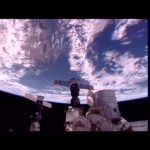
A small piece of Cosmos 2251 satellite debris safely passed by the International Space Station at 2:38a.m. EDT, Saturday March 24 allowing the six Expedition 30 crew members onboard the orbiting complex to exit their Soyuz spacecraft and resume normal activities.
The crew sheltered in the two Soyuz spacecraft as a precaution, the third time in station history that a crew has had to shelter in place due to the possibility of a conjunction with orbital debris and the first since June 2011. NASA’s Expedition 30 Commander Dan Burbank and Russian cosmonauts Anton Shkaplerov and Anatoly Ivanishin were in their Soyuz TMA-22 spacecraft attached to the Poisk module on the space-facing side of the Zvezda service module, while cosmonaut Oleg Kononenko, NASA’s Don Pettit and Andre Kuipers of the European Space Agency were in their Soyuz TMA-03M spacecraft on the Earth-facing side of the Zarya module.
The piece of debris was a remnant of a Feb. 10, 2009 collision between the dormant Cosmos 2251 satellite and an operational Iridium 33 communications satellite. The collision added about 2,000 trackable items to the orbital debris catalog. At the time of closest approach, the debris was moving from left to right in front of the station at an estimated overall miss distance of between 11 and 14 kilometers and a radial miss distance of 120 meters.