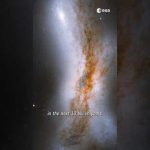
For years, astronomers believed the Milky Way and Andromeda were on a direct collision course in about 4.5 billion years. But new research using data from our Gaia mission and Hubble Space Telescope suggests the story isn’t so simple.
After running 100 000 simulations with the most precise data available, scientists now say there’s only a 50% chance the two galaxies will collide in the next 10 billion years.
The Large Magellanic Cloud, one of our satellite galaxies, could be tugging the Milky Way just enough to steer it away from Andromeda. Instead of crashing, the two galaxies might simply orbit each other in a slow cosmic dance.
So the fate of the Milky Way remains uncertain. And with the Sun expected to make Earth uninhabitable in about a billion years, a galaxy collision is low on our list of concerns.
📹 European Space Agency (ESA) 📸 NASA, ESA, STScI, Till Sawala (University of Helsinki), DSS, J. DePasquale (STScI)
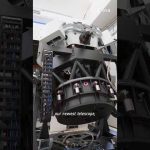
Meet Flyeye — the telescope that sees space like a fly! 🪰
With its very first glimpse of the sky, Flyeye is ready to begin scanning for asteroids that might one day come a little too close to Earth.
Inspired by the compound eye of a fly, it can spot a huge chunk of sky in one go — more than 200 times the area of the full Moon. And it’s designed to do it all automatically, night after night.
It hasn’t found any space rocks yet, but it’s only just opened its eye. This is the first step towards a future network of fly-eyed telescopes keeping watch over our planet.
Each year on 22 April, people across the planet join forces to raise awareness about the unequivocal effects of climate change and the importance of protecting our planet for future generations. We celebrate Earth Day every day at ESA. 💙
📹 European Space Agency (ESA) 📸 ESA/NASA 🎙️ The audio features a clip from David Attenborough
Skip the waitlist and invest in blue-chip art for the very first time by signing up for Masterworks: https://www.masterworks.art/historymarche Purchase shares in great masterpieces from artists like Pablo Picasso, Banksy, Andy Warhol, and more. See important Masterworks disclosures: https://www.masterworks.com/cd
🚩 If you like what you see, consider supporting my work on Patreon and you get ad-free early access to my videos for as little as $1 https://www.patreon.com/historymarche — You can also show your support by subscribing to the channel and liking the video. Thank you for watching.
It can be seen as a dark blob passing through to the lower left.
Phobos sits very close to Mars by Solar System standards, orbiting just 6000 km from Mars’s surface. For context, our own moon lies about 385 000 km away from Earth’s surface.
Oxia Planum contains one of the largest exposures of rocks on Mars that are around 3.9 billion years old and clay-rich, indicating that water once played a role here. The site sits in a wide catchment area of valley systems with the exposed rocks exhibiting different compositions, indicating a variety of deposition and wetting environments.
A European rover, Rosalind Franklin, is part of the ExoMars programme that will explore the surface of Mars. The rover will be the first mission to combine the capability to move across the surface and to study Mars at depth.
Remembering our fallen heroes, an agency town hall to talk safety, and the end of an historic mission on Mars … a few of the stories to tell you about – This Week at NASA!
Rollout of our experimental supersonic X-plane, schedule updates for future Artemis missions, and another year of global record heat … a few of the stories to tell you about – This Week at NASA!
Video Producer: Andre Valentine Video Editor: Andre Valentine Narrator: Emanuel Cooper Music: Universal Production Music Credit: NASA
Our first asteroid sample return mission is back on Earth, a record ride in space for a NASA astronaut, and our Artemis II mission is making prelaunch progress … a few of the stories to tell you about – This Week at NASA!
Link to download this video: https://images.nasa.gov/details/Our%20First%20Asteroid%20Sample%20Return%20Mission%20is%20Back%20on%20Earth%20on%20This%20Week%20@NASA%20%E2%80%93%20September%2029,%202023
Video Producer: Andre Valentine Video Editor: Andre Valentine Narrator: Andre Valentine Music: Universal Production Music Credit: NASA
Our SpaceX Crew-6 mission safely returns to Earth, the tech demo hitching a ride on our Psyche spacecraft, and studying ancient life on Earth to better understand Mars … a few of the stories to tell you about – This Week at NASA!
Link to download this video: https://images.nasa.gov/details/Our%20SpaceX%20Crew-6%20Mission%20Safely%20Returns%20to%20Earth%20on%20This%20Week%20@NASA%20%E2%80%93%20September%208,%202023
Video Producer: Andre Valentine Video Editor: Andre Valentine Narrator: Andre Valentine Music: Universal Production Music Credit: NASA
Our Webb Space Telescope captures a cosmic ring, the team behind our upcoming Psyche mission, and the unique thing about a star that was ripped apart by a black hole … a few of the stories to tell you about – This Week at NASA!
Our next space station crew rotation flight, a launch day simulation for our upcoming Moon mission, and visiting the splashdown recovery crew for Artemis II … a few of the stories to tell you about – This Week at NASA!
Link to download this video: https://images.nasa.gov/details/Our%20Next%20Space%20Station%20Crew%20Rotation%20Flight%20on%20This%20Week%20@NASA%20%E2%80%93%20July%2028,%202023
Video Producer: Andre Valentine Video Editor: Andre Valentine Narrator: Andre Valentine Music: Universal Production Music Credit: NASA
ESA’s latest astrophysics mission, Euclid, lifted off on a Space X Falcon 9 from Cape Canaveral in Florida, USA, at 17:12 CEST on 1 July 2023.
Euclid has now started its month-long journey to Sun-Earth Lagrange point L2, located 1.5 million kilometres from Earth, in the opposite direction from the Sun.
The telescope will survey one third of the sky with unprecedented accuracy and sensitivity. By observing billions of galaxies out to 10 billion light-years, it will create the most extensive 3D-map of the Universe, with the third dimension representing time.
ESA’s Euclid mission is designed to explore the composition and evolution of the dark Universe. Euclid will chart how the Universe has expanded and how large-scale structure is distributed across space and time, revealing more about the role of gravity and the nature of dark energy and dark matter.
Four weeks after launch, Euclid will enter its orbit around L2. Once in orbit, mission controllers will start the activities to verify all functions of the spacecraft, check out the telescope and finally turn the instruments on. Following this, scientists and engineers will be engaged in an intense two-month phase of testing and calibrating Euclid’s scientific instruments, and preparing for routine observations. The telescope begins its early phase of the survey of the Universe three months after launch.
We are Europe’s gateway to space. Our mission is to shape the development of Europe’s space capability and ensure that investment in space continues to deliver benefits to the citizens of Europe and the world. Check out https://www.esa.int/ to get up to speed on everything space related.
A crucial find by our James Webb Space Telescope, learning how life might be on Mars, and some tricky testing for a lunar roving robot … a few of the stories to tell you about – This Week at NASA!
Link to download this video: https://images.nasa.gov/details/NHQ_2023_0630_A%20Crucial%20Find%20by%20Our%20James%20Webb%20Space%20Telescope%20on%20This%20Week%20@NASA%20%E2%80%93%20June%2030,%202023
Video Producer: Andre Valentine Video Editor: Andre Valentine Narrator: Andre Valentine Music: Universal Production Music Credit: NASA
Showcasing our new Earth Information Center, in search of an atmosphere around a rocky exoplanet, and getting ready for an important delivery … a few of the stories to tell you about – This Week at NASA!
Link to download this video: https://images.nasa.gov/details/Showcasing%20Our%20New%20Earth%20Information%20Center%20on%20This%20Week%20@NASA%20%E2%80%93%20June%2023,%202023
Video Producer: Andre Valentine Video Editor: Andre Valentine Narrator: Andre Valentine Music: Universal Production Music Credit: NASA
A milestone for our experimental supersonic airplane, stretching Orion’s wings before the next flight, and technologies to help fight wildfires … a few of the stories to tell you about – This Week at NASA!
Link to download this video: https://images.nasa.gov/details/A%20Milestone%20for%20Our%20Experimental%20Supersonic%20Airplane%20on%20This%20Week%20@NASA%20–%20April%2014,%202023
Video Producer: Andre Valentine Video Editor: Andre Valentine Narrator: Andre Valentine Music: Universal Production Music Credit: NASA
Honoring our fallen heroes, working on a nuclear option for space travel, and the next crewed mission to the space station … a few of the stories to tell you about – This Week at NASA!
2022 was a year of many ‘firsts’ for space in Europe, seeing the first European female International Space Station commander, the launch of the first Vega-C rocket, the launch of the first Artemis mission working to bring humans back to the Moon, and first images from the James Webb Space Telescope among many other success stories and lessons learned.
★ Subscribe: http://bit.ly/ESAsubscribe and click twice on the bell button to receive our notifications.
We are Europe’s gateway to space. Our mission is to shape the development of Europe’s space capability and ensure that investment in space continues to deliver benefits to the citizens of Europe and the world. Check out https://www.esa.int/ to get up to speed on everything space related.
Where did our Moon come from? Over the years, there have been several theories, but most scientists think it’s likely that a Mars-sized object smashed into Earth, creating what we now see in the sky.
We are Europe’s gateway to space. Our mission is to shape the development of Europe’s space capability and ensure that investment in space continues to deliver benefits to the citizens of Europe and the world. Check out https://www.esa.int/ to get up to speed on everything space related.
Our journey back to the Moon and onto Mars starts at home, and NASA’s Veterans are a big part of accomplishing that mission. Veterans currently make up 12% of the NASA workforce. Many of the most iconic figures at the agency—our astronauts—have a strong veteran tie. In fact, all NASA astronauts were military pilots until 1965. Of the 385 total NASA Astronauts, 223 are Veterans! Veterans continue to have a sweeping impact on NASA, in every corner of our workforce. Thanks to all the men and women who have served in our armed forces. Have a safe and happy Veterans Day.
An update on our Artemis I Moon mission, the right moves for a small satellite mission, and a bright idea to search for water ice on the Moon … a few of the stories to tell you about – This Week at NASA!
The results of our DART planetary defense test, astronauts return safely from the space station, and more new imagery from the Webb Space Telescope … a few of the stories to tell you about – This Week at NASA!
Listen up! From long form interviews with astronauts and engineers to narrative shows that take you on a tour of the galaxy, NASA podcasts let you experience the thrill of space exploration without ever leaving Earth. Find your new favorite podcast at https://www.nasa.gov/podcasts.
Producer/Editor: Lacey Young Music: Universal Music Production Credit: NASA
An update on our Artemis I Moon mission, a first for our James Webb Space Telescope, and a new target launch date for the next commercial crew mission … a few of the stories to tell you about – This Week at NASA!
Our Artemis I flight test is “go for launch,” the first deep-space long-duration biology test, and the Webb Space Telescope captures new images of Jupiter … a few of the stories to tell you about – This Week at NASA!
The countdown to our Artemis I Moon mission, a Moon-observing small satellite hitching a ride on Artemis I, and some other tiny satellites that could help us better prepare for space weather … a few of the stories to tell you about – This Week at NASA!
Our Artemis I mega Moon rocket is rolled to the launch pad, the astronauts of our Crew-2 mission come to Washington, and investigating the impact of dust on our climate … a few of the stories to tell you about – This Week at NASA!
We reached 10 million subscribers on YouTube! NASA would like to thank all of YOU. Thank you for supporting us, subscribing and embracing your love of science.
So whether you’re interested in launches, flight innovations, climate science, investigating the wonders of the universe or sending humans to the Moon and Mars, we will continue to create the content you crave.
Join us as we explore the secrets of the universe for the benefit of ALL. https://nasa.gov
Video Producer: Sonnet Apple Music: Universal Production Music Credit: NASA
Once the preparatory work has been completed, and the satellite developed and manufactured, the next step is launch and operations with a view to ensuring that it fulfils its original mission objectives. The post-launch phase can span many years, often as long or longer than the developmental phase. Some ESA scientific satellites even continue to operate beyond their original planned lifespan.
Join ESA experts working in launchers, operations, mission management and scientific data processing to find out what happens in the final phases of the mission when all the planning and development comes to fruition.
We are Europe’s gateway to space. Our mission is to shape the development of Europe’s space capability and ensure that investment in space continues to deliver benefits to the citizens of Europe and the world. Check out https://www.esa.int/ to get up to speed on everything space related.
R&D plays a key role as part of ESA’s mission to share the development of Europe’s space capability and to keep European industry at the leading edge of technology development. Not only are new and innovative technologies constantly being developed and tested to pave the way for future satellite projects, but ESA is also facilitating their application to scientific and commercial products and services. And well before an individual satellite project can be started, ESA and its experts are hard at work preparing the way through feasibility studies and assessments.
Join ESA experts working in the Concurrent Design Facility, Phi-Lab and the ARTES Programme to hear about their contributions to the overall ESA mission.
We are Europe’s gateway to space. Our mission is to shape the development of Europe’s space capability and ensure that investment in space continues to deliver benefits to the citizens of Europe and the world. Check out https://www.esa.int/ to get up to speed on everything space related.
Have you ever wondered what it was like to work in a satellite development project at the European Space Agency? Learn from the experts working in the Ariel satellite project team.
Fiona Walsh from ESA Human Resources moderates a panel with Jean-Christophe Salvignol, ESA’s Ariel Project Manager and a couple of his managers. They explain the incredible team effort required to bring this complex project from early inception, manufacturing of the satellite, accommodating its payloads and ensuring a successful launch to pave the way for exciting scientific discoveries. Ariel is one ESA’s science missions that will be launched in 2029 and will discover the composition of exoplanets by examining their atmospheres.
They explain how the project team is structured and a bit about the international collaboration involved. They also touch on the importance of building the right team and creating a great team spirit.
We are Europe’s gateway to space. Our mission is to shape the development of Europe’s space capability and ensure that investment in space continues to deliver benefits to the citizens of Europe and the world. Check out https://www.esa.int/ to get up to speed on everything space related.
Testing our mega Moon rocket and ground systems, preparing the James Webb Space telescope for science, and testing an instrument for future X-59 research … a few of the stories to tell you about – This Week at NASA!
How long would it take us to reach our closest neighbour? How do astronomers know so much about the universe? Why is astronomy important for society? In this Meet the Experts episode, ESA research fellow Tereza Jerabkova discusses our place in the universe and takes us on a journey through space.
We are Europe’s gateway to space. Our mission is to shape the development of Europe’s space capability and ensure that investment in space continues to deliver benefits to the citizens of Europe and the world. Check out https://www.esa.int/ to get up to speed on everything space related.
Showcasing our efforts to monitor Earth’s climate, a spacecraft for an asteroid mission is close to its final configuration, and assembly of our Europa Clipper spacecraft is underway … a few of the stories to tell you about – This Week at NASA!
Producer: Andre Valentine Editor: David Anderson Music: Universal Production Music
An update on our Artemis I mission, test firing an Artemis rocket engine, and a resupply mission delivers to the space station … a few of the stories to tell you about – This Week at NASA!
Producer: Andre Valentine Editor: David Anderson Music: Universal Production Music
0:00 Introduction 0:14 Update on Preparations for Artemis I Moon Mission 0:59 Artemis Rocket Engine Test Series Continues 1:21 Commercial Mission Delivers Cargo to Space Station 1:58 The Next GOES Series Earth-Observing Satellite 2:37 60th Anniversary of Glenn’s Historic Flight on Friendship 7
The launch of our first planetary defense test mission, a new docking module for the space station, and shielding the Orion spacecraft from the heat … a few of the stories to tell you about – This Week at NASA!
Our Crew-3 mission launches to the space station, Crew-2 makes a splash at the end of its record-setting mission, and a big honor for our deputy administrator … a few of the stories to tell you about – This Week at NASA!
Producer/Writer: Andre Valentine Editor: Shane Apple Music: Universal Production Music
Computing power doubles every two years, an observation known as Moore’s Law. Prof Maarten Steinbuch, a high-tech systems scientist, entrepreneur and communicator, from Eindhoven University of Technology, discussed how this exponential rate of change enables accelerating developments in sensor technology, AI computing and automotive machines, to make products in modern factories that will soon be smart and self-learning. Cars will become like an iPad on wheels. The questions are, when will they be better than humans? Will humans still be necessary? And what does the future of schools and universities look like?
★ Subscribe: http://bit.ly/ESAsubscribe and click twice on the bell button to receive our notifications.
We are Europe’s gateway to space. Our mission is to shape the development of Europe’s space capability and ensure that investment in space continues to deliver benefits to the citizens of Europe and the world. Check out https://www.esa.int/ to get up to speed on everything space related.