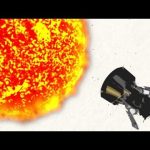
Say hello to the fastest-moving human-made object, NASA’s Parker Solar Probe. On a mission to “touch the Sun,” this spacecraft is set to make history on Dec. 24 by making its closest dive through the Sun’s corona, or upper atmosphere.
Join NASA experts on Tuesday, December 17 at 3:00 p.m. EST as they take your questions about the mission, the currently high-activity phase of the Sun and more. Share your questions in the chat!
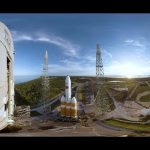
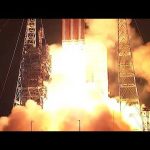
Watch in 360 degrees as an United Launch Alliance Delta IV Heavy rocket lifts off from Space Launch Complex-37 at Cape Canaveral Air Force Station in Florida carrying NASA’s Parker Solar Probe spacecraft. Roughly the size of a small car, the spacecraft lifted off at 3:31 a.m. EDT on Aug. 12, 2018, starting its historic mission to “touch” the Sun.
NASA’s historic Parker Solar Probe mission that launched Aug. 12, 2018 from Space Launch Complex 37 on Cape Canaveral Air Force Station in Florida will revolutionize our understanding of the Sun. The Parker Solar Probe spacecraft will travel through the Sun’s atmosphere, closer to the surface than any spacecraft before it, facing brutal heat and radiation conditions — and ultimately providing humanity with the closest-ever observations of a star. This is a look at the moments leading up to T-Zero for NASA’s mission to “touch” the Sun.
NASA’s Parker Solar Probe mission launched Aug. 11 from Cape Canaveral Air Force Station in Florida. The mission will be the first to fly directly through the Sun’s corona – the hazardous region of intense heat and solar radiation in the Sun’s atmosphere that is visible during an eclipse. It will gather data that could help answer questions about solar physics that have puzzled scientists for decades. Gathering information about fundamental processes near the Sun can help improve our understanding of how our solar system’s star changes the space environment, where space weather can affect astronauts, interfere with satellite orbits, or damage spacecraft electronics.
The Parker Solar Probe will be the first-ever mission to “touch” the Sun, traveling directly into the Sun’s atmosphere about 4 million miles from the surface. Read the story: https://go.nasa.gov/2KEExYZ NASA launch schedule: https://go.nasa.gov/2JfklMB
The Sun contains 99.8 of the mass in our solar system. Its gravitational pull is what keeps everything here, from tiny Mercury to the gas giants to the Oort Cloud, 186 billion miles away.
But even though the Sun has such a powerful pull, it’s surprisingly hard to actually go to the Sun: It takes 55 times more energy to go to the Sun than it does to go to Mars. Why is it so difficult? The answer lies in the same fact that keeps Earth from plunging into the Sun: Our planet is traveling very fast – about 67,000 miles per hour – almost entirely sideways relative to the Sun. The only way to get to the Sun is to cancel that sideways motion.
Since Parker Solar Probe will skim through the Sun’s atmosphere, it only needs to drop 53,000 miles per hour of sideways motion to reach its destination, but that’s no easy feat. In addition to using a powerful rocket, the Delta IV Heavy, Parker Solar Probe will perform seven Venus gravity assists over its seven-year mission to shed sideways speed into Venus’ well of orbital energy. These gravity assists will draw Parker Solar Probe’s orbit closer to the Sun for a record approach of just 3.83 million miles from the Sun’s visible surface on the final orbits.
Though it’s shedding sideways speed to get closer to the Sun, Parker Solar Probe will pick up overall speed, bolstered by Sun’s extreme gravity – so it will also break the record for the fastest-ever human-made objects, clocking in at 430,000 miles per hour on its final orbits.
Music: Percs and Pizz from Killer Tracks.
Credit: NASA’s Godddard Space flight Center
NASA’s Parker Solar Probe is heading to the Sun.Thermal Protection System Engineer Betsy Congdon (Johns Hopkins APL) outlines why Parker can take the heat. More: https://go.nasa.gov/2O7YKsK | NASA launch schedule: https://go.nasa.gov/2JfklMB
Music credit: Cheeky Chappy [Main Track] by Jimmy Kaleth, Ross Andrew McLean Credit: NASA’s Goddard Space Flight Center Genna Duberstein (USRA): Lead Producer/Lead Editor Rob Andreoli (AIMM): Lead Videographer Betsy Congdon (Johns Hopkins University/APL): Lead Engineer Ryan Fitzgibbons (USRA): Narrator Genna Duberstein (USRA): Writer Steve Gribben (Johns Hopkins University/APL ): Animator Brian Monroe (USRA): Animator Josh Masters (USRA): Animator Michael Lentz (USRA): Animator Genna Duberstein (USRA): Animator Mary P. Hrybyk-Keith (TRAX International Corporation): Illustrator This video is public domain and along with other supporting visualizations can be downloaded from the Scientific Visualization Studio at: https://svs.gsfc.nasa.gov/12867