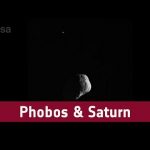
It can be seen as a dark blob passing through to the lower left.
Phobos sits very close to Mars by Solar System standards, orbiting just 6000 km from Mars’s surface. For context, our own moon lies about 385 000 km away from Earth’s surface.
These observations of Phobos and Saturn were taken by the Super Resolution Channel of the High Resolution Stereo Camera on Mars Express. The video comprises 30 separate images acquired during Mars Express orbit 16 346 on 26 November 2016. The slight up and down movement of Saturn and Phobos in these images is caused by the oscillation of the spacecraft’s orientation after completing the turn towards the moon. Phobos can be seen in the foreground, partially illuminated, with Saturn visible as a small ringed dot in the distance. For more information go tohttp://www.esa.int/Our_Activities/Space_Science/Mars_Express/Mars_Express_views_moons_set_against_Saturn_s_rings
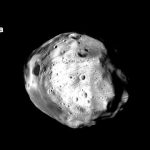
The innermost moon of Mars, Phobos, is seen here in full 360 degree glory. The images were taken by the High Resolution Stereo Camera (HRSC) on ESA’s Mars Express at various times throughout the mission’s 10 years.
The moon’s parallel sets of grooves are perhaps the most striking feature, along with the giant 9 km-wide Stickney impact crater that dominates one face of the 27 x 22 x 18 km moon.
The origin of the moon’s grooves is a subject of much debate. One idea assumes that the crater chains are associated with impact events on the moon itself.
Another idea suggests they result from Phobos moving through streams of debris thrown up from impacts 6000 km away on the surface of Mars, with each ‘family’ of grooves corresponding to a different impact event.
Mars Express has imaged Phobos from a wide range of distances, but will make its closest flyby yet on 29 December 2013, at just 45 km above the moon.
Although this is too close to take images, gravity experiments will give insight into the interior structure of Phobos.
The journey of Mars Express, from drawing board through launch, to its key science highlights during ten years of operations. With its suite of seven instruments, Mars Express has studied the subsurface of the Red Planet to the upper atmosphere and beyond to the two tiny moons Phobos and Deimos, providing an in depth analysis of the planet’s history and returning stunning 3D images.