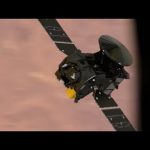
For years, scientists believed Mars got its red color from hematite, a type of rust that forms in dry conditions. But a new study suggests something surprising—ferrihydrite, a different kind of rust that forms in cool liquid water!
This discovery could mean Mars was once much wetter than we thought—maybe even habitable. And the best part? Our Rosalind Franklin rover will soon analyse Martian soil up close to uncover even more secrets.
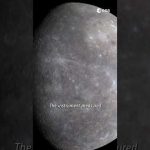
BepiColombo flew past Mercury for the fifth time on 1 December 2024.
During this flyby, BepiColombo gathered more data on the mysterious planet and its surroundings. Aside from taking some ‘regular’ photos of the planet and measuring particles and electromagnetic fields in the space around it, this flyby was the first time that any spacecraft imaged Mercury in mid-infrared wavelengths of light.
BepiColombo will pass much closer to Mercury’s north pole during its final flyby of Mercury on 8 January 2025, its last visit before arriving to enter orbit about the planet in November 2026.
📹 ESA – European Space Agency 📸 MERTIS/DLR/University of Münster & NASA/Johns Hopkins University Applied Physics Laboratory/Carnegie Institution of Washington
1️⃣ Space near Mercury is HOT. Sending a spacecraft there is a bit like asking a laptop to work inside a hot pizza oven! Some spacecraft have gotten close to Mercury but none have remained in this scorching heat continuously. This means we still don’t have high-resolution data covering Mercury’s entire surface.
2️⃣ It’s difficult to observe from Earth: Because Mercury is very close to the Sun, when we try to look at it from Earth, it’s often lost in the Sun’s glare.
3️⃣ It’s hard to reach: Mercury is not that far, but according to some estimates, it would take less energy to get to Pluto than to get to Mercury. The Sun’s strong gravitational pull means that spacecraft need to use a lot of energy to slow down enough to orbit Mercury.
But our BepiColombo mission, will help us learn a lot more about Mercury when it enters into orbit in 2026! It’s the most advanced spacecraft ever sent to Mercury. It will help us answer many questions, such as: Why is there ice in the polar craters of the scorched planet? And what are the mysterious ‘hollows’ on its surface?
Explore the mysteries behind the Earth-Moon system’s origin with these four intriguing theories. 🌍🌕 Which one do you think holds the key to our celestial companion’s creation?
During a break from looking at planets around other stars, ESA’s CHaracterising ExOPlanet Satellite (Cheops) mission has observed a dwarf planet in our own Solar System and made a decisive contribution to the discovery of a dense ring of material around it.
Studying these dwarf planets is difficult because of their small sizes and extreme distances. Quaoar itself orbits the Sun at almost 44 times the Sun-Earth distance. So, occultations are particularly valuable tools. Until recently, however, it has been difficult to predict exactly when and where they will take place.
For an occultation to occur, the alignment between the occulting object (here the TNO), the star, and the observing telescope must be extremely precise. In the past, it has been almost impossible to meet the stringent accuracy requirements to be certain of seeing an event. Nevertheless, to pursue this goal the European Research Council Lucky Star project, coordinated by Bruno Sicardy, Sorbonne University & Paris Observatory – PSL (LESIA), was created to predict upcoming occultations by TNOs, and to co-ordinate the observation of these events from professional and amateur observatories around the globe.
We are Europe’s gateway to space. Our mission is to shape the development of Europe’s space capability and ensure that investment in space continues to deliver benefits to the citizens of Europe and the world. Check out https://www.esa.int/ to get up to speed on everything space related.
Most striking about Webb’s new image is the crisp view of the planet’s dynamic rings — some of which haven’t been seen at all, let alone with this clarity, since the Voyager 2 flyby in 1989. In addition to several bright narrow rings, the Webb images clearly show Neptune’s fainter dust bands. Webb’s extremely stable and precise image quality also permits these very faint rings to be detected so close to Neptune.
We are Europe’s gateway to space. Our mission is to shape the development of Europe’s space capability and ensure that investment in space continues to deliver benefits to the citizens of Europe and the world. Check out https://www.esa.int/ to get up to speed on everything space related.
We are Europe’s gateway to space. Our mission is to shape the development of Europe’s space capability and ensure that investment in space continues to deliver benefits to the citizens of Europe and the world. Check out https://www.esa.int/ to get up to speed on everything space related.
The mission to return martian samples back to Earth will see a European 2.5 metre-long robotic arm pick up tubes filled with precious soil from Mars and transfer them to a rocket for an historic interplanetary delivery.
The sophisticated robot, known as the Sample Transfer Arm or STA, will play a crucial role in the success of the Mars Sample Return campaign. The joint endeavour between @NASA and ESA aims to bring back martian samples to the best labs in our planet by 2033.
The robotic arm will land on Mars to retrieve the sample tubes NASA’s Perseverance rover is currently collecting from the surface. Able to “see”, “feel” and take autonomous decisions, the Sample Transfer Arm will identify, pick up and transfer the tubes into the first rocket fired off another planet – the Mars Launch System.
Only after the robot closes the container’s lid, the martian samples will be launched for rendezvous with ESA’s Earth Return Orbiter (ERO) and bring the material back to Earth.
The Sample Transfer Arm is conceived to be autonomous, highly reliable and robust.
Its architecture mimics a human arm with a shoulder, elbow and wrist, and has its own built-in brain and eyes. The robot can perform a large range of movements with seven degrees of freedom.
We are Europe’s gateway to space. Our mission is to shape the development of Europe’s space capability and ensure that investment in space continues to deliver benefits to the citizens of Europe and the world. Check out http://www.esa.int/ESA to get up to speed on everything space related.
What is ESA’s Characterising Exoplanet Satellite, Cheops, and how will it improve our knowledge of exoplanets? Find out more in this interview with Kate Isaak, ESA Cheops project scientist.
We are Europe’s gateway to space. Our mission is to shape the development of Europe’s space capability and ensure that investment in space continues to deliver benefits to the citizens of Europe and the world. Check out http://www.esa.int/ESA to get up to speed on everything space related.
Three years after the Rosetta mission officially ended in 2016, scientists met at ESA’s ESTEC facility in The Netherlands to discuss the latest findings at the final Science Working Team (SWT) meeting.
From the launch in 2004, to its arrival at comet 67P in 2014, Rosetta has been an emotional and inspiring mission. Its findings have furthered our understanding of comets and changed our perceptions of how the Solar System formed.
The mission produced an enormous amount of data which will keep many scientists busy for years. The OSIRIS camera, for example, took 100 000 images. These are archived – with the analysis of images recently providing further insight into the comet’s activity.
Rosetta’s legacy of cometary science and data is not just continuing to produce more work, however, it’s also inspiring the next generation of scientists. Some began working on Rosetta as students and are now taking their experience forward onto ESA’s future Comet Interceptor mission.
We are Europe’s gateway to space. Our mission is to shape the development of Europe’s space capability and ensure that investment in space continues to deliver benefits to the citizens of Europe and the world. Check out http://www.esa.int/ESA to get up to speed on everything space related.
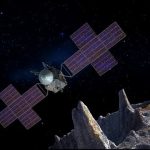
One of the first steps in understanding the geology of Psyche is for the Psyche science team to find out more about collisions and crater formation on metallic asteroids. Join Psyche Mission Science Team Co-Investigator Simone Marchi of the Southwest Research Institute as he explains how impact experiments are conducted at NASA’s Ames Vertical Gun Range and what we can learn about the cratering process to further understand and interpret the geology of Psyche.
Join us November 15 for the debut of the new NASA podcast, “Gravity Assist,” hosted by Dr. Jim Green, NASA’s director of planetary science. Gravity Assist is a virtual tour of the solar system and beyond with the top scientists in the world as your guides. The weekly podcast kicks off with a special 10-part series on the solar system that begins with the Sun, and takes you outward to Pluto and beyond.
This video is available for download from NASA’s Image and Video Library: https://images.nasa.gov/#/details-NHQ_2017_1027_NASA%E2%80%99s%20New%20%E2%80%9CGravity%20Assist%E2%80%9D%20Podcast%20Debuts%20Nov.15.html
On 14 March at 09:31 GMT ExoMars 2016 will be launched from Baikonur onboard a Proton rocket.
The joint European and Russian ExoMars mission will test key exploration technologies and search for evidence of methane and other rare gases in the Martian atmosphere. These gases could result from geological processes or they could be signatures of current biological activity on the planet.
This film examines the two European science instruments on the ExoMars Trace Gas Orbiter (TGO) – CaSSIS and NOMAD. The high-resolution CaSSIS (Colour and Stereo Surface Imaging System) acts as the orbiter’s scientific eye. It is a telescope with a sophisticated detector that can provide colour and stereo images over a nine and a half kilometre wide strip. CaSSIS will examine recurring slope linea – dark lines on the surface of Mars at different times of the day over the planet’s seasons. These linea are believed to be associated with liquid brine. They increase in size during the Martian spring and summer and fade away during autumn and winter.
NOMAD (Nadir and Occultation for MArs Discovery) will be the first high resolution instrument of its kind around the planet. It will observe information about Mars’ atmosphere by looking at the Sun during sunsets and sunrises. It contains three spectrometers – two working in the infrared and one in ultraviolet – and can identify trace gases in the atmosphere, such as methane. The presence of methane in Mars’ atmosphere could result from simple life forms like microbes.