Watch live as NASA astronaut Tracy Dyson and Roscosmos cosmonauts Nikolai Chub and Oleg Kononenko return home from the International Space Station. Their Soyuz MS-25 spacecraft will head for a parachute-assisted landing on the steppe of Kazakhstan at 8 a.m. EDT Monday, Sept. 23 (1200 UTC).
Dyson will conclude her third spaceflight with the landing of the Soyuz. Dyson’s mission spanned 184 days, 2,944 orbits of the Earth, and a journey of 78 million miles. While on orbit, she conducted an array of experiments and technology demonstrations that contribute to advancements for humanity on Earth and NASA’s trajectory to the Moon and Mars.
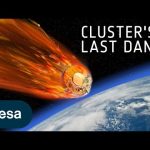
The first of four satellites that make up ESA’s Cluster mission is coming safely back down to Earth, marking a brilliant end to this remarkable mission.
The satellite’s orbit was tweaked back in January to target a region as far as possible from populated regions. This ensures that any spacecraft parts that survive the reentry will fall over open ocean.
During 24 years in space, Cluster has sent back precious data on how the Sun interacts with Earth’s magnetic field, helping us better understand and forecast potentially dangerous space weather.
With this first ever targeted reentry, Cluster goes down in history for a different reason, taking ESA well beyond international space safety standards and helping ensure the long-term sustainability of space activities.
Credits: ESA – European Space Agency
Chapters: 00:00 Introduction to the Cluster Mission 02:17 How do we deorbit a satellite? 05:05 Why does Cluster’s reentry matter so much? 06:15 Conclusion
★ Subscribe: http://bit.ly/ESAsubscribe and click twice on the bell button to receive our notifications.
We are Europe’s gateway to space. Our mission is to shape the development of Europe’s space capability and ensure that investment in space continues to deliver benefits to the citizens of Europe and the world. Check out https://www.esa.int/ to get up to speed on everything space related.
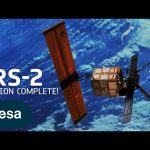
Mission complete. ESA’s second European Remote Sensing (ERS-2) satellite has reentered Earth’s atmosphere over the North Pacific Ocean. The satellite returned at 18:17 CET (17:17 UTC) between Alaska and Hawaii.
ERS-2 was launched almost 30 years ago, on 21 April 1995. Together with ERS-1, it provided invaluable long-term data on Earth’s land surfaces, ocean temperatures, ozone layer and polar ice extent that revolutionised our understanding of the Earth system.
ERS-2’s reentry was ‘natural’. ESA used the last of its fuel, emptied its batteries and lowered the satellite from its altitude of 785 km to 573 km. This reduced the risk of collision with other satellites and space debris. As a result, it was not possible to control ERS-2 at any point during its reentry and the only force driving its descent was unpredictable atmospheric drag. As well as leaving a remarkable legacy of data that still continue to advance science, this outstanding mission set the stage for many of today’s satellites and ESA’s position at the forefront of Earth observation.
The ERS-2 reentry is part of ESA’s wider efforts to ensure the long-term sustainability of space activities. These include ESA’s Clean Space initiative which promotes the development of new technologies for more sustainable space missions in collaboration with the wider European space community, as well as the Zero Debris Approach, which will even further reduce the debris left in both Earth and lunar orbits by future missions.
Credits: ESA – European Space Agency
★ Subscribe: http://bit.ly/ESAsubscribe and click twice on the bell button to receive our notifications.
We are Europe’s gateway to space. Our mission is to shape the development of Europe’s space capability and ensure that investment in space continues to deliver benefits to the citizens of Europe and the world. Check out https://www.esa.int/ to get up to speed on everything space related.
On Dec. 11, 2022, our uncrewed Orion spacecraft re-entered the atmosphere after completing the 1.4-million-mile, 25.5-day Artemis I mission around the Moon. Orion, which will soon take humans to the Moon, performed a “skip” entry technique, allowing it to splash down with accuracy at a selected site in the Pacific Ocean.
During reentry, the spacecraft endured temperatures about half as hot as the surface of the Sun at about 5,000°F (2,800°C), and slowed from nearly 25,000 mph (40,000 kph) to 16 mph (26 kph) for its 11-parachute-assisted splashdown.
In this video, Orion’s reentry can be seen from an in-cabin camera facing out one of four side windows. The loud sounds that can be heard are firings of the spacecraft’s 12 reaction control thrusters that are steering the capsule as it reenters.
View the full length video here: go.nasa.gov/orionreentry
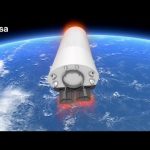
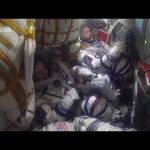
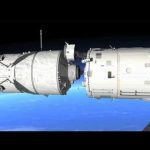
The ride home from the International Space Station sees the astronauts brake from 28 800 km/h to a standstill at touchdown in barely three hours. How does the Soyuz spacecraft reenter the atmosphere? And how does the capsule land?
Watch in just two minutes the sequence of events from farewell to landing. This video is based on a training lesson for ESA astronauts, and it features dramatic footage of actual landings.
ESA is Europe’s gateway to space. Our mission is to shape the development of Europe’s space capability and ensure that investment in space continues to deliver benefits to the citizens of Europe and the world. Check out http://www.esa.int/ESA to get up to speed on everything space related.
Every week, on average, a substantial, inert satellite drops into our atmosphere and burns up. Monitoring these reentries and warning European civil authorities has become routine work for ESA’s space debris experts.
Each year, about 100 tonnes of defunct satellites, uncontrolled spacecraft, spent upper stages and discarded items like instrument covers are dragged down by Earth’s upper atmosphere, ending their lives in flaming arcs across the sky.
Some of these objects are big and chunky, and pieces of them survive the fiery reentry to reach the surface. Our planet, however, is a big place, mostly covered by water, and much of what falls down is never seen by anyone, sinking to the bottom of some ocean, or landing far from human habitation.
While still in orbit, these and many other objects are tracked by a US military radar network, which shares the data with ESA, since Europe has no such capability of its own.It’s the task of ESA’s Space Debris team to look at these data and issue updates to ESA Member States and partner civil authorities around the globe.
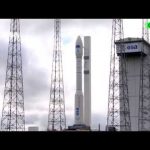
Replay of the liftoff of Vega VV04 with ESA’s Intermediate eXperimental Vehicle, IXV, launched from Kourou, French Guiana on 11 February 2015.
IXV was launched 340 km into space atop a Vega rocket, VV04, from Kourou in French Guiana on 11 February 2015. After separation from Vega, IXV coasted to 412 km before beginning a punishing glide back through the atmosphere. During its autonomous flight, IXV tested the latest technologies and critical systems to extend Europe’s capability for space exploration.
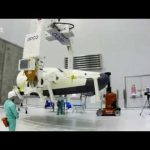
This time-lapse video shows IXV’s preparation, fairing encapsulation, transfer to the Vega mobile gantry and upper composite integration on the Vega launcher, at Europe’s Spaceport in Kourou, French Guiana, in January 2015. IXV will be launched 340 km into space on top of a Vega rocket, flight VV04, climbing to 412 km before beginning a long glide back through the atmosphere. During the flight, IXV will test the latest technologies and critical systems to help guide the design of future spaceplanes.
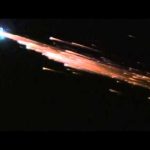
Europe’s space freighter ATV Jules Verne burning up over an uninhabited area of the Pacific Ocean at the end of its mission.
ATV Jules Verne was the first of ESA’s Automated Transfer Vehicles to bring supplies to the International Space Station and help keep its orbit 400 km above our planet.
A final deorbit burn at 14:58 CEST on 29 September 2008 slowed Jules Verne’s velocity by 70 m/s and spacecraft entered the upper atmosphere at an altitude of 120 km at 15:31 CEST. It broke up at an altitude of 75 km with the remaining fragments falling into the Pacific some 12 minutes later.
The planned reentry into the atmosphere was filmed from a DC-8 aircraft as part of an observation campaign including recording from the Station itself, as well as from two specially-equipped observation planes located in the vicinity of the ATV’s flight path in the skies above the South Pacific. The campaign served to determine whether the vehicle’s breakup matched computer modelling.
Soon, IXV, Europe’s Intermediate Experimental Vehicle, will be launched into space on a Vega launcher from Europe’s spaceport in Kourou, French Guiana. A short but crucial mission to advance Europe’s ambition to return autonomously from space.
How does an astronaut return to Earth from the International Space Station? What does it feel like to re-enter the atmosphere? How does the Soyuz capsule function? Watch and find out. This video is based on an actual lesson delivered to the ESA astronaut class of 2009 (also known as the #Shenanigans09) during their ESA Basic Training. It features interviews with astronauts who have flown on the Soyuz and dramatic footage of actual landings.
Produced by the ESA Human Spaceflight and Operations (HSO) Astronaut Training Division, Cologne, Germany, in collaboration with the HSO Strategic Planning and Outreach Office, Noordwijk, The Netherlands, with special support from Roskosmos.
Content Design: Stephane Ghiste, Dmitriy Churkin, Raffaele Castellano, Matthew Day (HSO-UT)
Animation & Video Editing: Raffaele Castellano (HSO-UT), HSO-K
Project Coordination: Matthew Day, Stephane Ghiste, Dmitriy Churkin (HSO-UT)
Special thanks to:
Martin Schweiger (Orbiter software: http://orbit/medphys.ucl.ac.uk/)
Nikita Vtyurin, Andrew Thielmann (Orbiter Soyuz model)
Lionel Ferra (HSO-UT)
Oleg Polovnikov (HSO-UT)
Frank De Winne (HSO-A)
Paolo Nespoli (HSO-A)
Antonio Rodenas Bosque (HSO-UT)
NASA
ROSCOSMOS
S.P. Korolev Rocket and Space Corporation Energia
Aerospace Search and Rescue Service of the Russian Federation
Parachute footage: Cambridge University Spaceflight
Surfer footage: copyright Red Bull Media House
Footage from inside Soyuz capsule courtesy of RSC Energia has limited rights:
a) These data are submitted with Limited Rights under Agreement among the Government of Canada, Governments of Member States of the European Space Agency, the Government of Japan, the Government of the Russian Federation and the Government of the United States of America concerning co-operation on the civil International Space Station.
These data may be used by the receiving co-operating agency and its contractors and subcontractors, provided that such data shall be used, duplicated or disclosed only for the following purposes, which are related to the Cooperating Agency Space Station Program for ISS:
1) Use for ESA astronaut training
2) Use for educational purposes
These data shall not be used by persons or entities other than the receiving Cooperating Agency, its contractors or subcontractors, or for any other purposes, without the prior written permission of the furnishing partner state, acting through its cooperating agency.
b) This notice shall be marked on any reproduction of these data in whole or part.
Captions available in English, French, German, Italian, Russian, Romanian (with thanks to Alexa Mirel) and Spanish. Click on the CC button to switch between languages.
ESA’s lead ATV-2 Mission Director Kris Capelle talks us through all phases of this complex mission – from launch preparation and lift-off to rendezvous and docking with the ISS through the attached phase, undocking and reentry.
![How do astronauts return to Earth? [with Closed Captions]](https://video.kidibot.ro/wp-content/uploads/2021/07/10518-how-do-astronauts-return-to-earth-with-closed-captions-150x150.jpg)