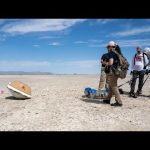
Missions to Mars have made many exciting discoveries that have transformed our understanding of the planet, but the next step is to bring samples to Earth for detailed analysis in sophisticated laboratories.
Watch a spacecraft deliver an asteroid sample to Earth! Our OSIRIS-REx (Origins, Spectral Interpretation, Resource Identification, and Security–Regolith Explorer) spacecraft is approaching Earth, and on Sept. 24, 2023, it will release its sample return capsule into the atmosphere on a path to land at the Department of Defense’s Utah Test and Training Range.
The touchdown will mark the end of a seven-year journey to explore asteroid Bennu, collect a sample from its surface, and deliver it to Earth as the U.S’s first pristine asteroid sample. Scientists around the world will study the sample over the coming decades to learn about how our planet and solar system formed, as well as the origin of organics that may have led to life on Earth.
NASA’s Origins, Spectral Interpretation, Resource Identification, Security-Regolith Explorer (OSIRIS-REx) is the first U.S. mission to return samples from an asteroid to Earth. When it lands, the OSIRIS-REx spacecraft will release the sample capsule for a safe landing in the Utah desert. The pristine material from Bennu – rocks and dust collected from the asteroid’s surface in 2020 – will offer generations of scientists a window into the time when the Sun and planets were forming about 4.5 billion years ago.
Watch NASA’s live broadcast on NASA TV, NASA.gov, the NASA app, or on social media (@NASA) starting at 10 a.m. ET on Sunday, Sept. 24.
Experts from NASA’s OSIRIS-REx (Origins, Spectral Interpretation, Resource Identification, and Security–Regolith Explorer) mission give an overview on the asteroid sample capsule’s landing and recovery plans set for Sept. 24, 2023.
News conference participants are:
• Melissa Morris, OSIRIS-REx program executive, NASA Headquarters, Washington • Dante Lauretta, OSIRIS-REx principal investigator, University of Arizona, Tucson • Rich Burns, OSIRIS-REx project manager, NASA’s Goddard Space Flight Center, Greenbelt, Maryland • Sandra Freund, OSIRIS-REx program manager, Lockheed Martin, Littleton, Colorado • Kevin Righter, OSIRIS-REx deputy curation lead, NASA’s Johnson Space Center, Houston
On Sept. 24, the OSIRIS-REx spacecraft will approach Earth and release its sample return capsule into the atmosphere on a path to land at the Department of Defense’s Utah Test and Training Range. The event makes it the first U.S. asteroid sample return.
The touchdown will mark the end of a seven-year journey to explore asteroid Bennu, collect a sample from its surface, and deliver it to Earth for study. Scientists around the world will study the sample over the coming decades to learn about how our planet and solar system formed, as well as the origin of organics that may have led to life on Earth.
Detect, fetch and collect. A seemingly easy task is being tested to find the best strategy to collect samples on the martian surface, some 290 000 million km away from home.
Testing technologies for Mars exploration is part of the daily job of Laura Bielenberg, an ESA graduate trainee for the Mars Sample Return campaign.
The test takes place at the rock-strewn recreation of the Red Planet at ESA’s ESTEC technical centre in Noordwijk, the Netherlands. The nickname of this test site is the ‘Mars Yard’ and is part of the Planetary Robotics Laboratory.
The tube is a replica of the sample caches that NASA’s Perseverance rover is leaving on Mars hermetically sealed with precious martian samples inside. They are called RSTA, an acronym of Returnable Sample Tube Assembly, and to most people on Earth they look like lightsabers. Laura is investigating sample tube collection strategies, from autonomous detection to pose estimation of sample tubes on Mars, with a testbed called the RABBIT (RAS Bread Boarding In-house Testbed).
The Sample Transfer Arm will need to load the tubes from the martian surface for delivery towards Earth. ESA’s robotic arm will collect them from the Perseverance rover, and possibly others dropped by sample recovery helicopters as a backup.
Besides cameras and sensors, the team relies on neural networks to detect the tubes and estimate their pose. Inspired by the way the human brain works, neural networks mimic the way biological neurons signal to one another.
We are Europe’s gateway to space. Our mission is to shape the development of Europe’s space capability and ensure that investment in space continues to deliver benefits to the citizens of Europe and the world. Check out https://www.esa.int/ to get up to speed on everything space related.
An international agreement to collaborate on Artemis, an intriguing discovery on the Moon, and an update on OSIRIS-REx … a few of the stories to tell you about – This Week at NASA!
Yesterday, Oct. 20, our OSIRIS-REx spacecraft descended to the surface of asteroid Bennu, touched down and attempted to capture a sample using a “Touch-And-Go,” or TAG, maneuver. Join us at 5 p.m. EDT for a live broadcast with the mission team, as they provide a recap of yesterday’s journey #ToBennuAndBack and reveal first images and videos of this historic event.
While NASA is working aggressively to meet our near-term goal of landing the first woman and next man on the Moon by 2024, our Artemis program also is focused on taking steps that will establish a safe and sustainable lunar exploration architecture.
NASA is taking a critical step forward by releasing a solicitation for commercial companies to provide proposals for the collection of space resources.
To meet NASA’s requirements, a company will collect a small amount of Moon “dirt” or rocks from any location on the lunar surface, provide imagery to NASA of the collection and the collected material, along with data that identifies the collection location, and conduct an “in-place” transfer of ownership of the lunar regolith or rocks to NASA. After ownership transfer, the collected material becomes the sole property of NASA for our use.
NASA’s goal is that the retrieval and transfer of ownership will be completed before 2024. The solicitation creates a full and open competition, not limited to U.S. companies, and the agency may make one or more awards. The agency will determine retrieval methods for the transferred lunar regolith at a later date.
Over the next decade, the Artemis program will lay the foundation for a sustained long-term presence on the lunar surface and use the Moon to validate deep space systems and operations before embarking on the much farther voyage to Mars. The ability to conduct in-situ resources utilization (ISRU) will be incredibly important on Mars, which is why we must develop techniques and gain experience with ISRU on the surface of the Moon.
Spacecraft in orbit and on Mars’s surface have made many exciting discoveries, transforming our understanding of the planet and unveiling clues to the formation of our Solar System, as well as helping us understand our home planet. The next step is to bring samples to Earth for detailed analysis in sophisticated laboratories where results can be verified independently and samples can be reanalysed as laboratory techniques continue to improve.
Bringing Mars to Earth is no simple undertaking—it would require at least three missions from Earth and one never-been-done-before rocket launch from Mars.
A first mission, NASA’s 2020 Mars Rover, is set to collect surface samples in pen-sized canisters as it explores the Red Planet. Up to 31 canisters will be filled and readied for a later pickup – geocaching gone interplanetary.
In the same period, ESA’s ExoMars rover, which is also set to land on Mars in 2021, will be drilling up to two meters below the surface to search for evidence of life.
A second mission with a small fetch rover would land nearby and retrieve the samples in a Martian search-and-rescue operation. This rover would bring the samples back to its lander and place them in a Mars Ascent Vehicle – a small rocket to launch the football-sized container into Mars orbit.
A third launch from Earth would provide a spacecraft sent to orbit Mars and rendezvous with the sample containers. Once the samples are safely collected and loaded into an Earth entry vehicle, the spacecraft would return to Earth, release the vehicle to land in the United States, where the samples will be retrieved and placed in quarantine for detailed analysis by a team of international scientists.
On Sept. 8, NASA launched the Origins, Spectral Interpretation, Resource Identification, Security – Regolith Explorer, or OSIRIS-REx mission from Cape Canaveral Air Force Station in Florida. OSIRIS-REx, the first U.S. mission to sample an asteroid, is scheduled to arrive at near-Earth asteroid Bennu in 2018. Mission plans call for the spacecraft to survey the asteroid, retrieve a small sample from its surface, and return the sample to Earth for study in 2023. Analysis of that sample is expected to reveal clues about the history of Bennu over the past 4.5 billion years, as well as clues about the evolution of our solar system. Also, Williams’ Record-Breaking Spaceflight Concludes, Next ISS Crew Prepares for Launch, Sample Return Robot Challenge, NASA X-Plane Gets its Wing, and Convergent Aeronautics Solutions Showcase!