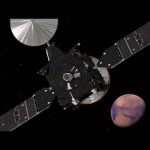
Scientists and engineers on the ExoMars project had their hearts in their mouths as the ExoMars mission reached the red planet, with the Schiaparelli probe going missing in action at the end of its descent just as the TGO mothership swept into a perfectly timed orbit.
The rollercoaster ride of arrival at Mars is the first installment in this ambitious Russian and European project that aims for the first time to directly search for signs of life on Mars.
The plight of Schiaparelli remains unclear. It is certainly on the Martian surface, but may well have hit the red dust much harder then engineers had planned, and nothing has been heard from it since.
Data relayed during the lander’s descent shows the initial high-speed entry to the Martian atmosphere went well, with the heatshield slowing the craft and the parachute deploying. However once the back heat shield and parachute were ejected the flow of events did not go to plan.
This video is available in the following languages:
English https://www.youtube.com/watch?v=S3eIilSYrok
French https://www.youtube.com/watch?v=mEXA_Fo7ABg
German https://www.youtube.com/watch?v=jCCFOjP0ocw
Spanish https://www.youtube.com/watch?v=bMnSKkSLLbA
Italian https://www.youtube.com/watch?v=wqi7XU0ojqI
Portuguese https://www.youtube.com/watch?v=-VyaoG_f51s
Hungarian https://www.youtube.com/watch?v=S7QLUBb5QbI
Greek https://www.youtube.com/watch?v=hlrNu0vselk