Tag: scientists

  • Euclid in a nutshell

    Euclid in a nutshell

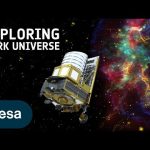
    ESA’s Euclid mission is designed to explore the composition and evolution of the dark Universe. The space telescope will create a great map of the large-scale structure of the Universe across space and time by observing billions of galaxies out to 10 billion light-years, across more than a third of the sky. Euclid will explore how the Universe has expanded and how structure has formed over cosmic history, revealing more about the role of gravity and the nature of dark energy and dark matter.

    Euclid is a fully European mission, built and operated by ESA, with contributions from NASA. The Euclid Consortium – consisting of more than 2000 scientists from 300 institutes in 13 European countries, the US, Canada and Japan – provided the scientific instruments and scientific data analysis. ESA selected Thales Alenia Space as prime contractor for the construction of the satellite and its Service Module, with Airbus Defence and Space chosen to develop the Payload Module, including the telescope. NASA provided the near-infrared detectors of the NISP instrument.

    More about Euclid: esa.int/euclid

    ★ Subscribe: http://bit.ly/ESAsubscribe and click twice on the bell button to receive our notifications.

    Check out our full video catalog: http://bit.ly/SpaceInVideos
    Follow us on Twitter: http://bit.ly/ESAonTwitter
    On Facebook: http://bit.ly/ESAonFacebook
    On Instagram: http://bit.ly/ESAonInstagram
    On LinkedIn: https://bit.ly/ESAonLinkedIn
    On Pinterest: https://bit.ly/ESAonPinterest
    On Flickr: http://bit.ly/ESAonFlickr

    We are Europe’s gateway to space. Our mission is to shape the development of Europe’s space capability and ensure that investment in space continues to deliver benefits to the citizens of Europe and the world. Check out https://www.esa.int/ to get up to speed on everything space related.

    Copyright information about our videos is available here: https://www.esa.int/ESA_Multimedia/Terms_and_Conditions

    #ESA
    #Euclid
    #Universe
  • NASA Explorers S3 E4: Chasing Clouds

    NASA Explorers S3 E4: Chasing Clouds

    “Earth science is a subject far too big for one country, one agency, to tackle all by itself.” So #NASAExplorers team up with researchers from around the country and the planet to answer some big questions about fires, clouds and climate from the Western Pacific, where we still have a lot to learn about the interaction between fires and cloud formation. #S3E4

  • NASA Explorers S3 E3: The Carbon Problem

    NASA Explorers S3 E3: The Carbon Problem

    In the Arctic, fires are a natural part of the ecosystem. But as the climate changes, fires are burning longer and hotter, releasing long-buried carbon from the soil. #NASAExplorers are looking from high in the sky to deep below the ground to better understand how a warming climate affects fires in the Arctic…and how fires in the region will contribute to climate change in the future. #S3E3

  • NASA Scientists Share Why They Like Earth

    NASA Scientists Share Why They Like Earth

    The Earth is a unique planet. In celebration of Earth Day, NASA scientists shared their favorite thing about our home planet.

  • Waiting for Gaia

    Waiting for Gaia

    On 25 April 2018, ESA’s Gaia mission will publish its much awaited second data release, including high-precision measurements of nearly 1.7 billion stars in our Galaxy.

    Scientists who have been working on creating and validating the data contained in the catalogue tell us why they are waiting for this extraordinary release.

    Featured in the video: Antonella Vallenari (INAF, Astronomical Observatory of Padua), Anthony Brown (Leiden University), Timo Prusti (European Space Agency), Annie Robin (Institut UTINAM, OSU THETA Franche-Comté-Bourgogne), Laurent Eyer (University of Geneva) and Federica Spoto (IMCCE, Observatory of Paris).

    A media briefing on the second Gaia data release will be held at the ILA Berlin Air and Space Show in Germany on 25 April 11:00-12:15 CEST. Watch the webstream at www.esa.int/live

    Learn more about Gaia: bit.ly/ESAsGaia

    ★ Subscribe: http://bit.ly/ESAsubscribe

  • ESA Euronews: Surfing scientists

    ESA Euronews: Surfing scientists

    We meet a surfing scientist and toxic algae hunters to see how Sentinel-3 satellite data is used to study the coastline of the English Channel in this month’s episode of Space.

    Bob Brewin is pioneering a new technique in satellite oceanography – by going surfing.
    The Plymouth Marine Laboratory scientist uses his board to take sea surface temperature measurements, and then use them to better interpret data from European satellite Sentinel-3.

    This video is also available in the following languages:
    German: https://youtu.be/1dU52RA1IEE
    French: https://youtu.be/kSJXmrSWG-s
    Italian: https://youtu.be/PRPvcvZgQno
    Spanish: https://youtu.be/H0vQdyanyKk
    Portuguese: https://youtu.be/_nP6Bmpa6YQ
    Greek: https://youtu.be/y4zObvFjckY
    Hungarian: https://youtu.be/kj3-iO2S4UQ

    ★ Subscribe to the channel: http://bit.ly/ESAsubscribe

  • 25 years of Hubble on This Week @NASA-April 24, 2015

    25 years of Hubble on This Week @NASA-April 24, 2015

    On April 24, 1990, NASA’s Hubble Space Telescope rode to space aboard space shuttle Discovery – on a mission to do just that – discover. The results over the past 25 years have been nothing short of remarkable.
    The storied and historic journey into the cosmos that Hubble’s eyes have taken us on, has led to groundbreaking discoveries, captivated imaginations and given humans a better understanding of our place in the universe. NASA celebrated Hubble’s Silver anniversary with a variety of events including the unveiling of the official Hubble 25th anniversary image at the Newseum in Washington and a gala at the Smithsonian’s National Air and Space Museum, during which many of the astronauts, scientists, engineers, technicians, educators, and others who have contributed to Hubble’s success were honored. Also, NASA celebrates Earth Day, 3-D printed copper engine part and more!

  • The Space Shuttle (Narrated by William Shatner)

    The Space Shuttle (Narrated by William Shatner)

    An idea born in unsettled times becomes a feat of engineering excellence. The most complex machine ever built to bring humans to and from space and eventually construct the next stop on the road to space exploration.