Tag: simulation

  • Supercomputer Simulation Reveals Supermassive Black Holes

    Supercomputer Simulation Reveals Supermassive Black Holes

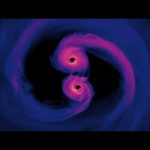
    A new supercomputer model could help astronomers find spiraling, merging systems of two supermassive black holes. These mergers happen often in the universe, but are hard to see. Watch as the simulation reveals the merger’s brighter, more variable X-rays. https://go.nasa.gov/2OsaMAs

    Credit: NASA’s Goddard Space Flight Center
    Music: “Games Show Sphere 01” from Killer Tracks

    This video is public domain and along with other supporting visualizations can be downloaded from the Scientific Visualization Studio at: http://svs.gsfc.nasa.gov/13043

  • The Hyades cluster

    The Hyades cluster

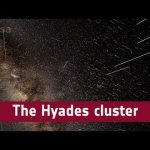
    Animated 3D view of the sky as observed by ESA’s Gaia satellite using information from the mission’s second data release.

    The bright band in the left half of the image is the Milky Way, where most of the stars in our Galaxy reside. The animation starts with the Orion constellation at the centre; we then move towards the neighbouring Taurus constellation and to the Hyades star cluster, which is part of this constellation. Hyades is the closest open cluster to the Solar System, some 150 light-years away.

    The animation first shows the 3D structure of the cluster, based on accurate position and distance information from Gaia. Then an animated view of the future motions of stars is shown – both in Hyades and beyond. This is based on Gaia’s measurements of the velocity of stars across the sky, also known as proper motion.

    Credit: ESA/Gaia/DPAC, CC BY SA 3.0 IGO

    Acknowledgement: Gaia Data Processing and Analysis Consortium (DPAC); Gaia Sky; S. Jordan / T. Sagristà, Astronomisches Rechen-Institut, Zentrum für Astronomie der Universität Heidelberg, Germany

    ★ Subscribe: http://bit.ly/ESAsubscribe

    Learn more: bit.ly/GaiaRickestStarMap

  • Gaia’s first asteroid survey

    Gaia’s first asteroid survey

    Animated view of 14 099 asteroids in our Solar System, as viewed by ESA’s Gaia satellite using information from the mission’s second data release. The orbits of the 200 brightest asteroids are also shown, as determined using Gaia data.

    In future data releases, Gaia will also provide asteroid spectra and enable a complete characterisation of the asteroid belt. The combination of dynamical and physical information that is being collected by Gaia provides an unprecedented opportunity to improve our understanding of the origin and the evolution of the Solar System.

    Credit: ESA/Gaia/DPAC, CC BY SA 3.0 IGO

    Acknowledgement: Gaia Data Processing and Analysis Consortium (DPAC); Orbits: Gaia Coordinating Unit 4; P. Tanga, Observatoire de la Côte d’Azur, France; F. Spoto, IMCCE, Observatoire de Paris, France; Animation: Gaia Sky; S. Jordan / T. Sagristà, Astronomisches Rechen-Institut, Zentrum für Astronomie der Universität Heidelberg, Germany

    ★ Subscribe: http://bit.ly/ESAsubscribe

    Learn more: bit.ly/GaiaRickestStarMap

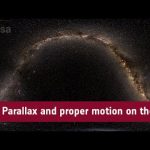
  • 360º Parallax and proper motion on the sky

    360º Parallax and proper motion on the sky

    A 360° animated view of the entire sky on 25 April 2018.

    After a few seconds, the stars start moving in the sky according to parallax, an apparent shift caused by Earth’s yearly motion around the Sun. Then, constellation outlines appear as visual aids. Finally, stars start moving according to their true motion through space, which is visible on the sky as proper motion. Parallaxes have been exaggerated by 100 000 and proper motions have been speeded up by one trillion (10^12) to make them visible in this animation. This animation is based on data from the second data release of ESA’s Gaia satellite, which has measured the positions, parallaxes and motions of more than one billion stars across the sky to unprecedented accuracy.

    ESA/Gaia/DPAC, CC BY SA 3.0 IGO

    Acknowledgement: Gaia Data Processing and Analysis Consortium (DPAC); Gaia Sky; S. Jordan / T. Sagristà, Astronomisches Rechen-Institut, Zentrum für Astronomie der Universität Heidelberg, Germany

    ★ Subscribe: http://bit.ly/ESAsubscribe

    Learn more: http://bit.ly/GaiaRickestStarMap

  • VR’s Healthcare Revolution: Transforming Medical Training at CHLA

    VR’s Healthcare Revolution: Transforming Medical Training at CHLA

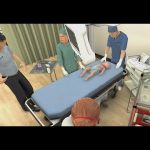
    Recently, we partnered with Children’s Hospital Los Angeles (CHLA) to build a VR simulation that places medical students and staff in rare yet high-risk pediatric trauma situations where split-second decisions determine whether a patient lives or dies. Thanks to the immersive power of VR, we can replicate these training scenarios in true-to-life fashion, complete with paramedics rattling off symptoms, nurses and techs urging you to make a decision, and distraught parents praying for their child’s survival.

    These visceral, interactive exercises up the stakes compared to traditional educational tools like non-VR simulations and mannequins. Powered by AiSolve and brought to life by the Hollywood VFX magic of BioflightVR, these virtual scenarios based on actual CHLA case studies let doctors and students practice and learn in realistic workplace conditions. Not only does this new innovation stand to significantly reduce the time and cost associated with mannequin-based training, it also better prepares people to respond in the real world.

    Official Oculus Channels:
    Oculus: http://ocul.us/Oculus
    Facebook: http://ocul.us/Facebook
    Twitter: http://ocul.us/Twitter
    Instagram: http://ocul.us/Instagram