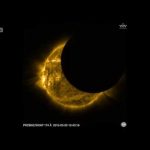
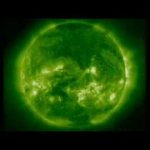
As Europe enjoyed a partial solar eclipse on the morning of Friday 20 March 2015, ESA’s Sun-watching Proba-2 minisatellite had a ringside seat from space. Orbiting Earth once approximately every 100 minutes, Proba-2 caught two eclipses over the course of the morning.
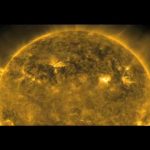
Proba-2 used its SWAP imager to capture the Moon passing in front of the Sun. SWAP views the solar disc at extreme ultraviolet wavelengths to capture the turbulent surface of the Sun and its swirling corona.
As Europe enjoyed a partial solar eclipse on the morning of Friday 20 March 2015, ESA’s Sun-watching Proba-2 minisatellite had a ringside seat from orbit. Proba-2 used its SWAP imager to capture the Moon passing in front of the Sun. SWAP views the solar disc at extreme ultraviolet wavelengths to capture the turbulent surface of the Sun and its swirling corona.
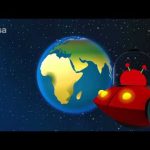
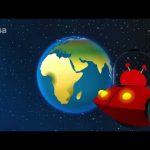
Únete a Paxi en su viaje a través de nuestro Sistema Solar, desde los planetas interiores rocosos cercanos al Sol, pasando por los planetas gigantes hasta los confines congelados, hogar de los cometas.
En este vídeo, destinado a niños de entre 6 y 12 años, Paxi nos lleva de viaje a través de nuestro Sistema Solar, visitando todos los ocho planetas y objetos menores como asteroides, cometas y el planeta enano Plutón.
Este vídeo es el segundo de una serie de animaciones en las que Paxi, la mascota de la Oficina de Educación de la ESA, explica diferentes aspectos del Sistema Solar, el Universo, los secretos del planeta Tierra y mucho más.
Credit: ESA; produced by Science Office, illustrations by Kaleidoscope Design, NL
Join Paxi on a journey through our Solar System, from the rocky inner planets close to the Sun, past the giant planets to the freezing edge, the home of comets.
In this video, targeted at children between 6 and 12, Paxi takes us on a tour of our Solar System, visiting all eight planets and other minor bodies such as asteroids, comets and the dwarf planet Pluto.
This video is the second of a series of animations in which Paxi, ESA’s Education mascot, touches on different aspects of the Solar System, the Universe, the secrets of planet Earth, and much more.
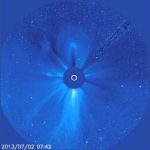
Two coronal mass ejections (CMEs) expand side-by-side from the Sun and out into space in this movie, playing out in front of the ESA/NASA Solar and Heliospheric Observatory, SOHO, on 1-2 July 2013.
The shaded disc at the centre of the image is a mask in SOHO’s LASCO instrument that blots out direct sunlight to allow study of the faint details in the Sun’s corona. The white circle added within the disc shows the size and position of the visible Sun.
Read the full experiment at http://www.stevespanglerscience.com/experiment/solar-oven-s-mores There are just some things that are synonymous with “summertime snacks,” and we can’t think of a summer snack we enjoy quite as much as s’mores. But what would you do if you weren’t allowed to have a fire or just didn’t have the tools necessary for a fire? We came up with a pretty neat way to harness the heat and energy of the sun to create a solar powered cooker that makes a delicious batch of s’mores without a fire!
This movie shows the transit of Venus on 5-6 June 2012 as seen from SWAP, a Belgian solar imager onboard ESA’s PROBA2 microsatellite. SWAP, watching the Sun in EUV light, observes Venus as a small, black circle, obscuring the EUV light emitted from the solar outer atmosphere – the corona – from 19:45UT onwards. At 22:16UT – Venus started its transit of the solar disk
The bright dots all over the image (‘snow storm’) are energetic particles hitting the SWAP detector when PROBA2 crosses the South Atlantic Anomaly, a region where the protection of the Earth magnetic field against space radiation is known to be weaker.
Note also the small flaring activity in the bright active region in the northern solar hemisphere as Venus passes over. Towards the end, you can see a big dim inverted-U-shape moving away from the Sun towards the bottom-right corner. This is a coronal mass ejection taking off.
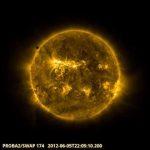
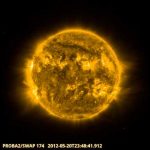
ESA’s space weather microsatellite Proba-2 observed the solar eclipse on the evening of 20 May 2012. It passed through the Moon’s shadow a total of four times, imaging a sequence of partial solar eclipses in the process. The first contact was made on Sunday May 20 at 21:09 GMT. The last contact finished at 03:04 GMT.
Pegaso 51 B è il nome che è stato dato al primo pianeta extra sistema solare scoperto nel 1995. Da allora ne sono stati scoperti altri 500. Space è andato a perlustare i recessi della ricerca su queste porzioni di universo.
Comets are primeval leftovers from the origins of the Solar System. To fully understand these ancient objects and perhaps the origins of life on Earth, ESA’s Rosetta mission will rendezvous with comet Churyumov-Gerasimenko in 2014. In November of that year, Rosetta’s Philae lander will touchdown on the comet and thoroughly investigate its composition.
Space missions are complicated pieces of orbital choreography. When planning a mission, spacecraft engineers must calculate how to point the solar panels towards the Sun, the main antenna towards Earth and the instruments towards the target. ESA Space Scientist Detlef Koschny build a LEGO model of Rosetta mission in order to visualise these precise orientations.
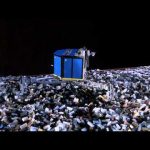
Built using LEGO Mindstorms, the Philae lander model can be controlled using a home computer. It can rotate and move the drill up and down to simulate the behaviour of the real lander. As part of ESA’s Rosetta space mission, Philae will land on comet Churyumov-Gerasimenko in November 2014 to study its composition.
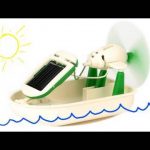
Order now at http://www.stevespanglerscience.com/product/6-in-1-solar-kit This cool science toy uses the sun to power a windmill, a plane, a boat, a car, and even make a dog wag its tail. You can build six different things with the Mini 6-in-1 Solar Kit.
About Steve Spangler Science…
Steve Spangler is a celebrity teacher, science toy designer, speaker, author and an Emmy award-winning television personality. Spangler is probably best known for his Mentos and Diet Coke geyser experiment that went viral in 2005 and prompted more than 1,000 related YouTube videos. Spangler is the founder of www.SteveSpanglerScience.com, a Denver-based company specializing in the creation of science toys, classroom science demonstrations, teacher resources and home for Spangler’s popular science experiment archive and video collection. Spangler is a frequent guest on the Ellen DeGeneres Show where he takes classroom science experiments to the extreme. Check out his pool filled with 2,500 boxes of cornstarch!
On the education side, Spangler started his career as a science teacher in the Cherry Creek School district for 12 years. Today, Steve travels extensively training teachers in ways to make learning more engaging and fun. His hands-on science boot camps and summer institutes for teachers inspire and teach teachers how to prepare a new generation for an ever-changing work force. Over the last 15 years, he has also made more than 500 television appearances as an authority on hands-on science and inquiry-based learning.
On the business side, Spangler is the founder and CEO of Steve Spangler Science, a Denver-based company specializing in the creation of educational toys and kits and hands-on science training services for teachers. The companys unique business strategies and viral creations have been featured in the Wall Street Journal, Inc. Magazine, Wired and TIME Magazine where online readers voted Steve Spangler #18 in the Top 100 Most Influential People of the Year for 2006 (what were they thinking?). You’ll find more than 140 Spangler created products available online at SteveSpanglerScience.com and distributed to toy stores and mass-market retailers worldwide.
Spangler joined NBC affiliate 9News in 2001 as the science education specialist. His weekly experiments and science segments are designed to teach viewers creative ways to make learning fun. His now famous Mentos Geyser experiment, turning 2-liter bottles of soda into erupting fountains, became an Internet sensation in September 2005 when thousands of people started posting their own Mentos explosions on YouTube.com.
As founder of SteveSpanglerScience.com, Spangler and his design team have developed more than 140 educational toys and science-related products featured by mass-market retailers like Target, Wal-Mart, Toys R’ Us, Discovery Channel Stores and over 1,400 independent specialty toy stores. His educational science catalog and on-line business offers more than a thousand science toys and unique learning resources. Recently, Spangler has been featured in the Wall Street Journal, Inc. Magazine, WIRED, the History Channel, Food Network and TIME Magazine where on-line readers voted Steve Spangler #18 in the Top 100 Most Influential People of the Year for 2006.
His recent appearances on the Ellen DeGeneres Show have taught viewers how to blow up their food, shock their friends, create mountains of foam, play on a bed of nails, vanish in a cloud of smoke and how to turn 2,500 boxes of cornstarch and a garden hose into a swimming pool of fun.
The first images of NASAs Solar Dynamics Observatory (SDO) released on April 21, 2010. Launched Feb. 11, 2010, SDO is the most advanced spacecraft ever designed to study the sun and its dynamic behavior. The spacecraft can produce images with clarity ten times better than high definition television and provide more comprehensive science data faster than any solar observing spacecraft in history. SDO will help scientists study solar activity to improve forecasts of how the suns weather affects Earth. www.nasa.gov/sdo http://www.nasa.gov/sdo
A Solar Bag is a http://www.SteveSpanglerScience.com product consisting of a long plastic bag made from a very thin plastic and colored black to absorb solar energy. The heated air inside the bag provides buoyancy and causes the bag to float. Over the years, it’s become a very popular science demo for teachers to share with their students as they explore the properties of air.
You can imagine how surprised we were to learn that scientists from Pioneer Astronautics and Jet Propulsion Laboratory conducted successful tests of its Mars solar balloon inflation system using our Solar Bag. This video give you a bird’s eye view of what our Solar Bag looks like at about 120,000 feet above the Earth.
The largest physics lesson involved 5,401 participants who were taught by Steve Spangler Science (USA) during a presentation at Coors Field in Denver, Colorado, USA, on 7 May 2009. The event was part of the 9News Weather & Science Day hosted by Steve Spangler and Kathy Sabine. Guinness World Records™ Adjudicator, Danny Girton, was present at the event to award the new record.
Order now at http://www.stevespanglerscience.com/product/hydrogen-car The car uses a fuel cell and on-board hydrogen storage system to power itself no batteries required. In fact, the H-Racer may just be the prototype for a cleaner, oil free future and is a great way to teach children—and adults alike—about the importance and functionality of alternative fuel resources.