Tag: sounds

  • The sounds of BepiColombo’s sixth flight past Mercury

    The sounds of BepiColombo’s sixth flight past Mercury

    Listen to the ESA/JAXA BepiColombo spacecraft as it flew past Mercury on 8 January 2025. This sixth and final flyby used the little planet’s gravity to steer the spacecraft on course for entering orbit around Mercury in 2026.

    What you can hear in the sonification soundtrack of this video are real spacecraft vibrations measured by the Italian Spring Accelerometer (ISA) instrument. The accelerometer data have been shifted in frequency to make them audible to human ears – one hour of measurements have been sped up to one minute of sound.

    BepiColombo is always shaking ever so slightly: fuel is slightly sloshing, the solar panels are vibrating at their natural frequency, heat pipes are pushing vapour through small tubes, and so forth. This creates the eerie underlying hum throughout the video.

    But as BepiColombo gets closer to Mercury, ISA detects other forces acting on the spacecraft. Most scientifically interesting are the audible shocks that sound like short, soft bongs. These are caused by the spacecraft responding to entering and exiting Mercury’s shadow, where the Sun’s intense radiation is suddenly blocked. One of ISA’s scientific goals is to monitor the changes in the ‘solar radiation pressure’ – a force caused by sunlight striking BepiColombo as it orbits the Sun and, eventually, Mercury.

    The loudest noises – an ominous ‘rumbling’ – are caused by the spacecraft’s large solar panels rotating. The first rotation occurs in shadow at 00:17 in the video, while the second adjustment at 00:51 was also captured by one of the spacecraft’s monitoring cameras.

    Faint sounds like wind being picked up in a phone call, which grow more audible around 30 seconds into the video, are caused by Mercury’s gravitational field pulling the nearest and furthest parts of the spacecraft by different amounts. As the planet’s gravity stretches the spacecraft ever so slightly, the spacecraft responds structurally. At the same time, the onboard reaction wheels change their speed to maintain the spacecraft’s orientation, which you can hear as a frequency shift in the background.

    This is the last time that many of these effects can be measured with BepiColombo’s largest solar panels, which make the spacecraft more susceptible to vibrations. The spacecraft module carrying these panels will not enter orbit around Mercury with the mission’s two orbiter spacecraft.

    The video shows an accurate simulation of the spacecraft and its route past Mercury during the flyby, made with the SPICE-enhanced Cosmographia spacecraft visualisation tool. The inset that appears 38 seconds into the video shows real photographs taken by one of BepiColombo’s monitoring cameras.

    Read more: https://www.esa.int/Science_Exploration/Space_Science/BepiColombo/BepiColombo_to_swing_by_Mercury_for_the_sixth_time

    Credits: ESA/BepiColombo/ISA & MTM
    Acknowledgements: Sonification and SPICE-enhanced Cosmographia spacecraft visualisation by Carmelo Magnafico (IAPS/INAF)

    ★ Subscribe: http://bit.ly/ESAsubscribe and click twice on the bell button to receive our notifications.

    Check out our full video catalog: http://bit.ly/SpaceInVideos
    Follow us on Twitter: http://bit.ly/ESAonTwitter
    On Facebook: http://bit.ly/ESAonFacebook
    On Instagram: http://bit.ly/ESAonInstagram
    On LinkedIn: https://bit.ly/ESAonLinkedIn
    On Pinterest: https://bit.ly/ESAonPinterest
    On Flickr: http://bit.ly/ESAonFlickr

    We are Europe’s gateway to space. Our mission is to shape the development of Europe’s space capability and ensure that investment in space continues to deliver benefits to the citizens of Europe and the world. Check out https://www.esa.int/ to get up to speed on everything space related.

    Copyright information about our videos is available here: https://www.esa.int/ESA_Multimedia/Terms_and_Conditions

    #ESA #BepiColombo #Mercury
  • 5,000 Exoplanets: Listen to the Sounds of Discovery (360 Video)

    5,000 Exoplanets: Listen to the Sounds of Discovery (360 Video)

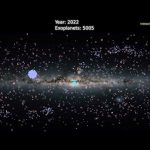
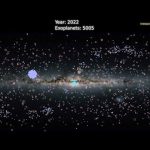
    On March 21, 2022, the number of known exoplanets passed 5,000 according to the NASA Exoplanet Archive. This 360-degree animation and sonification tracks humanity’s discovery of the planets beyond our solar system over time. Turning NASA data into sounds allows users to hear the pace of discovery with additional information conveyed by the notes themselves.

    As each exoplanet is discovered, a circle appears at its position in the sky. The size of the circle indicates the relative size of the planet’s orbit and the color indicates which planet detection method was used to discover it. The music is created by playing a note for each newly discovered world. The pitch of the note indicates the relative orbital period of the planet. Planets that take a longer time to orbit their stars are heard as lower notes, while planets that orbit more quickly are heard as higher notes.

    Exoplanet detection methods: radial velocity (pink); transit (purple); imaging (orange); microlensing (green); timing variations (red); orbital brightness modulation (yellow); astrometry (gray); disk kinematics (blue).

    Please note: Not all browsers support viewing 360 videos. YouTube supports their playback on computers using Chrome, Firefox, MS Edge, and Opera browsers. For the best experience on a mobile device, play this video in the YouTube app.

    Credit: NASA/JPL-Caltech/M. Russo, A. Santaguida (SYSTEM Sounds)

  • 5,000 Exoplanets: Listen to the Sounds of Discovery (NASA Data Sonification)

    5,000 Exoplanets: Listen to the Sounds of Discovery (NASA Data Sonification)

    On March 21, 2022, the number of known exoplanets passed 5,000 according to the NASA Exoplanet Archive. This animation and sonification tracks humanity’s discovery of the planets beyond our solar system over time. Turning NASA data into sounds allows users to hear the pace of discovery, with additional information conveyed by the notes themselves.

    As each exoplanet is discovered, a circle appears at its position in the sky. The size of the circle indicates the relative size of the planet’s orbit and the color indicates which planet detection method was used to discover it. The music is created by playing a note for each newly discovered world. The pitch of the note indicates the relative orbital period of the planet. Planets that take a longer time to orbit their stars are heard as lower notes, while planets that orbit more quickly are heard as higher notes.

    Credit: NASA/JPL-Caltech/M. Russo, A. Santaguida (SYSTEM Sounds)

  • NASA | Sounds of the Sun (Low Frequency)

    NASA | Sounds of the Sun (Low Frequency)

    NASA heliophysicist Alex Young explains how sound connects us with the Sun and all other stars. This piece features low frequency sounds of the Sun. Raw audio (no commentary): https://youtu.be/-I-zdmg_Dno Read more: https://go.nasa.gov/2JR0wLL

    Credit: NASA’s Goddard Space Flight Center
    Micheala Sosby (NASA/GSFC): Lead Producer
    Katie Atkinson (GSFC Interns): Lead Producer
    C. Alex Young (NASA/GSFC): Narrator
    Aaron E. Lepsch (ADNET Systems Inc.): Technical Support
    Music: “Flow” by Lee Rosevere

    This video is public domain and along with other supporting materials can be downloaded from the Scientific Visualization Studio at: https://svs.gsfc.nasa.gov/13011

  • ESA Euronews: The sounds of space

    ESA Euronews: The sounds of space

    There are many links between music and space. Astronauts like Frank De Winne take their favourite rock music with them to orbit, while musicians on Earth often take inspiration from the stars in their work. Some astrophysicists have transposed plasma waves and electron beams into audible sound.

  • Pop Bottle Sounds – Cool Science Fair Project

    Pop Bottle Sounds – Cool Science Fair Project

    Check out this and other cool science experiments at http://www.stevespanglerscience.com/experiments/ Mark Spangler shows us his big discovery of the sounds pop bottles make when filed with different amounts of water.

    About Steve Spangler Science…

    Steve Spangler is a celebrity teacher, science toy designer, speaker, author and an Emmy award-winning television personality. Spangler is probably best known for his Mentos and Diet Coke geyser experiment that went viral in 2005 and prompted more than 1,000 related YouTube videos. Spangler is the founder of www.SteveSpanglerScience.com, a Denver-based company specializing in the creation of science toys, classroom science demonstrations, teacher resources and home for Spangler’s popular science experiment archive and video collection. Spangler is a frequent guest on the Ellen DeGeneres Show where he takes classroom science experiments to the extreme. Check out his pool filled with 2,500 boxes of cornstarch!

    Cool Science Toys – http://www.SteveSpanglerScience.com
    Sign up for the Experiment of the Week – http://www.stevespanglerscience.com/experiment-of-the-week
    Watch Spangler’s Science Videos – http://www.stevespanglerscience.com/video/
    Attend a Spangler Hands-on Science Workshop for Teachers – http://www.stevespanglerscience.com/teacher_training/
    Visit Spangler’s YouTube Channel – http://www.youtube.com/stevespanglerscience

    Join the conversation on Steve Spangler’s blog – http://www.SteveSpangler.com

    Additional Information:

    On the education side, Spangler started his career as a science teacher in the Cherry Creek School district for 12 years. Today, Steve travels extensively training teachers in ways to make learning more engaging and fun. His hands-on science boot camps and summer institutes for teachers inspire and teach teachers how to prepare a new generation for an ever-changing work force. Over the last 15 years, he has also made more than 500 television appearances as an authority on hands-on science and inquiry-based learning.

    On the business side, Spangler is the founder and CEO of Steve Spangler Science, a Denver-based company specializing in the creation of educational toys and kits and hands-on science training services for teachers. The companys unique business strategies and viral creations have been featured in the Wall Street Journal, Inc. Magazine, Wired and TIME Magazine where online readers voted Steve Spangler #18 in the Top 100 Most Influential People of the Year for 2006 (what were they thinking?). You’ll find more than 140 Spangler created products available online at SteveSpanglerScience.com and distributed to toy stores and mass-market retailers worldwide.

    Spangler joined NBC affiliate 9News in 2001 as the science education specialist. His weekly experiments and science segments are designed to teach viewers creative ways to make learning fun. His now famous Mentos Geyser experiment, turning 2-liter bottles of soda into erupting fountains, became an Internet sensation in September 2005 when thousands of people started posting their own Mentos explosions on YouTube.com.

    As founder of SteveSpanglerScience.com, Spangler and his design team have developed more than 140 educational toys and science-related products featured by mass-market retailers like Target, Wal-Mart, Toys R’ Us, Discovery Channel Stores and over 1,400 independent specialty toy stores. His educational science catalog and on-line business offers more than a thousand science toys and unique learning resources. Recently, Spangler has been featured in the Wall Street Journal, Inc. Magazine, WIRED, the History Channel, Food Network and TIME Magazine where on-line readers voted Steve Spangler #18 in the Top 100 Most Influential People of the Year for 2006.

    His recent appearances on the Ellen DeGeneres Show have taught viewers how to blow up their food, shock their friends, create mountains of foam, play on a bed of nails, vanish in a cloud of smoke and how to turn 2,500 boxes of cornstarch and a garden hose into a swimming pool of fun.

  • Attenborough: the amazing Lyre Bird sings like a chainsaw! Now in high quality | BBC Earth

    Attenborough: the amazing Lyre Bird sings like a chainsaw! Now in high quality | BBC Earth

    The world is an amazing place full of stories, beauty and natural wonder. Jump in to BBC Earth’s YouTube channel and meet your planet.You’ll find 50 years worth of astounding, entertaining, thought-provoking and educational natural history content on here.

    Dramatic, rare, and exclusive, nature doesn’t get more exciting than this.
    Subscribe to be the first to view new clips and competitions.

    For more brilliant natural history shows, exclusive to YouTube, head over to our brand-new channel Earth Unplugged! http://www.youtube.com/earthunplugged

    David looks at this amazing bird, which mimics the calls of other birds – and chainsaws and camera shutters! Watch more high quality videos on the BBC Earth YouTube channel here: http://www.youtube.com/BBCEarth and visit http://www.BBCEarth.com for all the latest natural history exclusives and fantastic new wildlife videos.