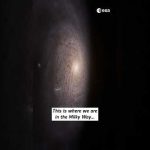
This stunning artist’s animation of the Milky Way is based on data from ESA’s Gaia space telescope. Gaia has completely reshaped our understanding of our home galaxy—revealing unexpected details about its spiral arms, central bar, and overall structure.
We can’t take a selfie of the Milky Way, but thanks to Gaia, we’re seeing it clearer than ever! And with more data releases on the way, our view will only get sharper.
This is a new artist’s animation of our galaxy, the Milky Way, based on data from ESA’s Gaia space telescope.
Gaia has changed our impression of the Milky Way. Even seemingly simple ideas about the nature of our galaxy’s central bar and the spiral arms have been overturned. Gaia has shown us that it has more than two spiral arms and that they are less prominent than we previously thought. In addition, Gaia has shown that its central bar is more inclined with respect to the Sun. No spacecraft can travel beyond our galaxy, so we can’t take a selfie, but Gaia is giving us the best insight yet of what our home galaxy looks like. Once all of Gaia’s observations collected over the past decade are made available in two upcoming data releases, we can expect an even sharper view of the Milky Way.
We are Europe’s gateway to space. Our mission is to shape the development of Europe’s space capability and ensure that investment in space continues to deliver benefits to the citizens of Europe and the world. Check out https://www.esa.int/ to get up to speed on everything space related.
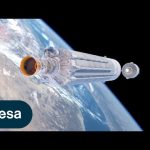
The animation shows the full launch sequence and timeline for the first Meteosat Third Generation Imager (MTG-I1) satellite. MTG-I1 launches on an Ariane 5 rocket from Europe’s Spaceport in Kourou, French Guiana.
MTG-I is the first of six satellites that form the full MTG system, which will provide critical data for weather forecasting over the next 20 years. In full operations, the mission will comprise two MTG-I satellites and one MTG Sounding (MTG-S) satellites working in tandem.
The MTG-I satellites carry two completely new instruments, a Flexible Combined Imager and Europe’s first Lightning Imager, to deliver high-quality data for better weather forecasting.
Credits: ESA/Mlabspace
★ Subscribe: http://bit.ly/ESAsubscribe and click twice on the bell button to receive our notifications.
We are Europe’s gateway to space. Our mission is to shape the development of Europe’s space capability and ensure that investment in space continues to deliver benefits to the citizens of Europe and the world. Check out https://www.esa.int/ to get up to speed on everything space related.
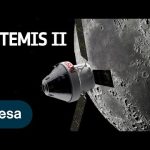
After the uncrewed Artemis I test flight, the Artemis II mission will have astronauts demonstrate what the Orion spacecraft – powered by a European Service Module – can do on its voyage around the Moon.
Two astronauts will fly on the second Artemis mission and take over controls to show how Orion handles at close-quarter flying. While in Earth orbit the spacecraft will detach from its second stage, fly away, turn around, approach the second stage and then fly away again – all using the European Service Module’s 33 thrusters.
Whereas in the first Artemis mission the second stage fired Orion into its lunar orbit, for the second mission it will be the European Service Module that will give the spacecraft its final push to its voyage around the Moon.
The crew will fly Orion to 8889 km beyond the Moon before completing a lunar flyby and returning to Earth. The mission will take a minimum of eight days and will collect valuable flight test data.
The European Service Module is one of ESA’s many contributions to NASA’s Orion spacecraft and the Artemis programme that will send astronauts to the Moon and beyond. It provides electricity, water, oxygen and nitrogen as well as keeping the spacecraft at the right temperature and on course.
The European Service Module has 33 thrusters, 11 km of electrical wiring, four propellant and two pressure tanks that all work together to supply propulsion and everything needed to keep astronauts alive far from Earth – there is no room for error.
★ Subscribe: http://bit.ly/ESAsubscribe and click twice on the bell button to receive our notifications.
We are Europe’s gateway to space. Our mission is to shape the development of Europe’s space capability and ensure that investment in space continues to deliver benefits to the citizens of Europe and the world. Check out https://www.esa.int/ to get up to speed on everything space related.
Meet Hera, our very own asteroid detective. Together with two CubeSats – Milani the rock decoder and Juventas the radar visionary – Hera is off on an adventure to explore Didymos, a double asteroid system that is typical of the thousands that pose an impact risk to planet Earth.
Suitable for kids and adults alike, this episode of ‘The Incredible Adventures of Hera’ details the miniaturised James-Bond-style technology that Hera and its CubeSats will carry aboard with them to explore their asteroid target.
We are Europe’s gateway to space. Our mission is to shape the development of Europe’s space capability and ensure that investment in space continues to deliver benefits to the citizens of Europe and the world. Check out https://www.esa.int/ to get up to speed on everything space related.