Tag: Space facts

  • Which planets have wind? 🌬️🪐

    Which planets have wind? 🌬️🪐

    Jupiter has super strong winds and massive storms, including the iconic Great Red Spot, a storm bigger than Earth! At the poles, winds can reach up to 1440 km/h.

    Saturn is even windier! It has some of the fastest, but not the fastest winds in our Solar System blow. Winds here can reach 1800 km/h.

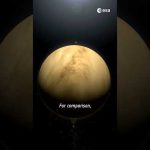
    Venus has super-rotating winds that race around the planet up to 60x faster than Venus itself spins. That’s way faster than Earth’s winds, which top out at 10–20% of our planet’s rotation speed.

    Mars has a thin atmosphere, so winds are usually gentle. But during dust storms, they can kick up to around 100 km/h.

    Neptune holds the record for the fastest winds in the Solar System, blowing at over 2000 km/h!

    For context: the fastest wind ever recorded on Earth? 408 km/h—during a massive tornado in Australia.

    📹 European Space Agency (ESA)
    📸 ESA/Voyager 2, NASA, NSSDC Photo Gallery ID P-34709C

    #ESA #Space #SolarSystem

  • How do foams behave in space? ⛓️ #shorts

    How do foams behave in space? ⛓️ #shorts

    On Earth, the mixture of gas and liquid that makes up a foam quickly starts to change. Gravity pulls the liquid between the bubbles downwards, and small bubbles shrink while the larger ones tend to grow at the expense of others. As the liquid is drawn downwards due to gravity the bubbles lose their strength and rupture, collapsing back to a liquid state.

    This is annoying for researchers as it limits the time they can study foams and interferes with their experiments. But in space foams are more stable as the liquid does not drain to the bottom in weightlessness.

    📹 @EuropeanSpaceAgency
    📸 ESA – European Space Agency

    #ESA #Foam #Space

  • What time is it on the Moon? 🕰️

    What time is it on the Moon? 🕰️

    A new era of lunar exploration is on the rise, with dozens of Moon missions planned for the coming decade. As these missions will be operating on and around the Moon and needing to communicate together and fix their positions independently from Earth, this new era will require its own time.

    Accordingly, space organisations have started considering how to keep time on the Moon. Having begun with a meeting at our technology centre in the Netherlands on November 2023, the discussion is part of a larger effort to agree a common ‘LunaNet’ architecture covering lunar communication and navigation services.

    ★ Subscribe: http://bit.ly/ESAsubscribe and click twice on the bell button to receive our notifications.

    Check out our full video catalog: http://bit.ly/SpaceInVideos
    Follow us on Twitter: http://bit.ly/ESAonTwitter
    On Facebook: http://bit.ly/ESAonFacebook
    On Instagram: http://bit.ly/ESAonInstagram
    On LinkedIn: https://bit.ly/ESAonLinkedIn
    On Pinterest: https://bit.ly/ESAonPinterest
    On Flickr: http://bit.ly/ESAonFlickr

    We are Europe’s gateway to space. Our mission is to shape the development of Europe’s space capability and ensure that investment in space continues to deliver benefits to the citizens of Europe and the world. Check out https://www.esa.int/ to get up to speed on everything space related.

    Copyright information about our videos is available here: https://www.esa.int/ESA_Multimedia/Terms_and_Conditions

    #ESA
    #LunarTime
    #WhatTimeIsIt