NASA’s SPHEREx and PUNCH missions are set to launch together, with one mission aiming to answer big-picture questions about our universe and the other seeking a better understanding of our Sun.
SPHEREx (Spectro-Photometer for the History of the Universe, Epoch of Reionization and Ices Explorer) is an infrared space telescope designed to map the entire sky like none before it. SPHEREx will study the origins of the universe, galaxies, and the ingredients for life in our galaxy.
PUNCH (Polarimeter to Unify the Corona and Heliosphere) is a constellation of four small satellites dedicated to studying the Sun’s outer atmosphere, the solar corona, and how it extends into space to form the solar wind. Understanding these processes is critical to predicting space weather and its impact on Earth’s magnetic field.
Together, SPHEREx and PUNCH demonstrate NASA’s commitment to uncovering the fundamental forces that shape our universe and our own star.
The double-satellite Proba-3 is the most ambitious member yet of ESA’s Proba family of experimental missions. Two spacecraft will fly together as one, maintaining precise formation down to a single millimetre. One will block out the fiery disc of the Sun for the other, to enable prolonged observations of the Sun’s surrounding atmosphere, or ‘corona’, the source of the solar wind and space weather. Usually, the corona can only be glimpsed for a few minutes during terrestrial total solar eclipses.
Proba-3 aims to reproduce such eclipses for up to six hours at a time, in a highly elliptical orbit taking it more than 60 000 km from Earth. The two spacecraft are being launched together by India’s PSLV-XL launcher from the Satish Dhawan Space Centre.
In the weekend of 10–12 May 2024, the biggest solar storm to hit Earth in over 20 years swept over our planet. This produced an intense geomagnetic storm, creating beautiful auroras.
The culprit? An active sunspot region called AR3664. As it rotated away from Earth’s view around 14 May, it sent out the strongest flare yet (class X8.79), causing large radio blackouts on Earth. But the fact that we could not see it anymore from Earth did not mean that this monster had gone to sleep.
Watching the Sun’s far side on 20 May, Solar Orbiter’s X-ray instrument STIX observed a massive flare with an estimated class of X12. This makes it the strongest flare yet of the current solar cycle, and in the top ten flares since 1996.
📹 ESA – European Space Agency 📸 ESA & NASA/Solar Orbiter/EUI
Aurora made a rare appearance across both the Northern and Southern Hemisphere skies after Earth was hit by one of the strongest geomagnetic storms for years. The storm over the weekend was classed as the highest G5.
Don’t worry if you missed them, we are entering a “solar maximum” where the Sun becomes very active meaning more storms and a greater chance of seeing Aurora in more places.
Let us know if and where you saw them in the comments👇
Did you know, the Northern lights or Aurora Borealis are created when the mythical Finnish ‘Firefox’ runs so quickly across the snow that its tail causes sparks to fly into the night sky? At least, that’s one of the stories that has been told in Finland about this beautiful phenomenon. Another that we love comes from the Sámi people of Finnish Lapland (among others), who describe them as plumes of water ejected by whales.
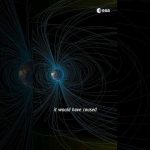
Today’s scientific explanation for the origin of the Aurora wasn’t thought up until the 20th Century, by the Norwegian scientist Kristian Birkeland. Charged particles, electrons and protons, are constantly emitted by the Sun, making up the solar wind. This wind slams into Earth’s ionosphere – sometimes sped up to vast speeds by solar storms – and the charged particles are deflected towards the poles by the magnetosphere.
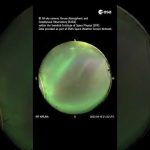
Molecules in our atmosphere then absorb energy from these charged particles from the Sun, and re-release it in their own unique set of colours. Oxygen produces green, but at high altitudes can create red, nitrogen creates blues, and colours can overlap creating purple. Waves, twists and streams are caused by variations in Earth’s magnetic fields. This striking video shows the Aurora over Kiruna, the northernmost city in Sweden. It’s composed of images taken by the Kiruna all-sky camera every minute for about ten hours over 18-19 September 2023.
The all-sky auroral camera is operated by the Kiruna Atmospheric and Geophysical Observatory (KAGO) within the Swedish Institute of Space Physics (IRF), and data from here is provided as part of ESA’s network of space weather services within the Agency’s Space Safety Programme. A sequence of multiple coronal mass ejections – large, sudden ejections of plasma and magnetic field from the Sun – recently struck Earth, and we are still recovering from the passage of the last of them. The fastest was travelling at around 700 km/s, which is considered a small event.
Solar storms are causing an increase in geomagnetic activity; temporary disturbances in Earth’s magnetosphere, which has led to increased light shows at Earth’s poles.
Credits: All-sky camera, Kiruna Atmospheric and Geophysical Observatory (KAGO) within the Swedish Institute of Space Physics (IRF). Data provided as part of ESA’s Space Weather Service Network.
Recently, Andreas Mogensen, now getting ready for his ‘Huginn’ mission to the ISS in 2023, stopped by ESA’s ESOC mission control centre in Darmstadt, Germany, to meet with some of the experts who keep our satellites flying.
Andreas usually works at NASA’s Johnson Space Center in Houston as an ISS ‘capcom’, and we don’t often see him in Europe. A few months back, while returning to Germany for some training at ESA’s Astronaut Centre in Cologne, we seized the opportunity to ask him if he’d like to stop over in Darmstadt for a look behind the scenes at mission control, and he immediately answered, ‘yes’!
Andreas’ studied aeronautical engineering with a focus on ‘guidance, navigation and control of spacecraft’ and we thought he’d be delighted to meet with the teams at mission control doing precisely that sort of work for our robotic missions.
We figured he’d also enjoy meeting colleagues from our Space Safety programme, especially the ones working on space debris and space weather, as these are crucial areas that influence the daily life of astronauts on the ISS.
Andreas met with Bruno Sousa and Julia Schwartz, who help keep Solar Orbiter healthy and on track on its mission to gather the closest-ever images of the Sun, observe the solar wind and our Star’s polar regions, helping unravel the mysteries of the solar cycle.
He also met with Stijn Lemmens, one of the analysts keeping tabs on the space debris situation in orbit, and Melanie Heil, a scientist helping ESA understand how space weather and our active Sun can affect missions in orbit and crucial infrastructure – like power grids – on ground.
We hope you enjoy this lively and informative day at mission control as much as Andreas and the teams at ESOC did!
★ Subscribe: http://bit.ly/ESAsubscribe and click twice on the bell button to receive our notifications.
We are Europe’s gateway to space. Our mission is to shape the development of Europe’s space capability and ensure that investment in space continues to deliver benefits to the citizens of Europe and the world. Check out https://www.esa.int/ to get up to speed on everything space related.
This sequence was taken by Solar Orbiter’s Extreme Ultraviolet Imager using the Full Sun Imager telescope, and shows the Sun at a wavelength of 17 nanometers. This wavelength is emitted by gas in the Sun’s atmosphere with a temperature of around one million degrees. The colour on this image has been artificially added because the original wavelength detected by the instrument is invisible to the human eye.
Credit: ESA & @NASA /Solar Orbiter/EUI Team
★ Subscribe: http://bit.ly/ESAsubscribe and click twice on the bell button to receive our notifications.
We are Europe’s gateway to space. Our mission is to shape the development of Europe’s space capability and ensure that investment in space continues to deliver benefits to the citizens of Europe and the world. Check out https://www.esa.int/ to get up to speed on everything space related.
Solar Orbiter has made the first ever remote sensing observation consistent with a magnetic phenomenon called a solar switchback – sudden and large deflections of the solar wind’s magnetic field. The new observation provides a full view of the structure, in this case confirming it has an S-shaped character, as predicted. Furthermore, the global perspective provided by the Solar Orbiter data indicates that these rapidly changing magnetic fields can have their origin near the surface of the Sun.
We are Europe’s gateway to space. Our mission is to shape the development of Europe’s space capability and ensure that investment in space continues to deliver benefits to the citizens of Europe and the world. Check out https://www.esa.int/ to get up to speed on everything space related.
Solar Orbiter is a space mission of international collaboration between ESA and @NASA.
Solar Orbiter’s closest approach to the Sun, known as perihelion, took place on 26 March. The spacecraft was inside the orbit of Mercury, at about one-third the distance from the Sun to the Earth, and its heatshield was reaching around 500°C. But it dissipated that heat with its innovative technology to keep the spacecraft safe and functioning.
It’s the first mission of its kind, set to monitor our active and unpredictable Sun and help protect us from its violent outbursts – and it has a new name.
Once known as “Lagrange,” ESA’s upcoming space weather mission needed a new name that would reflect its vital role: helping to protect Earth’s infrastructure, satellites, inhabitants and space explorers from unpredictable but violent solar events like solar flares and ‘coronal mass ejections’.
During the Name The Mission campaign, 5422 entries were submitted from across Europe and indeed around the world – and after weeks of deliberation, countless spreadsheets, three diverse and expert judges and a lively debate – a new name has been selected for our upcoming space weather mission: ESA Vigil.
“We are thrilled with our mission’s new name,” explains Juha-Pekka Luntama, ESA’s Head of Space Weather.
“When I first heard it, I thought it was just spot on. That is exactly what we do, we keep a vigilant watch and guard Earth”.
In Latin, ‘vigilis exceptus’ means sentry, or guard, while ‘vigilia’ means wakefulness and the act of keeping a devoted watch, which resonates with the mission’s role – a devoted guardian, keeping constant watch over the Sun, for Earth.
Protecting modern life, and life itself
Solar storms can damage power grids, disrupt telecommunications and threaten satellites and the vital services they provide. At the same time, as we launch ever-more satellites into orbit we are creating increasing amounts of debris – dramatically increasing the risks of collision for current and future missions.
These satellites have changed our lives and enlarged our perspective on Earth, but they – and the technologies they make possible on which modernity relies – are vulnerable.
The protection of space assets is at the heart of ESA’s Vision for the future. To do this, the new Protect ‘accelerator’ proposes the development of ‘air traffic control for space’, as well as an early warning system to help us prepare for hazardous solar activity.
We are Europe’s gateway to space. Our mission is to shape the development of Europe’s space capability and ensure that investment in space continues to deliver benefits to the citizens of Europe and the world. Check out https://www.esa.int/ to get up to speed on everything space related.
It’s the first mission of its kind, set to monitor our active and unpredictable Sun and help protect us from its violent outbursts – and it has a new name.
Once known as “Lagrange,” ESA’s upcoming space weather mission needed a new name that would reflect its vital role: helping to protect Earth’s infrastructure, satellites, inhabitants and space explorers from unpredictable but violent solar events like solar flares and ‘coronal mass ejections’.
During the Name The Mission campaign, 5422 entries were submitted from across Europe and indeed around the world – and after weeks of deliberation, countless spreadsheets, three diverse and expert judges and a lively debate – a new name has been selected for our upcoming space weather mission: ESA Vigil.
“We are thrilled with our mission’s new name,” explains Juha-Pekka Luntama, ESA’s Head of Space Weather.
“When I first heard it, I thought it was just spot on. That is exactly what we do, we keep a vigilant watch and guard Earth”.
In Latin, ‘vigilis exceptus’ means sentry, or guard, while ‘vigilia’ means wakefulness and the act of keeping a devoted watch, which resonates with the mission’s role – a devoted guardian, keeping constant watch over the Sun, for Earth.
Protecting modern life, and life itself
Solar storms can damage power grids, disrupt telecommunications and threaten satellites and the vital services they provide. At the same time, as we launch ever-more satellites into orbit we are creating increasing amounts of debris – dramatically increasing the risks of collision for current and future missions.
These satellites have changed our lives and enlarged our perspective on Earth, but they – and the technologies they make possible on which modernity relies – are vulnerable.
The protection of space assets is at the heart of ESA’s Vision for the future. To do this, the new Protect ‘accelerator’ proposes the development of ‘air traffic control for space’, as well as an early warning system to help us prepare for hazardous solar activity.
We are Europe’s gateway to space. Our mission is to shape the development of Europe’s space capability and ensure that investment in space continues to deliver benefits to the citizens of Europe and the world. Check out https://www.esa.int/ to get up to speed on everything space related.
We are Europe’s gateway to space. Our mission is to shape the development of Europe’s space capability and ensure that investment in space continues to deliver benefits to the citizens of Europe and the world. Check out https://www.esa.int/ to get up to speed on everything space related.
Space weather describes the changing environment throughout the Solar System, driven by the energetic and unpredictable nature of our Sun. Solar wind, solar flares and Coronal Mass Ejections can result in geomagetic storms on Earth, potentially damaging satellites in space and the technologies that rely on them, as well as infrastructure on the ground.
ESA’s future Lagrange mission will keep constant watch on the Sun. The satellite, located at the fifth Lagrange point, will send early warning of potentially harmful solar activity before it affects satellites in orbit or power grids on the ground, giving operators the time to act to protect vital infrastructure.
ESA is now working with European industry to assess options for the spacecraft and its mission, with initial proposals expected early in 2020.
Our star dominates the environment within our Solar System. Unpredictable and temperamental, the Sun has made life on the inner-most planets impossible, due to the intense radiation and colossal amounts of energetic material it blasts in every direction, creating the ever-changing conditions in space known as ‘space weather’.