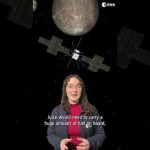
When a spacecraft launches on a mission to another planet it must first break free of the Earth’s gravitational field. Once it has done that, it enters interplanetary space, where the dominant force is the gravitational field of the Sun.
The spacecraft begins to follow a curving orbit, around the Sun, which is similar to the orbit of a comet. When this orbit brings it close to its target destination the spacecraft must fire a retrorocket to slow down and allow itself to be captured by the gravitational field of its target. The smaller the target, the more the spacecraft must slow down.
Sometimes passing a planet can result in the spacecraft being accelerated, even without the spacecraft firing any of its thrusters. This is known as the ‘slingshot’ effect. Such ‘gravity assist’ manoeuvres are now a standard part of spaceflight and are used by almost all our interplanetary missions. They take advantage of the fact that the gravitational attraction of the planets can be used to change the trajectory and speed of a spacecraft.
The amount by which the spacecraft speeds up or slows down is determined by whether it is passing behind or in front of the planet as the planet follows its orbit. When the spacecraft leaves the influence of the planet, it follows an orbit on a different course than before.
📹 @EuropeanSpaceAgency
★ Subscribe: http://bit.ly/ESAsubscribe and click twice on the bell button to receive our notifications.
We are Europe’s gateway to space. Our mission is to shape the development of Europe’s space capability and ensure that investment in space continues to deliver benefits to the citizens of Europe and the world. Check out https://www.esa.int/ to get up to speed on everything space related.
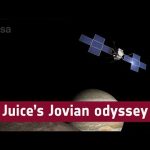
Juice, ESA’s Jupiter Icy Moons Explorer, is set to embark on a seven-year cruise to Jupiter starting May 2022. The mission will investigate the emergence of habitable worlds around gas giants and the Jupiter system as an archetype for the numerous giant planets now known to orbit other stars.
This animation depicts the journey to Jupiter and the highlights from its foreseen tour of the giant planet and its large ocean-bearing moons.
An Ariane 5 will lift Juice into space from Europe’s Spaceport in Kourou. A series of gravity-assist flybys at Earth (3), Venus (1) and Mars (1) will set the spacecraft on course for its October 2029 rendezvous in the Jovian system.
It is expected that a number of instruments will be activated during the gravity assists (indicated by the different coloured beams scanning across the planets) and measurements will be taken for calibration and to check the health of the instruments. The visualisations of the Earth flybys show the closest approaches over the planet according to current planning – over the South Pacific Ocean, Argentina and Peru, respectively. Throughout the animation, the instrument beam colours correspond to example observations by JANUS (green), MAJIS (red), UVS (purple), Gala (Blue) and RIME (grey), which are cameras, spectrometers, laser altimeter and radar.
During the Venus flyby, limited observations can be made because the spacecraft will be oriented to protect it from the heat of the Sun experienced in the inner Solar System. The Mars flyby will see Juice fly over the planet’s south pole to make scientific observations.
Juice will start its science mission about six months prior to arriving in orbit around the gas giant, making observations as it approaches its destination. Once in the Jovian system, a gravity-assist flyby of Jupiter’s largest moon Ganymede – the largest moon in the Solar System – helps Juice enter orbit around the gas giant 7.5 hours later.
While in Jupiter orbit, the spacecraft will study the Jovian system as an archetype for gas giants, making observations of its atmosphere, the magnetosphere, its rings and satellites.
During the tour, Juice will make two flybys of Europa, which has strong evidence for an ocean of liquid water under its icy shell. Juice will look at the moon’s active zones, its surface composition and geology, search for pockets of liquid water under the surface and study the plasma environment around Europa.
A sequence of Callisto flybys will not only be used to study this ancient, cratered world that may too harbor a subsurface ocean, but it will change the angle of Juice’s orbit with respect to Jupiter’s equator, making it possible to investigate the polar regions and environment at higher latitudes.
During the tour there will also be unique periods to observe events such as moon transits. The example in this animation shows Europa and Io passing in front of Jupiter on 27 January 2032. This type of event is rare, with less than 10 expected to occur during Juice’s tour of the Jovian system.
A sequence of Ganymede and Callisto flybys will adjust the orbit of Juice to enable it to enter orbit around Ganymede, marking it the first spacecraft to orbit another planet’s moon (aside from our own). The elliptical orbit will be followed by a 5000 km altitude cicular orbit, and later a 500 km circular orbit.
Ganymede is unique in the Solar System in that it is the only moon to have a magnetosphere. Juice will investigate this phenomenon and the moon’s internal magnetic field, and the interaction of its plasma environment with that of Jupiter. Juice will also study the moon’s atmosphere, surface, subsurface, interior and its internal ocean, investigating the moon as a planetary object and possible habitat.
Over time the 500 km orbit will naturally decay – eventually there will not be enough propellant to maintain it – and it will make a grazing impact on the surface. The animation concludes with an example of what the approach to impact could look like.
★ Subscribe: http://bit.ly/ESAsubscribe and click twice on the bell button to receive our notifications.
ESA is Europe’s gateway to space. Our mission is to shape the development of Europe’s space capability and ensure that investment in space continues to deliver benefits to the citizens of Europe and the world. Check out http://www.esa.int/ESA to get up to speed on everything space related.