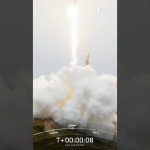
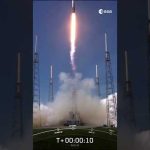
ESA’s EarthCARE satellite lifted off on a SpaceX Falcon 9 rocket from the Vandenberg Space Force Base in California, US, on 29 May at 00:20 CEST (28 May, 15:20 local time).
Developed as a cooperation between ESA and the Japan Aerospace Exploration Agency (JAXA), the Earth Cloud Aerosol and Radiation Explorer satellite carries a set of four instruments to make a range of different measurements that together will shed new light on the role that clouds and aerosols play in regulating Earth’s climate.
ESA’s EarthCARE mission is ready for lift-off! EarthCARE is a groundbreaking satellite mission designed to unravel the mysteries of Earth’s clouds and aerosols. EarthCARE will shed light on the role that clouds and aerosols play in heating and cooling Earth’s atmosphere – contributing to our better understanding of climate change. During our live coverage, we’ll hear from mission scientists and spacecraft operators, then follow the launch on a SpaceX Falcon 9 from California, expected at 00:20 CEST. Live from ESA’s spacecraft operations centre in Germany, we take you into the main control room around 01:12 CEST for the satellite’s acquisition of signal – EarthCARE’s first sign of life from space.
Credits: ESA/SpaceX
Timestaps of the video: 00:00 – 38:24 – Start of ESA WebTV Programme – Live from the European Space Operations Centre 38:25 – 50:44 – SpaceX live broadcast begins 50:45 – 1:01:40 – Lift-off 1:01:41 – 1:06:35 – Spacecraft deployment 1:06:36 – 1:40:40 – Stay tuned 1:40:41 – 1:44:50 – ESA WebTV Programme – Live from the European Space Operations Centre 1:44:51 – 1:55:00 – Acquisition of signal
★ Subscribe: http://bit.ly/ESAsubscribe and click twice on the bell button to receive our notifications.
We are Europe’s gateway to space. Our mission is to shape the development of Europe’s space capability and ensure that investment in space continues to deliver benefits to the citizens of Europe and the world. Check out https://www.esa.int/ to get up to speed on everything space related.
ESA’s latest astrophysics mission, Euclid, lifted off on a Space X Falcon 9 from Cape Canaveral in Florida, USA, at 17:12 CEST on 1 July 2023.
Euclid has now started its month-long journey to Sun-Earth Lagrange point L2, located 1.5 million kilometres from Earth, in the opposite direction from the Sun.
The telescope will survey one third of the sky with unprecedented accuracy and sensitivity. By observing billions of galaxies out to 10 billion light-years, it will create the most extensive 3D-map of the Universe, with the third dimension representing time.
ESA’s Euclid mission is designed to explore the composition and evolution of the dark Universe. Euclid will chart how the Universe has expanded and how large-scale structure is distributed across space and time, revealing more about the role of gravity and the nature of dark energy and dark matter.
Four weeks after launch, Euclid will enter its orbit around L2. Once in orbit, mission controllers will start the activities to verify all functions of the spacecraft, check out the telescope and finally turn the instruments on. Following this, scientists and engineers will be engaged in an intense two-month phase of testing and calibrating Euclid’s scientific instruments, and preparing for routine observations. The telescope begins its early phase of the survey of the Universe three months after launch.
We are Europe’s gateway to space. Our mission is to shape the development of Europe’s space capability and ensure that investment in space continues to deliver benefits to the citizens of Europe and the world. Check out https://www.esa.int/ to get up to speed on everything space related.
ESA’s latest astrophysics mission, Euclid, lifted off on a Space X Falcon 9 from Cape Canaveral in Florida, USA, at 17:12 CEST on 1 July 2023.
Euclid has now started its month-long journey to Sun-Earth Lagrange point L2, located 1.5 million kilometres from Earth, in the opposite direction from the Sun.
The telescope will survey one third of the sky with unprecedented accuracy and sensitivity. By observing billions of galaxies out to 10 billion light-years, it will create the most extensive 3D-map of the Universe, with the third dimension representing time.
ESA’s Euclid mission is designed to explore the composition and evolution of the dark Universe. Euclid will chart how the Universe has expanded and how large-scale structure is distributed across space and time, revealing more about the role of gravity and the nature of dark energy and dark matter.
Four weeks after launch, Euclid will enter its orbit around L2. Once in orbit, mission controllers will start the activities to verify all functions of the spacecraft, check out the telescope and finally turn the instruments on. Following this, scientists and engineers will be engaged in an intense two-month phase of testing and calibrating Euclid’s scientific instruments, and preparing for routine observations. The telescope begins its early phase of the survey of the Universe three months after launch.
We are Europe’s gateway to space. Our mission is to shape the development of Europe’s space capability and ensure that investment in space continues to deliver benefits to the citizens of Europe and the world. Check out https://www.esa.int/ to get up to speed on everything space related.
Watch a replay of the launch broadcast for ESA’s Euclid.
ESA’s Euclid mission was launched into space on a SpaceX Falcon 9 from Cape Canaveral in Florida, USA, on 1 July 2023. It is now on its way to Sun-Earth Lagrange point L2.
By observing billions of galaxies out to 10 billion light-years, the space telescope will create the most detailed 3D-map of the Universe, with time as the third dimension.
The launch broadcast programme includes live segments from the launch site and ESA’s European Spacecraft Operations Centre (ESOC) in Darmstadt, Germany.
Credits: ESA/SpaceX
00:00 – 45:35 Pre-launch programmes 45:35 – 55:00 Lift-off 55:00 – 01:27:00 Booster landing in the ocean 01:27:00 – 01:31:00 Euclid space craft separation 01:31:00 – 01:42:29 Acquisition of Signal (AOS)
★ Subscribe: http://bit.ly/ESAsubscribe and click twice on the bell button to receive our notifications.
We are Europe’s gateway to space. Our mission is to shape the development of Europe’s space capability and ensure that investment in space continues to deliver benefits to the citizens of Europe and the world. Check out https://www.esa.int/ to get up to speed on everything space related.