Tag: star formation

  • SPHEREx & PUNCH: Studying the Universe and Sun (NASA Mission Trailer)

    SPHEREx & PUNCH: Studying the Universe and Sun (NASA Mission Trailer)

    NASA’s SPHEREx and PUNCH missions are set to launch together, with one mission aiming to answer big-picture questions about our universe and the other seeking a better understanding of our Sun.

    SPHEREx (Spectro-Photometer for the History of the Universe, Epoch of Reionization and Ices Explorer) is an infrared space telescope designed to map the entire sky like none before it. SPHEREx will study the origins of the universe, galaxies, and the ingredients for life in our galaxy.

    PUNCH (Polarimeter to Unify the Corona and Heliosphere) is a constellation of four small satellites dedicated to studying the Sun’s outer atmosphere, the solar corona, and how it extends into space to form the solar wind. Understanding these processes is critical to predicting space weather and its impact on Earth’s magnetic field.

    Together, SPHEREx and PUNCH demonstrate NASA’s commitment to uncovering the fundamental forces that shape our universe and our own star.

    For more information on the missions, visit:
    https://nasa.gov/SPHEREx
    https://nasa.gov/punch

    Credit: NASA/JPL-Caltech/GSFC/KSC

  • How the Large Magellanic Cloud survived a galactic collision! 🌌

    How the Large Magellanic Cloud survived a galactic collision! 🌌

    Did you know the Large Magellanic Cloud, one of our galaxy’s closest neighbors, survived a dramatic collision with the Milky Way’s gaseous halo? Despite losing most of its gas, the Large Magellanic Cloud is still forming new stars—a testament to its resilience! Thanks to Hubble Space Telescope, astronomers measured the Large Magellanic Cloud’s halo for the first time, revealing incredible insights about galaxy interactions.

    📹 ESA – European Space Agency
    📸 NASA, ESA, R. Crawford

    #ESA #Hubble #LargeMagellanicCloud

  • Zoom Into the Tarantula Nebula ✨ #shorts

    Zoom Into the Tarantula Nebula ✨ #shorts

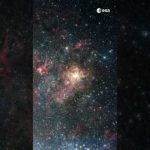
    This video takes the viewer on a journey that zooms through space to reveal the Tarantula Nebula.

    Thousands of never-before-seen young stars are spotted in the stellar nursery called 30 Doradus, captured by the NASA/ESA/CSA James Webb Space Telescope. It is nicknamed the Tarantula Nebula for the appearance of its dusty filaments in previous telescope images, the nebula has long been a favourite for astronomers studying star formation. In addition to young stars, Webb reveals distant background galaxies, as well as the detailed structure and composition of the nebula’s gas and dust.

    Credit: NASA, ESA, CSA, STScI, ESO, E. Slawik, N. Risinger, D. De Martin, D. Lennon, E. Sabbi, N. Bartmann, M. Zamani
    Music: tonelabs – Happy Hubble

    #ESA #Webb #TarantulaNebula

  • Happy Halloween! 🎃🕷️ #TarantulaNebula

    Happy Halloween! 🎃🕷️ #TarantulaNebula

    In this mosaic image stretching 340 light-years across, Webb’s Near-Infrared Camera (NIRCam) displays the Tarantula Nebula star-forming region in a new light, including tens of thousands of never-before-seen young stars that were previously shrouded in cosmic dust. The most active region appears to sparkle with massive young stars, appearing pale blue. Scattered among them are still-embedded stars, appearing red, yet to emerge from the dusty cocoon of the nebula. NIRCam is able to detect these dust-enshrouded stars thanks to its unprecedented resolution at near-infrared wavelengths.

    📹 ESA – European Space Agency
    📸 NASA, ESA, CSA, and STScI, N. Bartmann
    🎶 Haunted House – Goosebumps

    #ESA #Halloween #Webb