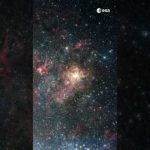
This video takes the viewer on a journey that zooms through space to reveal the Tarantula Nebula.
Thousands of never-before-seen young stars are spotted in the stellar nursery called 30 Doradus, captured by the NASA/ESA/CSA James Webb Space Telescope. It is nicknamed the Tarantula Nebula for the appearance of its dusty filaments in previous telescope images, the nebula has long been a favourite for astronomers studying star formation. In addition to young stars, Webb reveals distant background galaxies, as well as the detailed structure and composition of the nebula’s gas and dust.
Credit: NASA, ESA, CSA, STScI, ESO, E. Slawik, N. Risinger, D. De Martin, D. Lennon, E. Sabbi, N. Bartmann, M. Zamani Music: tonelabs – Happy Hubble
Thousands of never-before-seen young stars are spotted in a stellar nursery called 30 Doradus, captured by the @NASA/ESA/@Canadian Space Agency James Webb Space Telescope. Nicknamed the Tarantula Nebula for the appearance of its dusty filaments in previous telescope images, the nebula has long been a favourite for astronomers studying star formation. In addition to young stars, Webb reveals distant background galaxies, as well as the detailed structure and composition of the nebula’s gas and dust.
We are Europe’s gateway to space. Our mission is to shape the development of Europe’s space capability and ensure that investment in space continues to deliver benefits to the citizens of Europe and the world. Check out https://www.esa.int/ to get up to speed on everything space related.
Each year, the NASA/ESA Hubble Space Telescope dedicates a small portion of its precious observing time to taking a special anniversary image, showcasing particularly beautiful and meaningful objects. These images continue to challenge scientists with exciting new surprises and to enthral the public with ever more evocative observations.
To celebrate Hubble’s 30th anniversary, let’s look back at the beauty and science behind each of the anniversary images unveiled as of 2005. In this video, we will also feature the very special 2020 Hubble Space Telescope 30th anniversary image.
Credit:
Directed by: Bethany Downer
Visual design and editing: Martin Kornmesser
Written by: Bethany Downer
Narration: Sara Mendes da Costa
Images & VIdeos: NASA, ESA, M.Kornmesser, L. Calçada, ESO, NAOJ, G. Bacon, L. Frattare, Z. Levay and F. Summers (STScI/AURA), D. Lennon and E. Sabbi (ESA/STScI), J. Anderson, S.E. de Mink, R. van der Marel, T. Sohn, and N. Walborn (STScI), L. Bedin (INAF, Padua), C. Evans (STFC), H. Sana (Amsterdam), N. Langer (Bonn), P. Crowther (Sheffield), A. Herrero (IAC, Tenerife), N. Bastian (USM, Munich), and E. Bressert (ESO), the Hubble Heritage Team, T. Davis, L. Frattare, Z. Levay, (Viz 3D team, STScI), J. Anderson (STScI), the Hubble Heritage Team (STScI/AURA), A. Nota (ESA/STScI), and the Westerlund 2 Science Team, Eckhard Slawik (e.slawik@gmx.net).
Music: Johan B. Monell (www.johanmonell.com
Web and technical support: Raquel Yumi Shida
Executive producer: Mariya Lyubenova
★ Subscribe: http://bit.ly/ESAsubscribe and click twice on the bell button to receive our notifications.
We are Europe’s gateway to space. Our mission is to shape the development of Europe’s space capability and ensure that investment in space continues to deliver benefits to the citizens of Europe and the world. Check out http://www.esa.int/ESA to get up to speed on everything space related.
On 24 April 1990 the NASA/ESA Hubble Space Telescope was sent into orbit aboard the space shuttle Discovery, the first space telescope of its kind. It offered a new view of the Universe and has, for 30 years, reached and surpassed all expectations, beaming back data and images that have changed scientists’ understanding of the Universe and the public’s perception of it. Hubble’s discoveries have revolutionised nearly all areas of current astronomical research, from planetary science to cosmology, and its pictures are unmistakably out of this world.
This video revisits some of Hubble’s biggest science discoveries throughout its three decades of operation to celebrate the telescope’s 30th anniversary.
Credit:
Directed by: Bethany Downer
Visual design and editing: Martin Kornmesser
Written by: Bethany Downer
Narration: Sara Mendes da Costa
Images & Videos: NASA, ESA, M.Kornmesser, L. Calçada, ESO, G. Bacon (STScI), theHubble Heritage Team (STScI/AURA)-ESA/Hubble Collaboration, and H. Bond (STScI and Pennsylvania State University), A. Feild (STScI), and A. Riess (STScI/JHU), D. Jewitt (UCLA), F. Summers, Z. Levay, J. DePasquale, L. Hustak, L. Frattare, M. Robberto (STScI), R. Hurt (Caltech/IPAC) Acknowledgement: R. Gendler, spaceengine.org.
Music: Johan B. Monell (www.johanmonell.com)
Web and technical support: Raquel Yumi Shida
Executive producer: Mariya Lyubenova
★ Subscribe: http://bit.ly/ESAsubscribe and click twice on the bell button to receive our notifications.
We are Europe’s gateway to space. Our mission is to shape the development of Europe’s space capability and ensure that investment in space continues to deliver benefits to the citizens of Europe and the world. Check out http://www.esa.int/ESA to get up to speed on everything space related.
This month marks the 30th anniversary of the international Hubble Space Telescope.
Launched on 24 April 1990, and deployed from the Space Shuttle Discovery cargo bay a day later (25 April 1990), the telescope has given us a new perspective on the Universe.
The joint NASA/ESA mission has shown us distant galaxies and spectacular nebulae. It has revealed supermassive black holes and planets in distant solar systems; and has proved that the Universe is not only expanding, the expansion is accelerating.
Hubble’s mission has also been eventful. When it was first launched, a defect in the mirror meant it sent back blurry images. Since then, five servicing missions have enabled the telescope to be improved and upgraded. Today, it is still going strong.
We are Europe’s gateway to space. Our mission is to shape the development of Europe’s space capability and ensure that investment in space continues to deliver benefits to the citizens of Europe and the world. Check out http://www.esa.int/ESA to get up to speed on everything space related.