Tag: sunrise

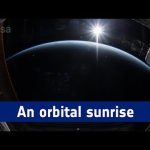
  • Horizons mission time-lapse – an orbital sunrise

    Horizons mission time-lapse – an orbital sunrise

    Orbiting Earth once every 90 minutes, the International Space Station soars into 16 sunrises and sunsets every single day. Many of these sunrises occur while the crew is working or sleeping, but ESA astronaut Alexander Gerst captured this stunning timelapse of a sunrise to share with us here on Earth.

    These photos were taken by Alexander at an interval of two per second and the video has been edited at 25 frames per second.

    Music: First Survivors 4 by Los Angeles-based British composer, Luke Richards. Sourced from Audio Network Limited.

    ★ Subscribe: http://bit.ly/ESAsubscribe

    Follow Alexander and the Horizons mission on social media via http://bit.ly/AlexanderGerstESA and on http://bit.ly/HorizonsBlogESA.
  • Lightning, aurora and sunrise timelapse

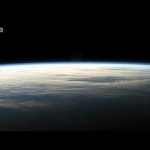
    Lightning, aurora and sunrise timelapse

    This timelapse video from space has it all: an orbit of Earth with lightning and aurora, followed by a space sunrise and daytime views of our cloudy planet. The images were taken by ESA astronaut Alexander Gerst as he orbited Earth on the International Space Station at around 400 km altitude. The nighttime video shows a Soyuz spacecraft that ferries the astronauts to the outpost. At the end of the video green aurora can be seen as Earth’s interacts with solar radiation.

    The International Space Station travels at 28 800 km/h meaning that it only takes 90 minutes to circle Earth completely. Each orbit the Station moves around 2200 km to the West in relation to 90 minutes before.

    Astronauts often use normal consumer digital cameras to take pictures of Earth through Europe’s observatory module Cupola in their spare time. Setting the camera to take an image every few seconds and then playing the images back quickly create this timelapse effect.

    Alexander worked as a geophysicist and volcanologist before he was chosen as an ESA astronaut in 2009. His Blue Dot mission includes an extensive scientific programme of experiments in physical science, biology, and human physiology as well as radiation research and technology demonstrations. All experiments chosen make use of the out-of-this-world laboratory to improve life on Earth or prepare for further human exploration of our Solar System.

  • Winter at the Concordia station in Antarctica

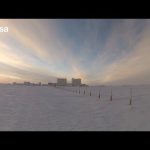
    Winter at the Concordia station in Antarctica

    The long Antarctic winter is turning to spring at the Franco-Italian Concordia research station, which has resisted the brutal forces of nature about 1200 km inland on top of an icy plateau 3000 m above sea level. During winter, the Sun doesn’t rise above the horizon for about three months, and temperatures can drop down to -80°C.

    This video shows the harsh but beautiful landscape around the station on one of the last sunny days in May and then how the darkness engulfed Concordia with its 12-strong winter-over team. Finally the Sun returned on 10 August — a memorable moment for the men and women who keep the station running and conduct the scientific work in those difficult, almost space-like conditions.

    The video was shot by Olivier Delanoe and it includes excerpts from the letters sent by Antonio Litterio to ESA’s Concordia blog.