Tag: tess

  • Invitata mea a descoperit o exoplanetă! 🪐 Diana Dragomir, o cercetătoare care explorează alte lumi

    Invitata mea a descoperit o exoplanetă! 🪐 Diana Dragomir, o cercetătoare care explorează alte lumi

    ❗Alege TU următorul subiect! ► https://tinyurl.com/cristianpresura
    ❗Devino membru ► https://tinyurl.com/membruyoutube
    ❗Primește răspunsuri direct pe whatsapp ► https://patreon.com/cristianpresura

    🔸 PAYPAL ► paypal.me/cristianpresura
    🔸 DONORBOX ► https://donorbox.org/cristianpresura

    ❗TikTok ► https://www.tiktok.com/@cristian.presura
    ❗Facebook ► https://www.facebook.com/presura
    ❗Facebook page ► https://www.facebook.com/stiintaclub
    ❗Instagram ► https://www.instagram.com/cristianpresura/
    ❗Twitch ► https://www.twitch.tv/cristian_presura
    ❗Discord ► https://www.discord.gg/presura
    ❗Reddit ► https://www.reddit.com/r/presura/

    📙 Carte ► “Fizica Povestita”: https://bit.ly/2YsKaAc
    📙 Carte ► “O calatorie prin Univers”: https://bit.ly/3pdOfGp
    📙 Carte ► “Care e diferența dintre un copil și un laptop?” https://bit.ly/3h4auLZ

    🔊 Spotify Podcast ► https://spoti.fi/3dbvYo6
    🔊 MixCloud Podcas ► https://www.mixcloud.com/StiintaClub/
    ❗Asociația “Știinta pentru toți” ► https://www.presura.ro/

    Seria Fizica Cool #seriacool https://tinyurl.com/2s437srj
    Seria shorts: https://tinyurl.com/yw8b4sab
    Seria carte “Fizica Povestită” #fizicapovestita https://tinyurl.com/966kzam9
    Seria „Dicţionarul de idei şi ideologii (#2i)”: https://tinyurl.com/muryddb5
    Seria “Deschis la cercetare”: https://tinyurl.com/2p9dtb6k
    Fizica pentru începători: https://tinyurl.com/4xbc67c2
    Fizica cuantică: https://tinyurl.com/mr2d7acu
    Fizica nucleara: https://tinyurl.com/3yv3kr5r
    Fizica spațiului: https://tinyurl.com/3kc5jz95
    Călătorie prin Univers: https://tinyurl.com/mv6sxxrb
    Teoria relativității: https://tinyurl.com/2m8umyew
    Fizica simplă: https://tinyurl.com/24j6ekje
    Fizica avansată: https://tinyurl.com/39chd56e
    Fizica mediului inconjurator: https://tinyurl.com/5n86xdzc
    Cum sa ne protejam? https://tinyurl.com/mmyvr3n7
    Fizica 5G: https://tinyurl.com/2p9b3j6r
    Podcast “Întâlnirea cu fizica”: https://tinyurl.com/5n8hsswe

    algoritm:” Exoplanetele sunt planete care orbitează în jurul unei stele, alta decât Soarele. Descoperirea și studiul lor se bazează pe metode diverse, dintre care metoda tranzitului este cea mai utilizată. Atunci când o planetă trece prin fața stelei, lumina acesteia scade ușor. Prin analizarea acestei variații de strălucire, astronomii pot determina mărimea și orbita planetei.

    Instrumente precum TESS (Transiting Exoplanet Survey Satellite) contribuie la descoperirea de noi exoplanete, iar telescopul James Webb Space Telescope permite studierea atmosferelor acestora. În special, planetele stâncoase mici, similare cu Pământul, aflate în zona locuibilă, sunt candidate importante în căutarea vieții extraterestre. Zona locuibilă este regiunea din jurul unei stele unde temperatura permite existența apei lichide.

    Printre cele mai comune exoplanete descoperite se numără superpământurile și sub-Neptunii, planete cu dimensiuni între Pământ și Neptun. În funcție de radiația primită de la stea, aceste planete pot fi fie gazoase, fie stâncoase, uneori pierzându-și complet atmosfera.

    O categorie interesantă este a planetelor din așa-numitul „deșert al Neptunilor fierbinți” – regiune în care, teoretic, planetele gazoase n-ar trebui să existe din cauza temperaturii ridicate. Totuși, au fost descoperite astfel de planete, precum 55 Cancrii e, care păstrează o atmosferă densă, posibil generată de activitate vulcanică internă.

    Descoperirea unor planete cu atmosferă, dioxid de carbon sau SO₂ ridică întrebări despre formarea și compoziția acestora. Relația dintre planete mari precum Jupiter și cele terestre mai mici este esențială în înțelegerea evoluției sistemelor planetare și a potențialului de viață.

    Cercetările continuă, iar viitorul promite descoperiri care ne vor aduce mai aproape de răspunsul la întrebarea: suntem singuri în Univers? “

    #stiinta #fizica #science #tehnologie #technology #cristianpresura #uvt
  • 5,000 Exoplanets: Listen to the Sounds of Discovery (360 Video)

    5,000 Exoplanets: Listen to the Sounds of Discovery (360 Video)

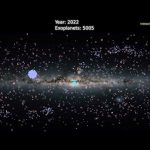
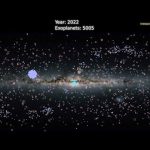
    On March 21, 2022, the number of known exoplanets passed 5,000 according to the NASA Exoplanet Archive. This 360-degree animation and sonification tracks humanity’s discovery of the planets beyond our solar system over time. Turning NASA data into sounds allows users to hear the pace of discovery with additional information conveyed by the notes themselves.

    As each exoplanet is discovered, a circle appears at its position in the sky. The size of the circle indicates the relative size of the planet’s orbit and the color indicates which planet detection method was used to discover it. The music is created by playing a note for each newly discovered world. The pitch of the note indicates the relative orbital period of the planet. Planets that take a longer time to orbit their stars are heard as lower notes, while planets that orbit more quickly are heard as higher notes.

    Exoplanet detection methods: radial velocity (pink); transit (purple); imaging (orange); microlensing (green); timing variations (red); orbital brightness modulation (yellow); astrometry (gray); disk kinematics (blue).

    Please note: Not all browsers support viewing 360 videos. YouTube supports their playback on computers using Chrome, Firefox, MS Edge, and Opera browsers. For the best experience on a mobile device, play this video in the YouTube app.

    Credit: NASA/JPL-Caltech/M. Russo, A. Santaguida (SYSTEM Sounds)

  • 5,000 Exoplanets: Listen to the Sounds of Discovery (NASA Data Sonification)

    5,000 Exoplanets: Listen to the Sounds of Discovery (NASA Data Sonification)

    On March 21, 2022, the number of known exoplanets passed 5,000 according to the NASA Exoplanet Archive. This animation and sonification tracks humanity’s discovery of the planets beyond our solar system over time. Turning NASA data into sounds allows users to hear the pace of discovery, with additional information conveyed by the notes themselves.

    As each exoplanet is discovered, a circle appears at its position in the sky. The size of the circle indicates the relative size of the planet’s orbit and the color indicates which planet detection method was used to discover it. The music is created by playing a note for each newly discovered world. The pitch of the note indicates the relative orbital period of the planet. Planets that take a longer time to orbit their stars are heard as lower notes, while planets that orbit more quickly are heard as higher notes.

    Credit: NASA/JPL-Caltech/M. Russo, A. Santaguida (SYSTEM Sounds)

  • How Do We Prepare a Spacecraft for Launch? Countdown to T-Zero for NASA’s TESS Mission

    How Do We Prepare a Spacecraft for Launch? Countdown to T-Zero for NASA’s TESS Mission

    Revisit the April 18, 2018, launch of NASA’s Transiting Exoplanet Survey Satellite (TESS) aboard a SpaceX Falcon 9 rocket. TESS is already scanning the skies, identifying planet candidates that may be orbiting distant stars. https://go.nasa.gov/2Q3J9ei

    TESS is NASA’s next step in the search for planets outside of our solar system, including those that could support life. The mission will find exoplanets that periodically block part of the light from their host stars, events called transits. TESS will survey 200,000 of the brightest stars near the sun to search for transiting exoplanets.