Tag: than

  • Worse than Cannae? – Battle of Arausio, 105 BC – Teutones and Cimbri challenge Rome

    Worse than Cannae? – Battle of Arausio, 105 BC – Teutones and Cimbri challenge Rome

    Download RAID today ➡️ https://t2m.io/Ap25_HistoryMarche to get exclusive bonuses in celebration of 6th anniversary 🎉 Available after downloading through this link only
    ✅ 1 – Epic Zargala and other goodies worth $60!
    ✅ 2 – Promo code for a Legendary Champion of your choice ⚡️ Available only for new players only, redeem it within 48 hours after registration
    ➡️ Supreme Galek – promo code SUPREME6
    ➡️ Sun Wukong – MONKEYKING
    ➡️ Alice the Wanderer – GETALICE
    ➡️ Loki the Deceiver – GETLOKI
    ✅ 3 – Promo codes available for both new and old players. Make sure to redeem 1 promo code in 24 hours:
    ➡️ Gameleap, PP500, YearlyGift, 1MGIFT

    In 105 BC, two Germanian tribes, the Teutones and the Cimbri, defeated a huge Roman army at Arausio – apparently, some 80,000 Roman and Italian soldiers died. In terms of losses, this battle is regarded as the worst defeat in the history of ancient Rome, surpassing the Battle of Cannae. While Arausio was a massive defeat and did result in some political upheval, it resulted in few notable long term events and the tribes we’re never able or willing to exploit the victory. In 104 BC, a new Consul will lead the recovery of Rome… Gaius Marius.

    🚩 If you like what you see, consider supporting my work on Patreon and you get ad-free early access to my videos for as little as $1 https://www.patreon.com/historymarche — You can also show your support by subscribing to the channel and liking the video. Thank you for watching.

    📢 Narrated by David McCallion

    🎼 Music:
    EpidemicSound
    Filmstro

    📚 Sources:
    The Cimbrian War: the Rise of Caius Marius (2023) by Nic Fields. Osprey Publishing Ltd. ISBN: (ebook) 9781472854940.
    Invasion: Rome Against the Cimbri (113-101 BC) (2022) by Philip Matyszak. Published by Pen and Sword Military. ISBN: 978-1-39909-731-4.
    Gaius Marius: the Rise and Fall of Rome’s Saviour (2017) by Marc Hyden. Published by Pen and Sword Military. ISBN: 978-1-52670-233-3.
    Fall of the Roman Republic (Six Lives) by Plutarch. Translated by Rex Warner. First published in 1958 by Penguin Classics.
    The History Of Rome – Volume 3 (1880) by Theodor Mommsen. Printed by William Clowes and Sons Ltd.
    The Geography of Strabo, Translated by Horace Leonard Jones. Published by G. P. Putnam’s Sons.
    Appian’s Roman History II (1912) Translated by Horace White. Loeb Classical Library.
    Periochae (66-70) by Livy: https://www.livius.org/sources/content/livy/livy-periochae-66-70/

    #rome #history #documentary

  • Iceberg larger than London breaks off Brunt

    Iceberg larger than London breaks off Brunt

    An iceberg around the size of Greater London broke off Antarctica’s Brunt Ice Shelf due to a natural process called ‘calving’. The iceberg, measuring 1550 sq km, detached from the 150 m-thick ice shelf a decade after scientists first spotted massive cracks in the shelf.

    For more information on the newly-birthed A81 iceberg: https://www.esa.int/Applications/Observing_the_Earth/Copernicus/Giant_iceberg_breaks_away_from_Antarctic_ice_shelf

    ★ Subscribe: http://bit.ly/ESAsubscribe and click twice on the bell button to receive our notifications.

    Check out our full video catalog: http://bit.ly/SpaceInVideos
    Follow us on Twitter: http://bit.ly/ESAonTwitter
    On Facebook: http://bit.ly/ESAonFacebook
    On Instagram: http://bit.ly/ESAonInstagram
    On LinkedIn: https://bit.ly/ESAonLinkedIn
    On Pinterest: https://bit.ly/ESAonPinterest
    On Flickr: http://bit.ly/ESAonFlickr

    We are Europe’s gateway to space. Our mission is to shape the development of Europe’s space capability and ensure that investment in space continues to deliver benefits to the citizens of Europe and the world. Check out https://www.esa.int/ to get up to speed on everything space related.

    Copyright information about our videos is available here: https://www.esa.int/ESA_Multimedia/Terms_and_Conditions

    #ESA
    #Iceberg
    #EarthObservation

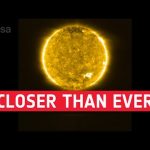
  • Closer than ever: Solar Orbiter’s first views of the Sun

    Closer than ever: Solar Orbiter’s first views of the Sun

    The first images from ESA’s Solar Orbiter are already exceeding expectations and revealing interesting new phenomena on the Sun.

    This animation combines a series of views captured with several remote-sensing instruments on Solar Orbiter between 30 May and 21 June 2020, when the spacecraft was roughly halfway between the Earth and the Sun ¬– closer to the Sun than any other solar telescope has ever been before.

    The red and yellow images were taken with the Extreme Ultraviolet Imager (EUI) in the extreme ultraviolet region of the electromagnetic spectrum, at wavelengths of 30 and 17 nanometers, respectively.

    The close-up views by EUI show the upper atmosphere of the Sun, or corona, with a temperature of around 1 million degrees. With the power to see features in the solar corona of only 400 km across, these images reveal a multitude of small flaring loops, erupting bright spots and dark, moving fibrils. A ubiquitous feature of the solar surface, uncovered for the first time by these images, have been called ‘campfires’. They are omnipresent minuature eruptions that could be contributing to the high temperatures of the solar corona and the origin of the solar wind.

    The EUI images are followed by three views based on data from the Polarimetric and Helioseismic Imager (PHI) instrument. The blue and red view is a ‘tachogram’ of the Sun, showing the line of sight velocity of the Sun, with the blue side turning to us and the red side turning away. The following view is a magnetogram, or a map of magnetic propertied for the whole Sun, featuring a large magnetically active region in the lower right-hand quadrant of the Sun. The yellow-orange view is a visible light image and represents what we would see with the naked eye: there are no sunspots visible because the Sun is displaying only low levels of magnetic activity at the moment.

    On larger scales, the Metis coronograph blocks out the dazzling light from the solar surface, bringing the fainter corona into view. Metis observes the corona simultaneously in visible light (shown in green) and ultraviolet light (shown in red) for the first time with unprecedented temporal coverage and spatial resolution. These images reveal the two bright equatorial streamers and fainter polar regions that are characteristic of the solar corona during times of minimal magnetic activity.

    On even grander scales, the Heliospheric Imager (SoloHI) telescope takes images of the solar wind – the stream of charged particles constantly released by the Sun into outer space – by capturing the light scattered by electrons in the wind. The first-light image from SoloHI is shown at the end, as a mosaic of four separate images from the instrument’s four separate detectors. In this view, the Sun is located to the right of the frame, and its light is blocked by a series of baffles; the last baffle is in the field of view on the right-hand side and is illuminated by reflections from the solar array. The partial ellipse visible on the right is the zodiacal light, created by sunlight reflecting off the dust particles that are orbiting the Sun. The signal from the solar wind outflow is faint compared to the much brighter zodiacal light signal, but the SoloHI team has developed techniques to reveal it. Planet Mercury is also visible as a small bright dot near the lower edge of the upper left tile.

    Solar Orbiter is a space mission of international collaboration between ESA and NASA.

    Learn more: https://bit.ly/SolarOrbitersFirstImages

    Credit: Solar Orbiter/EUI Team; PHI Team; Metis Team; SoloHI Team /ESA & NASA

    ★ Subscribe: http://bit.ly/ESAsubscribe and click twice on the bell button to receive our notifications.

    Check out our full video catalog: http://bit.ly/SpaceInVideos
    Follow us on Twitter: http://bit.ly/ESAonTwitter
    On Facebook: http://bit.ly/ESAonFacebook
    On Instagram: http://bit.ly/ESAonInstagram
    On Flickr: http://bit.ly/ESAonFlickr

    We are Europe’s gateway to space. Our mission is to shape the development of Europe’s space capability and ensure that investment in space continues to deliver benefits to the citizens of Europe and the world. Check out http://www.esa.int/ESA to get up to speed on everything space related.

    Copyright information about our videos is available here: http://www.esa.int/spaceinvideos/Terms_and_Conditions

    #ESA
    #SolarOrbiter
    #TheSunUpClose

  • 3 Things ‘Faster Than Light’

    3 Things ‘Faster Than Light’

    These 3 things go “faster” than the speed of light. How’s that even possible?
    Subscribe: http://www.youtube.com/channel/UCj1gf
    ↓Want more info?↓

    More about the experiment:
    Marissa Giustina’s research: http://arxiv.org/abs/1511.03190

    Advanced scientific note about Doppler: If there is a light moving away from you at constant velocity in static flat (Minkowski) space-time, no matter how red it is, you will never conclude it is going faster than light. But, here I am discussing the conclusions one might come to if you mistakenly use Doppler in the context of the curved space-time of the universe (where there is expansion). Interpreting the huge redshift as a result of the doppler effect, could make one think that galaxies we see are moving away at speeds approaching light speed. And since what we are actually seeing is light from those galaxies from billions of years ago, and given that the universe is expanding, you might be tempted to say that they have since “accelerated” to faster than the speed of light. You might go further and say that there are more distant galaxies that we can’t see which are moving away even faster. So you might conclude there are galaxies moving faster than light in the universe. But the redshift isn’t from doppler and this “acceleration” of the expanding universe isn’t actually causing a true increase in velocity.

    Sometimes astronomers do say there is a faster than light “recession speed” by pretending the expansion of the universe is causing distant galaxies to move away from each other at a corresponding velocity, but that’s misleading. In general relativity, you can actually have an increase in space between objects without causing a corresponding increase in the relatives velocities of those objects.

    CREDITS:

    Host, Writer, Animator, Editor:
    Greg Kestin

    From the producers of PBS NOVA
    © WGBH Educational Foundation

    Funding provided by FQXi

    Special thanks:
    Marissa Giustina
    Nick Hutzler
    Julie Elksy
    Byron Drury
    Jacob Barandes
    Tyler Howe
    Lissy Herman
    Ari Daniel
    Lauren Aguirre
    Kristine Allington
    Allison Eck
    Anna Rotschild

    MEDIA CREDITS:

    Music provided by APM:
    Deep_Science_No-perc
    Mysteries_of_Science_B
    Dreaming_of_the_Stars_a
    Curiosity_Kills_the_Cat_2
    Conundrum_a

    Images:
    Stars – Rene Barrios
    Earth – Eirika
    galaxy spiral (by coornio – diviantart)
    Squirrel with scissors – 60811670 – Dollarphotoclub
    Equations – 91613623 – Dollarphotoclub
    Maxresdefault – Sean Stewart
    Marissa Giustina – Lammerhuber
    Tangled cat – David Swayze
    Cat doll – Vicky Somma

    Stock footage:
    train-exits-tunnel – Pond5
    Bin_pulsar_442 – Courtesy of Nasa
    Expanding in space (40294) – Courtesy of Nasa
    WMAP_archive – Courtesy of Nasa