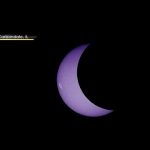
On April 8, 2024, North America’s last total solar eclipse until 2045 moved across the continent. It made landfall in Mexico, crossed the United States from Texas to Maine, and departed across Canada’s Atlantic coast.
This video offers viewers highlights of the eclipse from NASA’s live commentary. Different vantage points include the International Space Station, WB-57 aircraft, and 12 telescopes stationed across North America.
A total solar eclipse occurs when the Moon passes between the Sun and the Earth, completely blocking the face of the Sun. The sky darkens as if it were dawn or dusk.
On April 8, 2024, a total solar eclipse will travel through Mexico, cross the United States from Texas to Maine, and exit North America along Canada’s Atlantic coast.
A total solar eclipse occurs when the Moon passes between the Sun and Earth and briefly covers the full disk of the Sun. This reveals the Sun’s wispy, white outer atmosphere, called the corona.
Not in the path of the eclipse? Watch with NASA from anywhere in the world. We will provide live broadcast coverage on April 8 from 1:00 p.m. to 4:00 p.m. EDT (1700 to 2000 UTC) on NASA TV, NASA.gov, the NASA app, and right here on YouTube: go.nasa.gov/3OI7nLF
Weather permitting, people throughout most of North and Central America, including all of the contiguous United States, will be able to view at least a partial solar eclipse. A partial solar eclipse is when the Moon only covers part of the Sun. People in Hawaii and parts of Alaska will also experience a partial solar eclipse. Click here to learn more about when and where the solar eclipse will be visible: go.nasa.gov/Eclipse2024Map
WARNING: Except during the brief total phase of a total solar eclipse, when the Moon completely blocks the Sun’s bright face, it is not safe to look directly at the Sun without specialized eye protection for solar viewing. Indirect viewing methods, such as pinhole projectors, can also be used to experience an eclipse. For more on how to safely view this eclipse: go.nasa.gov/Eclipse2024Safety
Learn more about the upcoming total solar eclipse: go.nasa.gov/Eclipse2024
Watch a clean telescope feed of a total solar eclipse moving across North America on April 8, 2024, traveling through Mexico, across the United States from Texas to Maine, and exiting North America along Canada’s coast. Weather permitting, we will provide live views of the eclipse from several locations across the eclipse path, including showing the partially eclipsed Sun in different wavelengths of light.
A total solar eclipse occurs when the Moon passes between the Sun and Earth and briefly covers the full disk of the Sun. This reveals the Sun’s wispy, white outer atmosphere, called the corona. Weather permitting, people throughout most of North and Central America, including all of the contiguous United States, will be able to view at least a partial solar eclipse.
These telescope feeds are provided courtesy of our partners and collaborators. A full list of the telescope locations and providers is coming soon.
Review our total solar eclipse safety guidelines: go.nasa.gov/Eclipse2024Safety
Watch live with us as a total solar eclipse moves across North America on April 8, 2024, traveling through Mexico, across the United States from Texas to Maine, and out across Canada’s Atlantic coast.
A total solar eclipse occurs when the Moon passes between the Sun and the Earth, completely blocking the face of the Sun. The sky will darken as if it were dawn or dusk.
From 1 to 4 p.m. EDT (1700 to 2000 UTC) on April 8, we’ll share conversations with experts and provide telescope views of the eclipse from several sites along the eclipse path. Throughout the broadcast, send us your questions in the chat using #askNASA for a chance to have them answered live.
WARNING: Except during the brief total phase of a total solar eclipse, when the Moon completely blocks the Sun’s bright face, it is not safe to look directly at the Sun without specialized eye protection for solar viewing. Indirect viewing methods, such as pinhole projectors, can also be used to experience an eclipse. For more on how to safely view this eclipse: go.nasa.gov/Eclipse2024Safety
Review our eclipse safety guidelines: go.nasa.gov/Eclipse2024Safety Learn more about the total solar eclipse: go.nasa.gov/Eclipse2024 Track the eclipse path: go.nasa.gov/eclipseexplorer
ESA astronaut Thomas Pesquet takes you on a brief tour of the International Space Station like no other. Filmed with a 360 camera, he floats from Node-3 to Europe’s Columbus laboratory. Immerse yourself in this brief but unique fly through humankind’s orbital outpost.
We are Europe’s gateway to space. Our mission is to shape the development of Europe’s space capability and ensure that investment in space continues to deliver benefits to the citizens of Europe and the world. Check out https://www.esa.int/ to get up to speed on everything space related.
By combining the visible and infrared capabilities of the Hubble and Spitzer space telescopes, astronomers and visualization specialists from NASA’s Universe of Learning program have created a spectacular, three-dimensional, fly-through movie of the magnificent Orion nebula, a nearby stellar nursery. Using actual scientific data along with Hollywood techniques, a team at the Space Telescope Science Institute in Baltimore, Maryland, and the Caltech/IPAC in Pasadena, California, has produced the best and most detailed multi-wavelength visualization yet of the Orion nebula.
Credits: Space Telescope Science Institute
More: https://www.nasa.gov/feature/goddard/2018/hubble-yields-new-discoveries-at-the-winter-aas-meeting
Download: http://hubblesite.org/news_release/news/2018-04
This visualization tracks the trajectory of the Voyager 1 spacecraft through the solar system. Launched on September 5, 1977, it was one of two spacecraft sent to visit the giant planets of the outer solar system. Voyager 1 flew by Jupiter and Saturn before being directed out of the solar system.
To fit the 40 year history of the mission into a short visualization, the pacing of time accelerates through most of the movie, starting at about 5 days per second at the beginning and speeding up to about 11 months per second after the planet flybys are past.
The termination shock and heliopause are the ‘boundaries’ created when the plasma between the stars interacts with the plasma flowing outward from the Sun. They are represented with simple grid models and oriented so their ‘nose’ is pointed in the direction (Right Ascension = 17h 24m, declination = 17 degrees south) represented by more recent measurements from other missions. https://svs.gsfc.nasa.gov/4139
Credit: NASA’s Scientific Visualization Studio
This visualization tracks the trajectory of the Voyager 2 spacecraft through the solar system. Launched on August 20, 1977, it was one of two spacecraft sent to visit the giant planets of the outer solar system. Like Voyager 1, Voyager 2 flew by Jupiter and Saturn, but the Voyager 2 mission was extended to fly by Uranus and Neptune before being directed out of the solar system.
To fit the 40 year history of the mission into a short visualization, the pacing of time accelerates through most of the movie, starting at about 5 days per second at the beginning and speeding up to about 11 months per second after the planet flybys are past.
The termination shock and heliopause are the ‘boundaries’ created when the plasma between the stars interacts with the plasma flowing outward from the Sun. They are represented with simple grid models and oriented so their ‘nose’ is pointed in the direction (Right Ascension = 17h 24m, declination = 17 degrees south) represented by more recent measurements from other missions.
During the eclipse, 14 states across the U.S. were in the path of totality and experienced more than two minutes of darkness in the middle of the day – with a partial eclipse viewable all across North America. The broadcast – Eclipse Across America: Through the Eyes of NASA – covered locations along the path of totality, from Oregon to South Carolina including public reactions from all ages. The eclipse’s long path over land provided a unique opportunity to study the Sun, Earth, Moon and their interaction.
This video is available for download from NASA’s Image and Video Library:
Learn more at http://www.stevespanglerscience.com/lab/experiments/straw-through-a-potato/ Sometimes you have to stop and ask yourself, “Who comes up with this stuff?” No one ever uses a straw to eat a potato, but science nerds seem to like to find ways to poke straws through potatoes. There must be a deeper meaning… and there is!
Learn more at http://www.stevespanglerscience.com/experiment/index-card-tricks-sick-science What if we told you that you can fit a quarter through a dime-sized hole in an index card? Would you believe it was possible? It is possible, and we can even show you how to fit your entire body through an index card. Don’t believe us? Try it for yourself!
Learn more at http://www.stevespanglerscience.com/experiment/index-card-tricks-sick-science What if we told you that you can fit a quarter through a dime-sized hole in an index card? Would you believe it was possible? It is possible, and we can even show you how to fit your entire body through an index card. Don’t believe us? Try it for yourself!
Ed Waggoner, director of the Integrated Systems Research Program, and John Cavolowsky, director of the Airspace Systems Program, discuss what’s next for NASA in the field of aeronautics research during a briefing to the news media at NASA’s Kennedy Space Center.
Some things in this world just dont mix… dogs and cats, oil and water, needles and balloons. Everyone knows that a balloons worst fear is a sharp object… even a sharpened, wooden cooking skewer. With a little scientific knowledge about balloons under your belt, you’ll be able to perform a seemingly impossible task… pierce a balloon with a wooden skewer without popping it. Piercing takes on a whole new meaning!
Steve Spangler is a celebrity teacher, science toy designer, speaker, author and an Emmy award-winning television personality. Spangler is probably best known for his Mentos and Diet Coke geyser experiment that went viral in. Spangler is the founder of www.SteveSpanglerScience.com, a Denver-based company specializing in the creation of science toys, classroom science demonstrations, teacher resources and home for Spangler’s popular science experiment archive and video collection. Spangler is a frequent guest on the Ellen DeGeneres Show and Denver 9 News where he takes classroom science experiments to the extreme. For teachers, parents or DIY Science ideas – check out other sources of learning: