Tag: time-lapse

  • US Army Rangers climb a cliff while under fire! – Battle of Pointe du Hoc, 1944 – D-Day Landings

    US Army Rangers climb a cliff while under fire! – Battle of Pointe du Hoc, 1944 – D-Day Landings

    💥 Play War Thunder now for free with my link and get a massive bonus pack, including vehicles, boosts and more: https://playwt.link/historymarche
    💥 War Thunder is a highly detailed vehicle combat game containing over 2000 playable tanks, aircraft and ships spanning over 100 years of development. Immerse yourself completely in dynamic battles with an unparalleled combination of realism and approachability

    🚩 Support HistoryMarche on Patreon and get ad-free early access to our videos for as little as $1: https://www.patreon.com/historymarche

    🚩 Big thanks to Srpske Bitke for their collaboration on this video: https://www.youtube.com/@SrpskeBitke
    🚩 Big thanks to Historical Battlefields (aka Grantovich) for their excellent WW2 tokens: https://www.patreon.com/Grantovich

    📢 Narrated by David McCallion

    📝 Written by Jonathan Woody

    🎼 Music:
    Epidemic Sound
    Impact Allegretto – Kevin MacLeod
    Crypto – Kevin MacLeod

    📚 Sources:
    U.S. Army Center of Military History, Small Unit Actions: Pointe du Hoc, 2d Ranger Battalion
    https://history.army.mil/books/wwii/smallunit/smallunit-pdh.htm

    Alex Kershaw, The First Wave: The D-Day Warriors Who Led the Way to Victory in World War II
    https://www.amazon.com/First-Wave-D-Day-Warriors-Victory-ebook/dp/B07GV13P58

    #documentary #worldwar #dday

  • Attack on the WXYZ Complex 💥 Two US paratroopers wipe out a whole German company💥WW2 Docuumentary

    Attack on the WXYZ Complex 💥 Two US paratroopers wipe out a whole German company💥WW2 Docuumentary

    💥 Play War Thunder now for free with my link and get a massive bonus pack, including vehicles, boosts and more: https://playwt.link/historymarche
    💥 War Thunder is a highly detailed vehicle combat game containing over 2000 playable tanks, aircraft and ships spanning over 100 years of development. Immerse yourself completely in dynamic battles with an unparalleled combination of realism and approachability

    🚩 Support HistoryMarche on Patreon and get ad-free early access to our videos for as little as $1: https://www.patreon.com/historymarche

    🚩 Big thanks to Srpske Bitke for their collaboration on this video: https://www.youtube.com/@SrpskeBitke

    🚩 Big thanks to Historical Battlefields (aka Grantovich) for their excellent soldier tokens: https://www.patreon.com/Grantovich

    📢 Narrated by David McCallion

    📝 Written by Jonathan Woody

    🎼 Music:
    EpidemicSound.com
    Filmstro

    🖼 Maps & Graphics
    Historical Battlefields / Grantovich
    Inkarnate

    📚 Sources:
    U.S. Army Center of Military History, Small Unit Studies: Cassidy’s Battalion
    https://history.army.mil/documents/wwii/cassidy/cassidy.htm

    U.S. Army Center of Military History, Utah Beach to Cherbourg
    https://history.army.mil/books/wwii/utah/utah.htm

    John Koskimaki, D-Day with the Screaming Eagles
    https://www.amazon.com/D-Day-Screaming-Eagles-George-Koskimaki-ebook/dp/B00CE34W8M/ref=tmm_kin_swatch_0?_encoding=UTF8&qid=&sr=

    #ww2 #documentary #historymarche

  • Capturing a Cygnus spacecraft

    Capturing a Cygnus spacecraft

    Capturing a spacecraft requires a complex choreography between human and machine, but these two make it look easy. In this video ESA astronaut Thomas Pesquet and @NASA astronaut Megan McArthur work together to grapple and berth the @Northrop Grumman Cygnus 16 spacecraft on the Earth-facing port of the Unity module on the International Space Station.

    At 12:07 CEST (11:07 BST) Thursday 12 August, Megan used the International Space Station’s robotic Canadarm2 to grapple the spacecraft packed with over 3700 kg of science and supplies as Thomas monitored Cygnus systems during its approach.

    The Cygnus will remain docked to the Station for about three months before it departs in November 2021.

    Follow Thomas: http://bit.ly/ThomasPesquetBlog

    ★ Subscribe: http://bit.ly/ESAsubscribe and click twice on the bell button to receive our notifications.

    Check out our full video catalog: http://bit.ly/SpaceInVideos
    Follow us on Twitter: http://bit.ly/ESAonTwitter
    On Facebook: http://bit.ly/ESAonFacebook
    On Instagram: http://bit.ly/ESAonInstagram
    On Pinterest: https://bit.ly/ESAonPinterest
    On Flickr: http://bit.ly/ESAonFlickr

    We are Europe’s gateway to space. Our mission is to shape the development of Europe’s space capability and ensure that investment in space continues to deliver benefits to the citizens of Europe and the world. Check out https://www.esa.int/ to get up to speed on everything space related.

    Copyright information about our videos is available here: https://www.esa.int/ESA_Multimedia/Terms_and_Conditions

    #ESA
    #Timelapse
    #MissionAlpha

  • Soyuz spacecraft launch timelapse seen from space

    Soyuz spacecraft launch timelapse seen from space

    This is what three astronauts being launched into space looks like – seen from space. ESA astronaut Alexander Gerst took this time-lapse sequence from the International Space Station’s Cupola observatory on 3 December 2018.

    Inside the Soyuz MS-11 spacecraft were NASA astronaut Anne McClain, Canadian Space Agency astronaut David Saint-Jacques and Roscosmos astronaut and Soyuz commander Oleg Konenenko. The trio blasted into orbit at 11:31 GMT from the Baikonur cosmodrome in Kazakhstan and docked with the International Space Station just six hours later.

    Spacecraft are launched after the Space Station flies overhead. This allowed Alexander to set up a camera to take regular pictures at intervals that are played back to create this video.

    The rocket leaves behind a trail of exhaust as it gains altitude and passes through the layers of Earth’s atmosphere.

    Download the video from ESA’s space in videos: http://www.esa.int/spaceinvideos/Videos/2018/12/Soyuz_spacecraft_launch_timelapse_seen_from_space

    Follow Alexander and the #Horizons mission on social media via http://bit.ly/AlexanderGerstESA and on http://bit.ly/HorizonsBlogESA.

    Credits: ESA/NASA.

    ★ Subscribe: http://bit.ly/ESAsubscribe and click twice on the bell button to receive our notifications.

    Check out our full video catalog: http://bit.ly/SpaceInVideos
    Follow ESA on Twitter: http://bit.ly/ESAonTwitter
    On Facebook: http://bit.ly/ESAonFacebook
    On Instagram: http://bit.ly/ESAonInstagram
    On Flickr: http://bit.ly/ESAonFlickr

    ESA is Europe’s gateway to space. Our mission is to shape the development of Europe’s space capability and ensure that investment in space continues to deliver benefits to the citizens of Europe and the world. Check out http://www.esa.int/ESA to get up to speed on everything space related.

    Copyright information about our videos is available here: http://www.esa.int/spaceinvideos/Terms_and_Conditions

  • Releasing the Dragon

    Releasing the Dragon

    This timelapse video shows still pictures taken from the International Space Station of the departing #Dragon supply spacecraft. Played in quick succession the video displays faster than real life but in 4K resolution.

    The Dragon spacecraft was released from the Station’s robotic arm at 18:38 GMT on 3 August 2018. Thrusters fired to increase its distance from the Space Station and the spacecraft started its deorbit and return to Earth, splashing down in the Pacific Ocean less than seven hours after release.

    The International Space Station flies at 28 800 km/h above our planet doing a complete orbit in around 90 minutes – during release operations the sun set and rose above the horizon many times.

    As Dragon faded into the distance it flew over a stormy part of Earth – lightning flashes can be seen many kilometres below.

    Dragon is the only spacecraft that can return to Earth with scientific cargo aside from the Soyuz spacecraft that ferries astronauts to space and back – this flight carried over 1700 kg of cargo.

    Watch the release of Cygnus here: https://youtu.be/bttU_rKoti0

    ★ Subscribe: http://bit.ly/ESAsubscribe

    Follow Alexander and the Horizons mission on social media via http://bit.ly/AlexanderGerstESA and on http://bit.ly/HorizonsBlogESA.

    Check out our full video catalog: http://bit.ly/SpaceInVideos
    Follow ESA on Twitter: http://bit.ly/ESAonTwitter
    On Facebook: http://bit.ly/ESAonFacebook
    On Instagram: http://bit.ly/ESAonInstagram
    On Flickr: http://bit.ly/ESAonFlickr

    ESA is Europe’s gateway to space. Our mission is to shape the development of Europe’s space capability and ensure that investment in space continues to deliver benefits to the citizens of Europe and the world. Check out http://www.esa.int/ESA to get up to speed on everything space related.

    Copyright information about our videos is available here: http://www.esa.int/spaceinvideos/Terms_and_Conditions

  • Time-lapse: Preparing Sentinel-3B for liftoff

    Time-lapse: Preparing Sentinel-3B for liftoff

    See in this time-lapse how the Sentinel-3B satellite was prepared for its liftoff on 25 April 2018 from Plesetsk in Russia.

    Sentinel-3B joined its twin, Sentinel-3A, in orbit. The pairing of identical satellites provides the best coverage and data delivery for Europe’s Copernicus programme – the largest environmental monitoring programme in the world. The satellites carry the same suite of cutting-edge instruments to measure oceans, land, ice and atmosphere.

    Credits: Directed by Stephane Corvaja, ESA;
    Edited by Manuel Pedoussaut, Zetapress;
    Music by Hubrid-Rockot

    ★ Subscribe: http://bit.ly/ESAsubscribe

    Watch the first set of images taken by Sentinel-3B http://bit.ly/FirstImagesSentinel3B

  • A peaceful and breathless Moonrise from the Space Station

    A peaceful and breathless Moonrise from the Space Station

    On 18 September 2017, ESA astronaut Paolo Nespoli shot this beautiful time-lapse showing the Moon rising above the Earth’s horizon together with Mercury, Mars, the star Regulus, and Venus.

    ESA astronaut Paolo Nespoli is currently working and living on board the International Space Station as part of his long duration Vita mission.

    Follow the Vita mission: http://blogs.esa.int/VITAmission/
    Connect with Paolo via http://paolonespoli.esa.int

  • ESTEC: a day in the life

    ESTEC: a day in the life

    A composite day at ESTEC, the European space research and technology centre, as depicted in time-lapse format.

    Located in Noordwijk, the Netherlands, ESTEC is Europe’s largest place for space, the technical heart of the European Space Agency. For almost all European space missions, the path to space leads through ESTEC.

    Around 2700 people arrive here for work every day, working on a broad range of space activities from scientific exploration to telecommunications, Earth observation to navigation, robotics to human spaceflight.

    A suite of unique laboratories probe every aspect of the space environment, applying decades of hard-won expertise. Seen here is preparation for testing materials in simulated space conditions as well as atomic force microscopy, employing a nanometer-wide tip like a stylus across a record player to reveal surface topography down to the atomic scale.

    Full-scale testing of satellites takes place in the ESTEC Test Centre, including the Maxwell Chamber, kept isolated from the external world for precision electromagnetic testing, and the Large Space Simulator, Europe’s largest vacuum chamber used to reproduce the airlessness and temperature extremes encountered in space. The chamber uses large quantities of liquid nitrogen to mimic the chill of deep space.

    Erasmus is ESTEC’s human spaceflight facility, supporting researchers in the design and performance of experiments in microgravity conditions. Also based there is ESTEC’s Telerobotics lab – developing methods of remotely controlling robots using force feedback, extending the human sense of touch to space. The lab team are putting the finishing touches to the Interact Centaur rover, a robot designed to be operated remotely by astronauts in orbit.

    Want to see more? You can on Sunday 4 October, with your own eyes – register to attend the 2015 ESTEC Open Day! http://www.esa.int/About_Us/ESTEC/See_spacecraft_and_meet_astronauts_at_ESA_s_technical_heart

    Credit: ESA–S. Verzier

  • Gaia sunshield deployment time-lapse sequence

    Gaia sunshield deployment time-lapse sequence

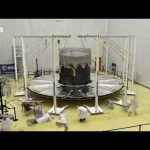
    Time-lapse sequences from the deployment test of the Gaia Deployable Sunshield Assembly (DSA) on 10 October 2013, in the cleanroom at Europe’s spaceport in Kourou.

    Since the DSA will operate in microgravity, it is not designed to support its own weight in the one-g environment at Earth’s surface. Therefore, during deployment testing on the ground, the DSA panels are attached to a system of support cables and counterweights that bears their weight, preventing damage and providing a realistic test environment.

    Once in space, the sunshield has two purposes: to shade Gaia’s sensitive telescopes and cameras, and to provide power to operate the spacecraft. Gaia will always point away from the Sun, so the underside of the skirt is partially covered with solar panels to generate electricity.

    Credit: ESA

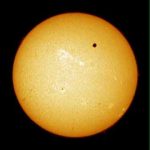
  • Transiting the midnight sun

    Transiting the midnight sun

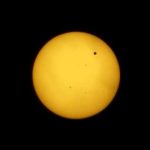
    Time lapse movie of the transit of Venus, as seen from the land of the midnight sun in Svalbard. Interference from cloud gives an eerie feel to the scene.

    Credits: ESA – Andy Oates

  • Venus Express and transit of Venus

    Venus Express and transit of Venus

    This movie was compiled from images taken by the Venus Monitoring Camera on Venus Express as it approached the planet on its elliptical orbit on 1 June 2012. Initially, the spacecraft is looking at the south side of the planet from a distance of 63 000 km and clouds can be seen moving below. As the spacecraft draws closer, Venus starts filling the field of view and the equatorial regions can be seen. The sequence finishes with observations of cloud features at high latitudes.

    Copyright: ESA/MPS/DLR/IDA

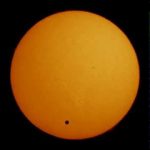
  • Venus Transit seen from Longyearbyen, Spitsbergen

    Venus Transit seen from Longyearbyen, Spitsbergen

    Cloudy weather did impact on the Venus transit observations at Longyearbyen, Spitsbergen. Still most of the Venus transit could be captured.
    Credit: ESA – M. Breitfellner, M. Perez

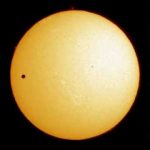
  • Venus Transit seen from Canberra, Australia (part 2)

    Venus Transit seen from Canberra, Australia (part 2)

    Almost the whole Venus transit could be captured despite of some clouds did get into the way of those observing the Venus Transit in Canberra, Australia.
    Credit: ESA – Manuel Castillo-Fraile and Miguel Sanchez-Portal

  • Venus Transit seen from Canberra, Australia (part 1)

    Venus Transit seen from Canberra, Australia (part 1)

    Almost the whole Venus transit could be captured despite of some clouds did get into the way of those observing the Venus Transit in Canberra, Australia.
    Credit: ESA – Manuel Castillo-Fraile and Miguel Sanchez-Portal

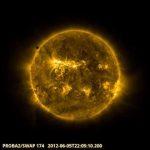
  • Venus solar transit 2012 – Proba-2’s journey across the Sun

    Venus solar transit 2012 – Proba-2’s journey across the Sun

    This movie shows the transit of Venus on 5-6 June 2012 as seen from SWAP, a Belgian solar imager onboard ESA’s PROBA2 microsatellite. SWAP, watching the Sun in EUV light, observes Venus as a small, black circle, obscuring the EUV light emitted from the solar outer atmosphere – the corona – from 19:45UT onwards. At 22:16UT – Venus started its transit of the solar disk

    The bright dots all over the image (‘snow storm’) are energetic particles hitting the SWAP detector when PROBA2 crosses the South Atlantic Anomaly, a region where the protection of the Earth magnetic field against space radiation is known to be weaker.

    Note also the small flaring activity in the bright active region in the northern solar hemisphere as Venus passes over. Towards the end, you can see a big dim inverted-U-shape moving away from the Sun towards the bottom-right corner. This is a coronal mass ejection taking off.

    Credit: ESA/ROB

  • First Soyuz transfer and liftoff from French Guiana

    First Soyuz transfer and liftoff from French Guiana

    The Russian Soyuz vehicle lifted off for the first time from its new launch complex at Europe’s Spaceport in French Guiana on 21 October 2011. Flight VS01 carried the first two operational satellites of Europe’s Galileo navigation system into orbit.
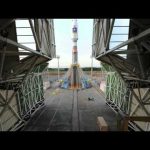
    This time-lapse movie shows the three-stage Soyuz transfer from the assembly and testing building to the launch pad where it is then raised to the vertical. Once in the Mobile gantry, the Upper Composite containing the satellites and Fregat-MT upper stage is hoisted into position on top of the vehicle. The gantry is then rolled back, clearing the way for Soyuz to lift off.