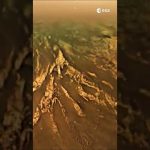
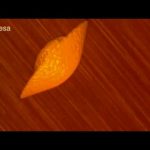
19 years ago, on 25 December 2004, ESA’s Huygens probe was released from the Cassini spacecraft. Huygens continued on to Titan, Saturn’s largest and most interesting moon, descending via parachute and touching-down at 11:30 UTC, 14 January 2005. The descent phase lasted around 2 hours, 27 minutes, with a further 1 hour and 10 minutes of operation on the surface.
This video has been accelerated to 200% speed, showing the descent from an altitude of 62 km at 9:41 UTC to the touchdown.
#stiinta #fizica #science #tehnologie #technology #cristianpresura Measured Paces de la Kevin MacLeod este licențiată în baza unei licențe Creative Commons Attribution 4.0. https://creativecommons.org/licenses/by/4.0/
Multumim Surfshark pentru sponsorizarea acestui videoclip. Introdu codul “Presura” pentru pentru o oferta exclusiva si inca 3 luni gratuite.👇 https://surfshark.deals/presura
An international agreement to collaborate on Artemis, an intriguing discovery on the Moon, and an update on OSIRIS-REx … a few of the stories to tell you about – This Week at NASA!
Is there life beyond Earth? How did life get started on Earth anyway? This season of NASA’s Gravity Assist podcast is about the origins of life on Earth and the search for life elsewhere. Subscribe at https://www.nasa.gov/gravityassist. See all NASA podcasts: www.nasa.gov/podcasts
Hosted by NASA’s Chief Scientist Jim Green, each episode features a conversation with a scientist who has researched some aspect of these questions. We’ll talk about the search for life on Mars, what kind of life might survive on Saturn’s moon Titan, and much more.
Science is the underpinning theme of ESA, driving the spiral of inspiration, innovation, information exchange and interaction with our stakeholders. In this video, Günther Hasinger, ESA Director of Science, reflects on the growth of ESA’s space science programme over the past decades, as well as on its current and future challenges. He also highlights the importance of long-term strategic planning and international cooperation in these endeavours, and finally looks back at some recent successes of ESA’s space science missions.
Science is everywhere at ESA. As well as exploring the Universe and answering the big questions about our place in space we develop the satellites, rockets and technologies to get there. Science also helps us to care for our home planet. All this week we’re highlighting different aspects of science at ESA. Join the conversation with #ScienceAtESA.
Credits: ESA/NASA/JPL/University of Arizona (Huygens landing); ESA/Rosetta/Philae/ROLIS/DLR, Stefano Mottola (Philae landing); ESA/Planck Collaboration (cosmic microwave background); ESA/Gaia/DPAC (Milky Way); MPG/ESO (Eagle Nebula, visible); ESA/Herschel/PACS/SPIRE/Hill, Motte, HOBYS Key Programme Consortium (Eagle Nebula, far-infrared); ESA/XMM-Newton/EPIC/XMM-Newton-SOC/Boulanger (Eagle Nebula, X-rays); NASA, ESA/Hubble and the Hubble Heritage Team (Pillars of Creation); ESO (Pillars of Creation, ground-based view); Koppelman, Villalobos & Helmi, Kapteyn Astronomical Institute, University of Groningen (Milky Way simulation); ESA/XMM-Newton/F. Nicastro et al./R. Cen (warm-hot intergalactic medium); ESA/DLR/FU Berlin, CC BY-SA 3.0 IGO (Mars surface); ESA/NASA/JPL/ASI/Univ. Rome (Mars, liquid water under south pole); NASA/JPL-Caltech (Mars view); ESO, M. Kornmesser, L. Calcada (`Oumuamua animation)
★ Subscribe: http://bit.ly/ESAsubscribe and click twice on the bell button to receive our notifications.
ESA is Europe’s gateway to space. Our mission is to shape the development of Europe’s space capability and ensure that investment in space continues to deliver benefits to the citizens of Europe and the world. Check out http://www.esa.int/ESA to get up to speed on everything space related.
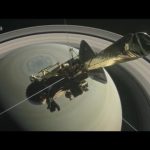
Following over a decade of ground-breaking discoveries, Cassini is now approaching its mission end.
With little fuel left to correct the NASA’s spacecraft trajectory, it has been decided to end the mission by plunging it into Saturn’s atmosphere on 15 September 2017. In the process, Cassini will burn up, satisfying planetary protection requirements to avoid possible contamination of any moons of Saturn that could have conditions suitable for life. These include Saturn’s largest moon Titan and Enceladus, which has a liquid ocean under its icy crust.
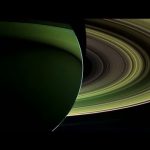
The grand finale is not only a spectacular way to complete this extraordinary mission, but will also return a bounty of unique scientific data that was not possible to collect during the previous phases of the mission. Cassini has never ventured into the area between Saturn and its rings before, so the new set of orbits is almost like a whole new mission.
These close orbits will provide the highest resolution observations ever achieved of the inner rings and the planet’s clouds. The orbits will also give the chance to examine in situ the material in the rings and plasma environment of Saturn. It will also probe the planet’s magnetic field at close distances.
This video explains Cassini ‘s final operations, what the Cassini-Huygens mission has taught us about Saturn, the potential for life on its moons and the promise of more science to come.
Cassini-Huygens was launched on 15 October 1997 from Cape Canaveral, Florida.After nearly 13 years in orbit around Saturn, the international Cassini-Huygens mission is going through its final chapter: NASA’s Cassini spacecraft is performing a series of daring dives between the planet and its rings, leading to a dramatic final plunge into Saturn’s atmosphere on 15 September.
On 14 January 2005, ESA’s Huygens probe, which hitched a ride to the Saturn system attached to Cassini during the seven-year voyage, entered the history books by descending to the surface of Titan, Saturn’s largest moon. This was humanity’s first successful attempt to land a probe on another world in the outer Solar System.
Huygens made a 21-day solo cruise toward the haze-shrouded moon. Plunging into Titan’s atmosphere, the probe touched down safely on Titan’s frozen surface.
Huygens provided a stream of data representing a unique treasure trove of in situ measurements from the planet-sized satellite which scientists are still mining today.
This video recalls the ‘one of a kind’ journey of Huygens.
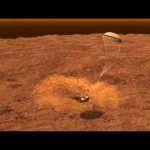
A new rendering of Huygens descent and touchdown created using real data recorded by the probe’s instruments as it descended to the surface of Titan, Saturn’s largest moon, on 14 January 2005.
The animation takes into account Titan’s atmospheric conditions, including the Sun and wind direction, the behaviour of the parachute (with some artistic interpretation only on the movement of the ropes after touchdown), and the dynamics of the landing itself. Even the stones immediately facing Huygens were rendered to match the photograph of the landing site returned from the probe, which is revealed at the end of the animation.
Split into four sequences, the animation first shows a wide-angle view of the descent and landing followed by two close-ups of the touchdown from different angles, and finally a simulated view from Huygens itself — the true Huygens experience.
This animation was released on the eighth anniversary of Huygen’s touchdown on Titan as a Space Science Image of the Week feature.
Animation: ESA–C. Carreau/Schröder, Karkoschka et al (2012). Image from Titan’s surface: ESA/NASA/JPL/University of Arizona
Há algumas décadas, para observar Saturno, os cientistas recorriam a telescópios. Hoje em dia, os segredos de Saturno e da sua misteriosa lua Titã são revelados graças aos dados e imagens enviados pela missão Cassini-Huygens. Saturno nunca antes visto, é o tema de Space esta semana.
Hasta hace algunas décadas para ver Saturno la ciencia tenía que mirar a través de telescópios. Hoy Saturno y su misteriosa luna Titán son nuevos conocidos gracias a la misión Cassini-Huygens que desde 2004 envía imágenes y datos. Una aventura que está cambiando la percepción que hasta ahora teníamos de nuestro Sistema Solar.
Noch vor einigen Jahrzehnten konnte man den Saturn nur mit dem Teleskop beobachten. Heute lüftet die Cassini-Huygens-Mission mit ihren Bildern die Geheimnisse des Saturnsystems und liefert Antworten auf entscheidende wissenschaftliche Fragen.
After an epic space journey, the European Huygens probe landed on Saturn’s moon Titan, a mysterious satellite that has perplexed astronomers for decades. On 14 January 2005, Huygens made the farthest touchdown of any human-built object sent to land on another world.