On April 8, 2024, North America’s last total solar eclipse until 2045 moved across the continent. It made landfall in Mexico, crossed the United States from Texas to Maine, and departed across Canada’s Atlantic coast.
This video offers viewers highlights of the eclipse from NASA’s live commentary. Different vantage points include the International Space Station, WB-57 aircraft, and 12 telescopes stationed across North America.
A total solar eclipse occurs when the Moon passes between the Sun and the Earth, completely blocking the face of the Sun. The sky darkens as if it were dawn or dusk.
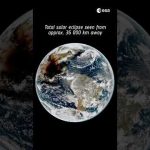
A total solar eclipse swept across North America yesterday, blocking out the Sun momentarily with parts of the continent plunged into darkness. Geostationary satellites orbiting 36 000 km away captured images of the rare celestial event.
These images, captured by the Geostationary Operational Environmental Satellite (GOES-16), captured the moon’s shadow moving across North America from approximately 16:00 to 23:00 CEST (15:00 to 22:00 BST.)
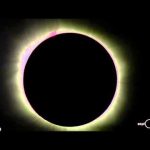
A total solar eclipse occurs when the Moon passes between the Sun and Earth and, for a short period, blocks the face of the Sun, save for a visible ring of light, known as the Sun’s corona.
The track of the moon’s shadow across Earth’s surface, called the path of totality, spanned across the North American continent – from Mexico to the very eastern tip of Canada.
The GOES series is a collaborative development and acquisition effort between National Oceanic and Atmospheric Administration (NOAA) and NASA. The GOES-16 (GOES-East) satellite, the first of the series, provides continuous imagery and atmospheric measurements of Earth’s western hemisphere and monitors space weather.
The Copernicus Sentinel-3 mission also captured images of the eclipse with its Sea and Land Surface Temperature Radiometer (SLSTR).
The eclipse also acts as a laboratory for researching what happens to weather when the Moon’s shadow passes over. The shadow makes air temperatures drop and can cause clouds to evolve in different ways. Data from GOES, Sentinel-3 and other satellites are now being used to explore these effects.
Join us for a news conference on Tuesday, March 26, as NASA and other agencies discuss the 2024 total solar eclipse. On Monday, April 8, millions of people across North America will experience the eclipse. During this event, representatives will engage the public, share safety information, and discuss other eclipse updates.
Briefing participants include: • NASA Administrator Bill Nelson • NASA Deputy Administrator Pam Melroy • NASA Associate Administrator Jim Free • Kelly Korreck, eclipse program manager, NASA Headquarters • Elsayed Talaat, director, National Oceanic and Atmospheric Administration’s Office of Space Weather Observations
On April 8, 2024, a total solar eclipse will travel through Mexico, cross the United States from Texas to Maine, and exit North America along Canada’s Atlantic coast.
A total solar eclipse occurs when the Moon passes between the Sun and Earth and briefly covers the full disk of the Sun. This reveals the Sun’s wispy, white outer atmosphere, called the corona.
Not in the path of the eclipse? Watch with NASA from anywhere in the world. We will provide live broadcast coverage on April 8 from 1:00 p.m. to 4:00 p.m. EDT (1700 to 2000 UTC) on NASA TV, NASA.gov, the NASA app, and right here on YouTube: go.nasa.gov/3OI7nLF
Weather permitting, people throughout most of North and Central America, including all of the contiguous United States, will be able to view at least a partial solar eclipse. A partial solar eclipse is when the Moon only covers part of the Sun. People in Hawaii and parts of Alaska will also experience a partial solar eclipse. Click here to learn more about when and where the solar eclipse will be visible: go.nasa.gov/Eclipse2024Map
WARNING: Except during the brief total phase of a total solar eclipse, when the Moon completely blocks the Sun’s bright face, it is not safe to look directly at the Sun without specialized eye protection for solar viewing. Indirect viewing methods, such as pinhole projectors, can also be used to experience an eclipse. For more on how to safely view this eclipse: go.nasa.gov/Eclipse2024Safety
Learn more about the upcoming total solar eclipse: go.nasa.gov/Eclipse2024
Watch a clean telescope feed of a total solar eclipse moving across North America on April 8, 2024, traveling through Mexico, across the United States from Texas to Maine, and exiting North America along Canada’s coast. Weather permitting, we will provide live views of the eclipse from several locations across the eclipse path, including showing the partially eclipsed Sun in different wavelengths of light.
A total solar eclipse occurs when the Moon passes between the Sun and Earth and briefly covers the full disk of the Sun. This reveals the Sun’s wispy, white outer atmosphere, called the corona. Weather permitting, people throughout most of North and Central America, including all of the contiguous United States, will be able to view at least a partial solar eclipse.
These telescope feeds are provided courtesy of our partners and collaborators. A full list of the telescope locations and providers is coming soon.
Review our total solar eclipse safety guidelines: go.nasa.gov/Eclipse2024Safety
Watch live with us as a total solar eclipse moves across North America on April 8, 2024, traveling through Mexico, across the United States from Texas to Maine, and out across Canada’s Atlantic coast.
A total solar eclipse occurs when the Moon passes between the Sun and the Earth, completely blocking the face of the Sun. The sky will darken as if it were dawn or dusk.
From 1 to 4 p.m. EDT (1700 to 2000 UTC) on April 8, we’ll share conversations with experts and provide telescope views of the eclipse from several sites along the eclipse path. Throughout the broadcast, send us your questions in the chat using #askNASA for a chance to have them answered live.
WARNING: Except during the brief total phase of a total solar eclipse, when the Moon completely blocks the Sun’s bright face, it is not safe to look directly at the Sun without specialized eye protection for solar viewing. Indirect viewing methods, such as pinhole projectors, can also be used to experience an eclipse. For more on how to safely view this eclipse: go.nasa.gov/Eclipse2024Safety
Review our eclipse safety guidelines: go.nasa.gov/Eclipse2024Safety Learn more about the total solar eclipse: go.nasa.gov/Eclipse2024 Track the eclipse path: go.nasa.gov/eclipseexplorer
Go outside with NASA and watch the total lunar eclipse! On the evening of May 15, Earth will pass between the Sun and the Moon, blocking sunlight and casting a shadow on the lunar surface. Starting at 9:32 p.m. EDT (1:32 UTC on May 16), people with clear skies in the Americas, Europe, and parts of Africa will begin to see the Moon get bathed in the red glow of every sunrise and sunset refracted through Earth’s atmosphere. Totality will occur at 12:12 a.m. EDT on May 16 (4:12 UTC).
Join NASA experts to learn about this incredible natural phenomenon, look through telescope views across the world, and hear about plans to return humans to the lunar surface with the Artemis program. Have questions? Ask them in our live chat.
Few conflicts have rivaled the scale and destruction of the Punic wars fought between Rome and Carthage. In this first episode I set the stage for a conflict that will reshape history!
Sources:
“The Fall of Carthage” by Adrian Goldsworthy
“In the Name of Rome” by Adrian Goldsworthy
“The Rise of Rome” by Anthony Everitt
The gameplay comes from Total War: Rome 2
“Please note this is an unofficial video and is not endorsed by SEGA or the Creative Assembly in any way. For more information on Total War, please visit www.totalwar.com.”
NASA collaborated with the Exploratorium in San Francisco and the National Science Foundation to provide live coverage of the 2016 total solar eclipse from Micronesia, on March 8. The fully eclipsed sun was visible from only a few Pacific islands, but the live broadcast made the phenomenon available to millions of people around the world.