Tag: Trace Gas Orbiter

  • ESA Euronews: ExoMars at Mars

    ESA Euronews: ExoMars at Mars

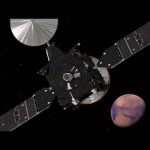
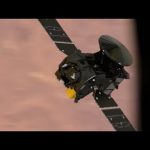
    Scientists and engineers on the ExoMars project had their hearts in their mouths as the ExoMars mission reached the red planet, with the Schiaparelli probe going missing in action at the end of its descent just as the TGO mothership swept into a perfectly timed orbit.

    The rollercoaster ride of arrival at Mars is the first installment in this ambitious Russian and European project that aims for the first time to directly search for signs of life on Mars.

    The plight of Schiaparelli remains unclear. It is certainly on the Martian surface, but may well have hit the red dust much harder then engineers had planned, and nothing has been heard from it since.

    Data relayed during the lander’s descent shows the initial high-speed entry to the Martian atmosphere went well, with the heatshield slowing the craft and the parachute deploying. However once the back heat shield and parachute were ejected the flow of events did not go to plan.

    This video is available in the following languages:
    English https://www.youtube.com/watch?v=S3eIilSYrok
    French https://www.youtube.com/watch?v=mEXA_Fo7ABg
    German https://www.youtube.com/watch?v=jCCFOjP0ocw
    Spanish https://www.youtube.com/watch?v=bMnSKkSLLbA
    Italian https://www.youtube.com/watch?v=wqi7XU0ojqI
    Portuguese https://www.youtube.com/watch?v=-VyaoG_f51s
    Hungarian https://www.youtube.com/watch?v=S7QLUBb5QbI
    Greek https://www.youtube.com/watch?v=hlrNu0vselk
  • ExoMars: From separation to landing

    ExoMars: From separation to landing

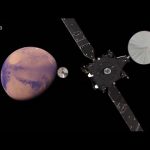
    On 16 October, seven months and 500 million km after launching from Baikonur in Kazakhstan, the joint European and Russian ExoMars 2016 mission reaches a crucial phase.

    The Trace Gas Orbiter will release its Schiaparelli lander for a three day coast and a six minute descent to the Martian surface.The lander, which was designed to demonstrate technologies for entry, descent and landing on Mars, is heading for the Meridiani Planum. This is an area that is currently being studied by NASA’s Opportunity rover and Europe’s Mars Express orbiter.

    On 19 October, the Schiaparelli lander will be activated a few hours before reaching the Martian atmosphere, when it will be travelling at some 21 000 km/h. The front heatshield – covered with 90 insulating tiles – will be subjected to temperatures of up to 1500 degrees Celsius.

    This video covers the separation, descent and landing procedures, as well as the orbiter’s critical burn to avoid crashing on the surface of Mars.

  • ExoMars at Mars

    ExoMars at Mars

    Three days before arriving at Mars on 19 October 2016, the ExoMars Trace Gas Orbiter (TGO) will release its entry, descent and landing demonstrator, Schiaparelli, towards the Red Planet. ExoMars is several missions in one. Its orbiter is a science and relay mission. The TGO will search for evidence of gases, such as methane, that may be associated with geological or biological processes. The Schiaparelli lander is a technology demonstrator to test key technologies for future missions to Mars.

    The landing site is an elliptical region close to the equator about 100 km long and 15 km wide in the planet’s Meridiani Planum area. It is relatively flat, smooth and well studied as NASA’s Opportunity rover is on the ground and ESA’s Mars Express spacecraft, which will also act as one of the data relay orbiters, has been overhead since 2003.

    This video covers the landing and orbital manoeuvres, including the use of aerobraking – which ESA is using for the first time at Mars.

  • ExoMars science

    ExoMars science

    On 14 March at 09:31 GMT ExoMars 2016 will be launched from Baikonur onboard a Proton rocket.

    The joint European and Russian ExoMars mission will test key exploration technologies and search for evidence of methane and other rare gases in the Martian atmosphere. These gases could result from geological processes or they could be signatures of current biological activity on the planet.

    This film examines the two European science instruments on the ExoMars Trace Gas Orbiter (TGO) – CaSSIS and NOMAD. The high-resolution CaSSIS (Colour and Stereo Surface Imaging System) acts as the orbiter’s scientific eye. It is a telescope with a sophisticated detector that can provide colour and stereo images over a nine and a half kilometre wide strip. CaSSIS will examine recurring slope linea – dark lines on the surface of Mars at different times of the day over the planet’s seasons. These linea are believed to be associated with liquid brine. They increase in size during the Martian spring and summer and fade away during autumn and winter.

    NOMAD (Nadir and Occultation for MArs Discovery) will be the first high resolution instrument of its kind around the planet. It will observe information about Mars’ atmosphere by looking at the Sun during sunsets and sunrises. It contains three spectrometers – two working in the infrared and one in ultraviolet – and can identify trace gases in the atmosphere, such as methane. The presence of methane in Mars’ atmosphere could result from simple life forms like microbes.

  • ExoMars prepares for launch

    ExoMars prepares for launch

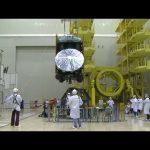
    The ExoMars 2016 spacecraft – consisting of the Trace Gas Orbiter (TGO) and the Schiaparelli entry, descent and landing demonstrator – is in Baikonur, Kazakhstan, preparing for its mid-March launch on a Russian Proton rocket.

    This joint European and Russian mission will test key exploration technologies and search for evidence of methane and other rare gases in the martian atmosphere. These gases could result from geological processes or they could be signatures of current biological activity on the planet. Three days before reaching Mars in October, Schiaparelli will separate from the orbiter and coast towards the planet in hibernation mode to reduce power consumption.

    This video covers the journey, the orbit of the Trace Gas Orbiter, the separation of the Schiaparelli lander and its 20 000 km/hour descent and eventual landing. It also contains filming at ESA’s European Space and Technology Centre (ESTEC) Mars Yard in the Netherlands. 

    Learning more about Mars’ water and environment will shed further light on this planet – while knowing the origin of its methane could finally answer the exciting question of whether there is life on Mars.

    Read more about ExoMars:
    http://www.esa.int/exomars