Tag: Trajectory

  • Artemis I Trajectory Burn en Route to the Moon

    Artemis I Trajectory Burn en Route to the Moon

    Watch live as NASA’s Orion spacecraft completes its first outbound trajectory burn on the way to the Moon after having launched aboard the Space Launch System (SLS) rocket and began the Artemis I mission. During Artemis I, Orion will travel 280,000 miles (450,000 km) from Earth and 40,000 miles (64,000 km) beyond the far side of the Moon, carrying science and technology payloads to expand our understanding of lunar science, technology developments, and deep space radiation.

    Through Artemis missions, NASA will land the first woman and the first person of color on the Moon, paving the way for a long-term lunar presence and serving as a steppingstone to send astronauts to Mars. We are going.

    More: https://www.nasa.gov/artemis

  • Voyager 1 Trajectory through the Solar System

    Voyager 1 Trajectory through the Solar System

    This visualization tracks the trajectory of the Voyager 1 spacecraft through the solar system. Launched on September 5, 1977, it was one of two spacecraft sent to visit the giant planets of the outer solar system. Voyager 1 flew by Jupiter and Saturn before being directed out of the solar system.

    To fit the 40 year history of the mission into a short visualization, the pacing of time accelerates through most of the movie, starting at about 5 days per second at the beginning and speeding up to about 11 months per second after the planet flybys are past.

    The termination shock and heliopause are the ‘boundaries’ created when the plasma between the stars interacts with the plasma flowing outward from the Sun. They are represented with simple grid models and oriented so their ‘nose’ is pointed in the direction (Right Ascension = 17h 24m, declination = 17 degrees south) represented by more recent measurements from other missions.
    https://svs.gsfc.nasa.gov/4139
    Credit: NASA’s Scientific Visualization Studio

  • Voyager 2 Trajectory through the Solar System

    Voyager 2 Trajectory through the Solar System

    This visualization tracks the trajectory of the Voyager 2 spacecraft through the solar system. Launched on August 20, 1977, it was one of two spacecraft sent to visit the giant planets of the outer solar system. Like Voyager 1, Voyager 2 flew by Jupiter and Saturn, but the Voyager 2 mission was extended to fly by Uranus and Neptune before being directed out of the solar system.

    To fit the 40 year history of the mission into a short visualization, the pacing of time accelerates through most of the movie, starting at about 5 days per second at the beginning and speeding up to about 11 months per second after the planet flybys are past.

    The termination shock and heliopause are the ‘boundaries’ created when the plasma between the stars interacts with the plasma flowing outward from the Sun. They are represented with simple grid models and oriented so their ‘nose’ is pointed in the direction (Right Ascension = 17h 24m, declination = 17 degrees south) represented by more recent measurements from other missions.

    Credit: NASA’s Scientific Visualization Studio
    https://svs.gsfc.nasa.gov/4140

  • BepiColombo’s journey to Mercury

    BepiColombo’s journey to Mercury

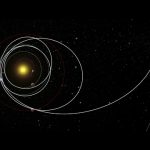
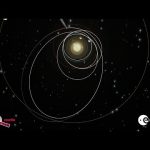
    Animation visualising BepiColombo’s 7.2 year journey to Mercury.

    This animation is based on a launch date of 5 October, marking the start of the launch window in October 2018. It illustrates the gravity assist flybys that the spacecraft will make at Earth, Venus and Mercury before arriving at Mercury in December 2025.

    More about the journey:
    http://www.esa.int/Our_Activities/Space_Science/BepiColombo/Journey_to_Mercury

  • Juice’s journey to Jupiter

    Juice’s journey to Jupiter

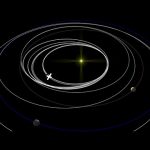
    This animation shows the proposed trajectory of ESA’s Jupiter Icy Moons Explore (Juice) mission to Jupiter.

    Based on a launch in June 2022, the spacecraft will make a series of gravity-assist flybys at Earth (May 2023, September 2024 and November 2026), Venus (October 2023) and Mars (February 2025) before arriving in the Jupiter system in October 2029.

    The animation ends at the Jupiter orbit insertion point, but the planned 3.5 year mission will see Juice not only orbit Jupiter, but also make dedicated flybys of the moons Europa, Callisto and Ganymede, before orbiting the largest moon, Ganymede.

    More about Juice:
    http://sci.esa.int/juice/

  • Rosetta’s last orbits around the comet

    Rosetta’s last orbits around the comet

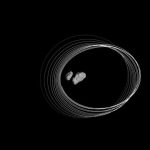
    Animation of Rosetta’s trajectory over the last two months of its mission at Comet 67P/Churyumov–Gerasimenko.

    The animation begins in early August, when the spacecraft started flying elliptical orbits that brought it progressively closer to the comet at its closest approach.

    On 24 September 2016, Rosetta will leave its current close, flyover orbits and transfer into the start of a 16 x 23 km orbit that will be used to prepare and line up for the final descent.

    On the evening of 29 September (20:50 GMT) Rosetta will manoeuvre onto a collision course with the comet, beginning the descent from an altitude of 19 km. The spacecraft will fall freely, without further manoeuvres, collecting scientific data during the descent.

    The trajectory shown here was created from real data provided over the last month, but may not necessarily follow the exact comet distance because of natural deviations from the comet’s gravity and outgassing.

    Find out more about Rosetta at:
    http://blogs.esa.int/rosetta
    and
    http://www.esa.int/rosetta

  • Rosetta’s final path

    Rosetta’s final path

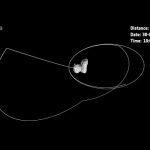
    Animation of Rosetta’s final trajectory in the last 10 days of its mission at Comet 67P/Churyumov–Gerasimenko.

    On 24 September 2016, Rosetta will leave a close flyover orbit and transfer into the start of a 16 x 23 km orbit that will be used to prepare and line up for the final descent. In the evening of 29 September (20:50 GMT) Rosetta will manoeuvre onto a collision course with the comet, beginning the descent from an altitude of 19 km. The spacecraft will fall freely, without further manoeuvres, collecting scientific data during the descent.

    The trajectory shown in this animation is created from real data provided in the last month, but may not necessarily follow the exact distance/time details because of natural deviations in the trajectory associated with the comet’s gravity and outgassing.

    Find out more about Rosetta at:
    http://blogs.esa.int/rosetta
    and
    http://www.esa.int/rosetta

  • ExoMars 2016 journey to Mars

    ExoMars 2016 journey to Mars

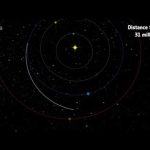
    The journey that the ExoMars 2016 spacecraft will take from Earth to Mars. ‘Distance to Mars’ is the straight-line distance between the spacecraft and Mars, and not the actual distance that the spacecraft will travel.

    The mission is scheduled for launch in the 14–25 March window. The Trace Gas Orbiter and the Schiaparelli entry, descent and landing demonstrator module will separate on 16 October. Schiaparelli is set to enter the martian atmosphere on 19 October, while TGO will enter orbit around Mars.

    More about the ExoMars mission:
    http://www.esa.int/exomars

    Credits: ESA/ATG medialab

  • Rosetta: close orbits to lander deployment (annotated)

    Rosetta: close orbits to lander deployment (annotated)

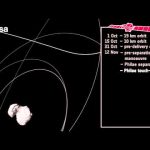
    Animation showing Rosetta’s orbit in the lead up to, during and after lander separation.

    The animation begins on 1 October 2014, when Rosetta is orbiting about 19 km from Comet 67P/Churyumov–Gerasimenko (all distances refer to the comet’s centre). The animation shows the transition to the close 10 km orbit by mid-October, and then the steps taken to move onto the pre-separation trajectory.

    On the day of landing, 12 November, Rosetta makes a further manoeuvre 2–3 hours before separation to move to 22.5 km from the comet centre to deploy the lander, Philae. While Philae descends to the surface over a period of seven hours, Rosetta makes another manoeuvre to maintain visibility with the lander. A series of ‘relay phase’ manoeuvres then move Rosetta out to a distance of about 50 km, before moving first to a 30 km orbit and later to an orbit at about 20 km by early December.

    The speed of the animation slows during the separation and lander phase to better highlight these events. The comet shape and rate of rotation is real – the comet rotates with a period of about 12.4 hours.

    Credits: ESA

  • Rosetta’s twelve-year journey in space

    Rosetta’s twelve-year journey in space

    This animation tracks Rosetta’s journey through the Solar System, using gravity slingshots from Earth and Mars to reach its final destination: Comet 67P/Churyumov–Gerasimenko. Rosetta made three flybys of Earth, on 4 March 2005, 13 November 2007 and 13 November 2009, and one of Mars, on 25 February 2007. Rosetta has also visited two asteroids, taking extensive close-up images of 2867 Steins on 5 September 2008 and 21 Lutetia on 10 July 2010. Once the spacecraft is woken up from deep space hibernation on 20 January 2014, it will head for rendezvous with the comet in May. In November the Philae probe will be deployed to the comet surface. Rosetta will follow the comet to its closest distance to the Sun on 13 August 2015 and as it moves back towards the outer Solar System. The nominal mission end is December 2015.
    Credits: ESA

    (This replaces a previously published version)