Cloudy weather did impact on the Venus transit observations at Longyearbyen, Spitsbergen. Still most of the Venus transit could be captured.
Credit: ESA – M. Breitfellner, M. Perez
Tag: transit’
-
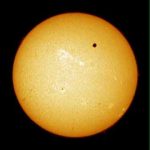
Venus Transit seen from Longyearbyen, Spitsbergen
-
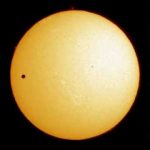
Venus Transit seen from Canberra, Australia (part 2)
Almost the whole Venus transit could be captured despite of some clouds did get into the way of those observing the Venus Transit in Canberra, Australia.
Credit: ESA – Manuel Castillo-Fraile and Miguel Sanchez-Portal -
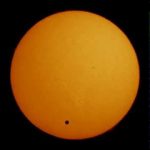
Venus Transit seen from Canberra, Australia (part 1)
Almost the whole Venus transit could be captured despite of some clouds did get into the way of those observing the Venus Transit in Canberra, Australia.
Credit: ESA – Manuel Castillo-Fraile and Miguel Sanchez-Portal -
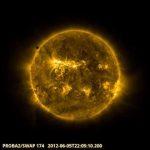
Venus solar transit 2012 – Proba-2’s journey across the Sun
This movie shows the transit of Venus on 5-6 June 2012 as seen from SWAP, a Belgian solar imager onboard ESA’s PROBA2 microsatellite. SWAP, watching the Sun in EUV light, observes Venus as a small, black circle, obscuring the EUV light emitted from the solar outer atmosphere – the corona – from 19:45UT onwards. At 22:16UT – Venus started its transit of the solar disk
The bright dots all over the image (‘snow storm’) are energetic particles hitting the SWAP detector when PROBA2 crosses the South Atlantic Anomaly, a region where the protection of the Earth magnetic field against space radiation is known to be weaker.
Note also the small flaring activity in the bright active region in the northern solar hemisphere as Venus passes over. Towards the end, you can see a big dim inverted-U-shape moving away from the Sun towards the bottom-right corner. This is a coronal mass ejection taking off.
Credit: ESA/ROB
-

NASA TV Hosts 2012 Venus Transit
Pre-ingress coverage from NASA Headquarters in Washington, DC, of the last-in-a-lifetime event.
-
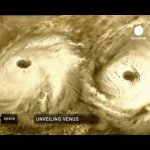
ESA Euronews: Desvelando los secretos de Venus
Es conocido como el lucero del alba o la estrella de la mañana, pero no es una estrella: es un planeta. Venus es, junto con Marte, nuestro vecino más cercano, y al mismo tiempo, un gran desconocido. Levantamos el velo que esconde los misterios del planeta ardiente.
-

ESA Euronews: Quand Vénus se dévoile
On l’appelle l’étoile du berger ou encore l’étoile du matin, mais c’est tout sauf une étoile. C’est même une planète de notre voisinage immédiat. Vénus est, avec Mars, la plus proche planète de la Terre. Proche peut-être mais au combien différente. On commence tout juste à lever quelques pans du voile qui entoure le mystère de la planète brûlante.
-

ESA Euronews: Unveiling Venus
It can be called the morning or evening star, depending on where you are or what time it is, but it is anything but a star. In fact, it is one of our nearest planetary neighbours. Venus and Mars may be Earth’s close cousins, but they are oh-so different. Only now are we starting to peer through Venus’ clouds to reveal the burning planet’s secrets.