
Tag: unique

  • We discovered a unique #BlackHole 🕳️🕳️ #shorts

    We discovered a unique #BlackHole 🕳️🕳️ #shorts

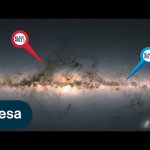
    Using data from our Gaia mission, astronomers have discovered not only the closest but also the second closest black hole to Earth. The black holes, Gaia BH1 and Gaia BH2, are respectively located just 1560 light-years away from us in the direction of the constellation Ophiuchus and 3800 light-years away in the constellation Centaurus. In galactic terms, these black holes reside in our cosmic backyard.

    The two black holes were discovered by studying the movement of their companion stars. A strange ‘wobble’ in the movement of the stars on the sky indicated that they are orbiting a very massive object. In both cases, the objects are approximately ten times more massive than our Sun. Other explanations for these massive companions, like double-star systems, were ruled out since they do not seem to emit any light.

    📹 @EuropeanSpaceAgency
    📸 ESA/Gaia/DPAC; Creative commons CC BY-SA 3.0 IGO

    ★ Subscribe: http://bit.ly/ESAsubscribe and click twice on the bell button to receive our notifications.

    Check out our full video catalog: http://bit.ly/SpaceInVideos
    Follow us on Twitter: http://bit.ly/ESAonTwitter
    On Facebook: http://bit.ly/ESAonFacebook
    On Instagram: http://bit.ly/ESAonInstagram
    On LinkedIn: https://bit.ly/ESAonLinkedIn
    On Pinterest: https://bit.ly/ESAonPinterest
    On Flickr: http://bit.ly/ESAonFlickr

    We are Europe’s gateway to space. Our mission is to shape the development of Europe’s space capability and ensure that investment in space continues to deliver benefits to the citizens of Europe and the world. Check out https://www.esa.int/ to get up to speed on everything space related.

    Copyright information about our videos is available here: https://www.esa.int/ESA_Multimedia/Terms_and_Conditions

    #ESA
    #GAIA
    #BlackHoles
  • Gaia discovers a unique black hole

    Gaia discovers a unique black hole

    ESA’s Gaia mission has helped discover a new kind of black hole. The new family already has two members, and both are closer to Earth than any other black hole that we know of.

    The two black holes were discovered by studying ultra-precise measurements of stellar positions and motions in Gaia’s third data release.

    A strange ‘wobble’ in the movement of two stars on the sky indicated that they are orbiting a very massive object. In both cases, the objects are approximately ten times more massive than our Sun. Other explanations for these massive companions, like double-star systems, were ruled out since they do not seem to emit any light.

    Gaia’s second black hole, BH2, is located 3800 light-years away from Earth. It is a binary system consisting of a red giant star and likely a black hole.

    In this animation of Gaia BH2, created in Gaia Sky, the orbits are accurately sized, but the back hole diameter is not to scale.

    Credit: ESA/Gaia/DPAC

    ★ Subscribe: http://bit.ly/ESAsubscribe and click twice on the bell button to receive our notifications.

    Check out our full video catalog: http://bit.ly/SpaceInVideos
    Follow us on Twitter: http://bit.ly/ESAonTwitter
    On Facebook: http://bit.ly/ESAonFacebook
    On Instagram: http://bit.ly/ESAonInstagram
    On LinkedIn: https://bit.ly/ESAonLinkedIn
    On Pinterest: https://bit.ly/ESAonPinterest
    On Flickr: http://bit.ly/ESAonFlickr

    We are Europe’s gateway to space. Our mission is to shape the development of Europe’s space capability and ensure that investment in space continues to deliver benefits to the citizens of Europe and the world. Check out https://www.esa.int/ to get up to speed on everything space related.

    Copyright information about our videos is available here: https://www.esa.int/ESA_Multimedia/Terms_and_Conditions

    #ESA
    #Earth
    #EarthObservation

  • NASA names Unique Solar Mission after University of Chicago Physicist Eugene Parker

    NASA names Unique Solar Mission after University of Chicago Physicist Eugene Parker

    On May 31, NASA renamed humanity’s first mission to fly a spacecraft directly into the sun’s atmosphere in honor of Professor Eugene Parker, a pioneering physicist at the University of Chicago. This is the first time in agency history a spacecraft has been named for a living individual. Parker, the S. Chandrasekhar Distinguished Service Professor Emeritus in Physics, is best known for developing the concept of solar wind—the stream of electrically charged particles emitted by the sun.

    Previously named Solar Probe Plus, the Parker Solar Probe will launch in summer 2018. Placed in orbit within four million miles of the sun’s surface, and facing heat and radiation unlike any spacecraft in history, the spacecraft will explore the sun’s outer atmosphere and make critical observations that will answer decades-old questions about the physics of how stars work. The resulting data will improve forecasts of major space weather events that impact life on Earth, as well as satellites and astronauts in space.