Tag: version

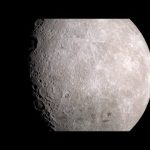
  • Clair de Lune 4K Version – Moon Images from NASA’s Lunar Reconnaissance Orbiter

    Clair de Lune 4K Version – Moon Images from NASA’s Lunar Reconnaissance Orbiter

    This visualization uses a digital 3D model of the Moon built from global elevation maps and image mosaics by NASA’s Lunar Reconnaissance Orbiter mission. It was created to accompany a performance of Claude Debussy’s Clair de Lune by the National Symphony Orchestra Pops, led by conductor Emil de Cou, at the Kennedy Center for the Performing Arts in Washington, DC, on June 1 and 2, 2018, as part of a celebration of NASA’s 60th anniversary.

    Clair de Lune (moonlight in French) was published in 1905, as the third of four movements in the composer’s Suite Bergamasque, and unlike the other parts of this work, Clair is quiet, contemplative, and slightly melancholy, evoking the feeling of a solitary walk through a moonlit garden.

    The visuals were composed like a nature documentary, with clean cuts and a mostly stationary virtual camera. The viewer follows the Sun throughout a lunar day, seeing sunrises and then sunsets over prominent features on the Moon. The sprawling ray system surrounding Copernicus crater, for example, is revealed beneath receding shadows at sunrise and later slips back into darkness as night encroaches.

    This video is public domain and along with other supporting visualizations can be downloaded from the Scientific Visualization Studio at: http://svs.gsfc.nasa.gov/4655

    Credit: NASA’s Scientific Visualization Studio

    If you liked this video, subscribe to the NASA Goddard YouTube channel: http://www.youtube.com/NASAExplorer

    Visualization Credits
    Ernie Wright (USRA)
    Lead Visualizer and Editor

    Laurence Schuler (ADNET Systems Inc.)
    Technical Support

    Ian Jones (ADNET Systems Inc.)
    Technical Support

    Wade Sisler (NASA/GSFC)
    Producer

    Noah Petro (NASA/GSFC)
    Scientist

  • Steve Spangler’s Version of 52-Pickup

    Steve Spangler’s Version of 52-Pickup

    Science guy Steve Spangler is back with a brand new experiment. You never know what he’ll have up his sleeve!

  • World’s Simplest Motor Version 01 – Sick Science! #034

    World’s Simplest Motor Version 01 – Sick Science! #034

    When it comes to creating something out of nothing, Steve Spangler takes the cake. The Steve Spangler Science team recently challenged Steve to create a simple homopolar motor by using objects that he could find around his home. The trick to homopolar motors is the use of electromagnets and a lack of polarity change. It’s complicated, so we were sure that Steve would have trouble. Much to the surprise of everyone, Steve not only accomplished the (what we thought to be) impossible, but he did it twice. Steve was so proud that he wanted to give both of his designs to you. It’s a Sick Science 2-for-1 with the Electromagnetic Motor.

    Want more experiments like this? Check out http://www.stevespanglerscience.com/product/fire-bubbles-exploding-toothpaste-book

    Sick Science™ is a trademark of Steve Spangler, inc.

    © 2011 Steve Spangler Science all rights reserved

  • World’s Simplest Motor Version 02 – Sick Science! #033

    World’s Simplest Motor Version 02 – Sick Science! #033

    When it comes to creating something out of nothing, Steve Spangler takes the cake. The Steve Spangler Science team recently challenged Steve to create a simple homopolar motor by using objects that he could find around his home. The trick to homopolar motors is the use of electromagnets and a lack of polarity change. It’s complicated, so we were sure that Steve would have trouble. Much to the surprise of everyone, Steve not only accomplished the (what we thought to be) impossible, but he did it twice. Steve was so proud that he wanted to give both of his designs to you. It’s a Sick Science 2-for-1 with the Electromagnetic Motor.

    Want more experiments like this? Check out http://www.stevespanglerscience.com/product/naked-eggs-and-flying-potatoes

    Sick Science™ is a trademark of Steve Spangler, inc.

    © 2011 Steve Spangler Science all rights reserved