Tag: want

  • I want to break free… 🎶 #shorts

    I want to break free… 🎶 #shorts

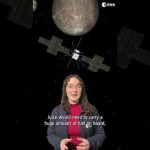
    When a spacecraft launches on a mission to another planet it must first break free of the Earth’s gravitational field. Once it has done that, it enters interplanetary space, where the dominant force is the gravitational field of the Sun.

    The spacecraft begins to follow a curving orbit, around the Sun, which is similar to the orbit of a comet. When this orbit brings it close to its target destination the spacecraft must fire a retrorocket to slow down and allow itself to be captured by the gravitational field of its target. The smaller the target, the more the spacecraft must slow down.

    Sometimes passing a planet can result in the spacecraft being accelerated, even without the spacecraft firing any of its thrusters. This is known as the ‘slingshot’ effect. Such ‘gravity assist’ manoeuvres are now a standard part of spaceflight and are used by almost all our interplanetary missions. They take advantage of the fact that the gravitational attraction of the planets can be used to change the trajectory and speed of a spacecraft.

    The amount by which the spacecraft speeds up or slows down is determined by whether it is passing behind or in front of the planet as the planet follows its orbit. When the spacecraft leaves the influence of the planet, it follows an orbit on a different course than before.

    📹 @EuropeanSpaceAgency

    ★ Subscribe: http://bit.ly/ESAsubscribe and click twice on the bell button to receive our notifications.

    Check out our full video catalog: http://bit.ly/SpaceInVideos
    Follow us on Twitter: http://bit.ly/ESAonTwitter
    On Facebook: http://bit.ly/ESAonFacebook
    On Instagram: http://bit.ly/ESAonInstagram
    On LinkedIn: https://bit.ly/ESAonLinkedIn
    On Pinterest: https://bit.ly/ESAonPinterest
    On Flickr: http://bit.ly/ESAonFlickr

    We are Europe’s gateway to space. Our mission is to shape the development of Europe’s space capability and ensure that investment in space continues to deliver benefits to the citizens of Europe and the world. Check out https://www.esa.int/ to get up to speed on everything space related.

    Copyright information about our videos is available here: https://www.esa.int/ESA_Multimedia/Terms_and_Conditions

    #ESA
    #Jupiter
    #JuiceMission
  • So You Want a Degree in Physics

    So You Want a Degree in Physics

    Even if you don’t, watch anyway. Maybe I’ll convince you. And if not, maybe I’ll impart some important skills or perspectives upon you. A lot of what I say can be applied not only to physics, but to other academic disciplines as well.

    Online resources for learning math:

    Khan Academy
    https://www.khanacademy.org/math/
    patrickjmt
    https://www.youtube.com/user/patrickJMT
    Dr. Chris Tisdell
    https://www.youtube.com/user/DrChrisTisdell/
    MIT Open Courseware
    https://www.youtube.com/user/MIT

    Here are some resources for learning physics (in order of increasing difficulty)

    Amateur (little to no math)
    A Briefer History of Time by Stephen Hawking
    The Grand Design by Stephen Hawking and Leonard Mlodinow
    The Elegant Universe by Brian Greene
    Cosmos by Carl Sagan
    Fearful Symmetry by Anthony Zee

    Recruit (some calculus, maybe a DiffEQ here or there)
    University Physics by Roger Freedman
    Physics (Vol 1 and 2) by Resnick, Halliday, and Krane

    Regular (know calculus cold, and have a good handle on DiffEQs)
    An Introduction to Mechanics by Kleppner and Kolenkow
    Electricity and Magnetism by Purcell
    Classical and Statistical Thermodynamics by Ashley Carter

    Hardened (all of the “baby maths” should be second nature to you)
    Classical Mechanics by Taylor
    Introduction to Electrodynamics by Griffiths
    Introduction to Quantum Mechanics by Griffiths
    Introduction to Elementary Particles by Griffiths

    Veteran (you will not survive)
    A Modern Approach to Quantum Mechanics by Townsend
    Quantum Field Theory in a Nutshell by Anthony Zee

    Studies indicating that studying in pairs is ideal:
    Hake, R. R. (1998). Interactive-engagement versus traditional methods: A six-thousand-student survey of mechanics test data for introductory physics courses. American journal of Physics, 66, 64.

    Hoellwarth, C., & Moelter, M. J. (2011). The implications of a robust curriculum in introductory mechanics. American Journal of Physics, 79, 540.
    Prince, M. (2004). Does active learning work? A review of the research. Journal of engineering education, 93(3), 223-231.
    http://www.sciencedirect.com/science/article/pii/S030095720100449X
    http://www.colorincolorado.org/article/13346/

    Support me on Patreon: https://www.patreon.com/user?u=581251