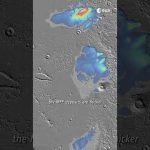
Our Mars Express has revisited one of Mars’s most intriguing features the Medusae Fossae, revealing what seems to be layers of water ice below the dusty surface.
If melted, this potential water would be enough to fill Earth’s Red Sea, or cover Mars in a layer of water up to 2.7 m deep!
📸 Planetary Science Institute/Smithsonian Institution 📸 European Space Agency / DLR / FU Berlin 📸 CReSIS/KU/Smithsonian Institution
Scientists are on a quest to understand how water, the foundation of life as we know it, reaches distant planets. The PDS 70 system, with its inner and outer discs hosting gas-giant planets, holds intriguing clues. Recently, MIRI, part of the James Webb Space Telescope, detected water vapor in the inner disc at distances less than 160 million km from the star – a zone where rocky, Earth-like planets may be taking shape!
This discovery is groundbreaking, as it delves into the region where terrestrial planets typically form. The PDS 70 star is relatively old, yet it surprisingly harbors water vapor, offering the raw materials needed for rocky world construction. But where did the water come from? Could it be forming in place or transported from the outer disc?
The PDS 70 system’s secrets await further exploration, and Webb’s NIRCam and NIRSpec instruments will soon dive deeper into this fascinating cosmic phenomenon. As we unlock the mysteries of water in space, we inch closer to understanding the origins of life beyond our own planet.
📹 ESA – European Space Agency
★ Subscribe: http://bit.ly/ESAsubscribe and click twice on the bell button to receive our notifications.
We are Europe’s gateway to space. Our mission is to shape the development of Europe’s space capability and ensure that investment in space continues to deliver benefits to the citizens of Europe and the world. Check out https://www.esa.int/ to get up to speed on everything space related.
Just think about the amount of food and water that a crew of astronauts would need to go all the way to Mars, as well as all the mental, physiological, and, most importantly, radiation risk challenges. How about we avoid all of those issues by putting the astronauts to sleep?
The main problem is that humans don’t hibernate. Astronauts would have to take a drug to induce hibernation and enter sleeping pods, quiet environments with low lights, high humidity, kept at temperatures below 10°C.
Hibernation not only promises to benefit astronauts in space, but it may also offer new potential applications for patient care on Earth.
★ Subscribe: http://bit.ly/ESAsubscribe and click twice on the bell button to receive our notifications.
We are Europe’s gateway to space. Our mission is to shape the development of Europe’s space capability and ensure that investment in space continues to deliver benefits to the citizens of Europe and the world. Check out https://www.esa.int/ to get up to speed on everything space related.