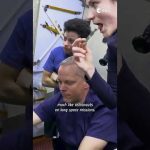
From the deep sea to outer space! Submarines are helping scientists’ study how humans adapt to extreme environments — just like astronauts on long space missions.
What we learn underwater today could shape the future of space exploration tomorrow.
📹 ESA – European Space Agency 📸 ESA/Portuguese Space Agency/Portuguese Navy
Steve Spangler is a bestselling author, STEM educator and Emmy award-winning television personality with more than 2,100 television appearances to his credit. Steve appeared as a regular guest on the Ellen DeGeneres Show from 2007-2022. Learn more about Steve at https://stevespangler.com/about-steve-spangler/
Steve Spangler is a bestselling author, STEM educator and Emmy award-winning television personality with more than 2,100 television appearances to his credit. Steve appeared as a regular guest on the Ellen DeGeneres Show from 2007-2022. Learn more about Steve at https://stevespangler.com/about-steve-spangler/
Lying in bed for a full 60 days – with one shoulder always touching the mattress – might sound like bliss, but add cycling, spinning and constant medical tests to the equation and it becomes a challenging experience for the sake of human space exploration.
A group of 12 volunteers are bracing themselves for a bedridden journey that put them into a compulsory reclined lifestyle. Participants are kept in beds tilted 6 degrees below the horizontal with their feet up – meals, showers and toilet breaks included.
As blood flows to the head and muscle is lost from underuse, researchers are charting how their bodies react. Bedrest studies offer a way of testing measures to counter some of the negative aspects of living in space.
During space missions, astronauts’ bodies go through a wide array of changes due to lack of gravity – everything from their eyes to their heart is affected, and muscles and bones start to waste away.
📹 @EuropeanSpaceAgency 📷 ESA/CNES/MEDES-IMPS
★ Subscribe: http://bit.ly/ESAsubscribe and click twice on the bell button to receive our notifications.
We are Europe’s gateway to space. Our mission is to shape the development of Europe’s space capability and ensure that investment in space continues to deliver benefits to the citizens of Europe and the world. Check out https://www.esa.int/ to get up to speed on everything space related.
The ‘Enabling Lunar In-Situ Agriculture by Producing Fertilizer from Beneficiated Regolith’ project, involves studying a combination of mechanical, chemical and biological processes to extract mineral nutrients from the lunar soil. Valuable elements might need concentrating before use, while undesirable ones would be removed.
The current study represents a proof of principle using available lunar regolith simulants, opening the way to more detailed research in future.
★ Subscribe: http://bit.ly/ESAsubscribe and click twice on the bell button to receive our notifications.
We are Europe’s gateway to space. Our mission is to shape the development of Europe’s space capability and ensure that investment in space continues to deliver benefits to the citizens of Europe and the world. Check out https://www.esa.int/ to get up to speed on everything space related.
The Pirs docking compartment (also called DC-1) left the International Space Station together with the Progress MS-16 cargo spacecraft after 20 years of service and burned up safely in the atmosphere above the Pacific Ocean on 26 July 2021. Its departure made room for the Nauka science module.
European Space Agency astronaut, Thomas Pesquet, filmed this video and shared on social media with the caption: “Here’s a timelapse of DC1’s re-entry last week, together with its tow truck, Progress 77P, seen from above. Atmospheric re-entry without a heat shield results in a nice fireball (you clearly see smaller pieces of melting metal floating away and adding to the fireworks). This timelapse is sped up, we could observe the fireball for around six minutes. Next time you see a shooting star, it might be our ISS trash getting burnt up… Not sure it will be granted in that case, but you never know, I’d still advise to go ahead and make a wish.”
We are Europe’s gateway to space. Our mission is to shape the development of Europe’s space capability and ensure that investment in space continues to deliver benefits to the citizens of Europe and the world. Check out https://www.esa.int/ to get up to speed on everything space related.