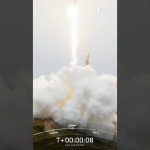
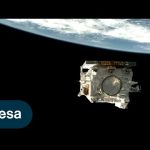
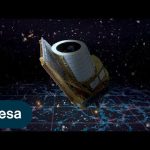
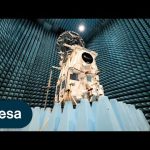
ESA’s EarthCARE satellite lifted off on a SpaceX Falcon 9 rocket from the Vandenberg Space Force Base in California, US, on 29 May at 00:20 CEST (28 May, 15:20 local time).
Developed as a cooperation between ESA and the Japan Aerospace Exploration Agency (JAXA), the Earth Cloud Aerosol and Radiation Explorer satellite carries a set of four instruments to make a range of different measurements that together will shed new light on the role that clouds and aerosols play in regulating Earth’s climate.
ESA’s EarthCARE satellite lifted off on a SpaceX Falcon 9 rocket from the Vandenberg Space Force Base in California, US, on 29 May at 00:20 CEST (28 May, 15:20 local time).
Developed as a cooperation between ESA and the Japan Aerospace Exploration Agency (JAXA), the Earth Cloud Aerosol and Radiation Explorer satellite carries a set of four instruments to make a range of different measurements that together will shed new light on the role that clouds and aerosols play in regulating Earth’s climate.
Credits: ESA/SpaceX
★ Subscribe: http://bit.ly/ESAsubscribe and click twice on the bell button to receive our notifications.
We are Europe’s gateway to space. Our mission is to shape the development of Europe’s space capability and ensure that investment in space continues to deliver benefits to the citizens of Europe and the world. Check out https://www.esa.int/ to get up to speed on everything space related.
ESA’s EarthCARE mission is ready for lift-off! EarthCARE is a groundbreaking satellite mission designed to unravel the mysteries of Earth’s clouds and aerosols. EarthCARE will shed light on the role that clouds and aerosols play in heating and cooling Earth’s atmosphere – contributing to our better understanding of climate change. During our live coverage, we’ll hear from mission scientists and spacecraft operators, then follow the launch on a SpaceX Falcon 9 from California, expected at 00:20 CEST. Live from ESA’s spacecraft operations centre in Germany, we take you into the main control room around 01:12 CEST for the satellite’s acquisition of signal – EarthCARE’s first sign of life from space.
Credits: ESA/SpaceX
Timestaps of the video: 00:00 – 38:24 – Start of ESA WebTV Programme – Live from the European Space Operations Centre 38:25 – 50:44 – SpaceX live broadcast begins 50:45 – 1:01:40 – Lift-off 1:01:41 – 1:06:35 – Spacecraft deployment 1:06:36 – 1:40:40 – Stay tuned 1:40:41 – 1:44:50 – ESA WebTV Programme – Live from the European Space Operations Centre 1:44:51 – 1:55:00 – Acquisition of signal
★ Subscribe: http://bit.ly/ESAsubscribe and click twice on the bell button to receive our notifications.
We are Europe’s gateway to space. Our mission is to shape the development of Europe’s space capability and ensure that investment in space continues to deliver benefits to the citizens of Europe and the world. Check out https://www.esa.int/ to get up to speed on everything space related.
Steve Spangler is a bestselling author, STEM educator and Emmy award-winning television personality with more than 2,100 television appearances to his credit. Steve appeared as a regular guest on the Ellen DeGeneres Show from 2007-2022. Learn more about Steve at https://stevespangler.com/about-steve-spangler/
Steve Spangler is a bestselling author, STEM educator and Emmy award-winning television personality with more than 2,100 television appearances to his credit. Steve appeared as a regular guest on the Ellen DeGeneres Show from 2007-2022. Learn more about Steve at https://stevespangler.com/about-steve-spangler/
🚩 Today we have the Battle of Tolbiac, which took place in Gaul during/after the collapse of the last fragments of the Western Roman Empire. Despite being fought in AD 496 (or 506, depending on who you ask) it marked the beginning of what would one day become modern France.
📚 Sources and citations: Visiting Battlefields: The Battle of Tolbiac – Denny Koch (2015) Bernard S Bachrach – Merovingian Military Organization, 481-751 (1972) John F. Drinkwater – The Alamanni and Rome 213-496: Caracalla to Clovis (2007) Peter Heather – The Restoration of Rome: Barbarian Popes and Imperial Pretenders (2013) Simon MacDowell, Angus McBride – Germanic Warrior, 236-568 (1996) Ian Wood – The Merovingian Kingdoms 450-751 (1994)
Get ready for a fizzy, fiery, and explosive good time with Science Max! This compilation is packed with mind-blowing chemical reactions that will have you bubbling over with excitement. First, Phil takes the classic baking soda volcano experiment to the MAX (literally!), using epic proportions and crazy chemicals to see what erupts. Then, he blasts off with a series of rockets powered by the surprising science of antacids! But wait, there’s more! Phil dives into the bubbly world of carbonation with a giant Diet Coke and Mentos fountain, and explores other cool reactions like crystal formation and light-emitting chemistry. This episode is guaranteed to leave you saying “WOW!” (and maybe a little sticky!).
Getting ready to image faraway planets, discussing artificial intelligence at NASA, and a milestone for our supersonic X-plane … a few of the stories to tell you about – This Week at NASA!
Link to download this video: https://images.nasa.gov/details/Getting%20Ready%20to%20Image%20Faraway%20Planets%20on%20This%20Week%20@NASA%20%E2%80%93%20May%2024,%202024
Video Producer: Andre Valentine Video Editor: Andre Valentine Narrator: Emanuel Cooper Music: Universal Production Music Credit: NASA
ESA’s Euclid space mission has released five unprecedented new views of the Universe. These never-before-seen images demonstrate Euclid’s remarkable ability to unravel the secrets of the cosmos. Scientists are now equipped to hunt for rogue planets, study mysterious matter through lensed galaxies, and explore the evolution of the Universe. Join us as we explore these groundbreaking discoveries and what they mean for the future of space exploration.
Credits: ESA – European Space Agency
Chapters: 00:00 – 00:36 Intro 00:36 – 01:14 The Galaxy Cluster Abell 2390 01:15 – 02:14 Messier 78: Stellar Nurseries and Galactic Formation 02:15 – 03:02 Galaxies in the Dorado Group 03:03 – 04:27 NGC 6744 04:28 – 05:25 Abell 2764 05:26 – 6:16 Conclusion
★ Subscribe: http://bit.ly/ESAsubscribe and click twice on the bell button to receive our notifications.
We are Europe’s gateway to space. Our mission is to shape the development of Europe’s space capability and ensure that investment in space continues to deliver benefits to the citizens of Europe and the world. Check out https://www.esa.int/ to get up to speed on everything space related.
#stiinta #fizica #science #tehnologie #technology #cristianpresura algoritm:”isterul construcției piramidelor egiptene. S-a rezolvat și ultima verigă din misterul construcției piramidelor! De la istoricul Herodot se știa cum s-au construit piramidele: nu au fost extratereștrii, ci zeci de mii de sclavi care munceau, pentru o piramidă, 20 de ani! Foloseau rampe și alte mecanisme inginerești ale vremii lor, pentru a urca și pune blocurile de piatră unul peste altul. Dar cum ajungeau blocurile de piatră, masive, acolo, de la mari distanțe? Recent, arheologii americani au găsit răspunsul: folosind un braț maritim al fluviului Nil, necunoscut până acum. Privit aici harta. În dreapta este Nilul. Linia albastră, punctată, din stânga este locul prin care, acum cinci mii de ani, trecea un braț al Nilului. Remarcați cum acesta trecea pe lângă locurile unde s-au construit cele mai mari piramide. Ei bine, pe el erau transportate marile blocuri de piatră și alte lucruri necesare constructorilor. Brațul a secat de atunci, iar urmele lui sunt ascunse în terenurile agricole de azi. Arheologii le-au găsit folosind săpături specifice și măsurători din satelit. Se poate ca de-a lungul acestui braț de apă, azi secat, să existe și alte construcții ascunse în pământ. Desigur, poate să scrie Herodot ce vrea și arheologii moderni să găsească orice, asta nu va opri niciun conspiraționist să pretindă că piramidele au fost construite de extratereștri”
ESA is releasing a new set of full-colour images captured by the space telescope Euclid. Five new portraits of our cosmos were captured during Euclid’s early observations phase, each revealing amazing new science. Euclid’s ability to unravel the secrets of the cosmos is something you will not want to miss.
Credits: ESA – European Space Agency
★ Subscribe: http://bit.ly/ESAsubscribe and click twice on the bell button to receive our notifications.
We are Europe’s gateway to space. Our mission is to shape the development of Europe’s space capability and ensure that investment in space continues to deliver benefits to the citizens of Europe and the world. Check out https://www.esa.int/ to get up to speed on everything space related.
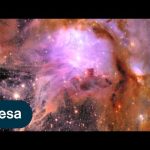
Today, ESA’s Euclid space mission releases five unprecedented new views of the Universe. The never-before-seen images demonstrate Euclid’s ability to unravel the secrets of the cosmos and enable scientists to hunt for rogue planets, use lensed galaxies to study mysterious matter, and explore the evolution of the Universe.
Read more about Euclid’s first images and download the individual images here:
Credits: ESA/Euclid/Euclid Consortium/NASA, image processing by J.-C. Cuillandre (CEA Paris-Saclay), G. Anselmi
★ Subscribe: http://bit.ly/ESAsubscribe and click twice on the bell button to receive our notifications.
We are Europe’s gateway to space. Our mission is to shape the development of Europe’s space capability and ensure that investment in space continues to deliver benefits to the citizens of Europe and the world. Check out https://www.esa.int/ to get up to speed on everything space related.
Join us as NASA Administrator Bill Nelson and Deputy Administrator Pam Melroy host a town hall on artificial intelligence (AI) and the future of AI across the agency.
NASA experts participating in this town hall include:
Katherine Calvin, NASA Chief Scientist A.C. Charania, NASA Chief Technologist David Salvagnini, NASA Chief Artificial Intelligence Officer Jeff Seaton, NASA Chief Information Officer
00:01:36 Ce e viața? 00:04:26 De ce s-a rupt alianța PNL-USR? 00:09:03 Ieșirea din USR 00:28:24 Capcana “votului util” 00:29:32 Pe scurt 00:31:46 despre Partidul REPER 00:34:47 Primele trei priorități 00:38:23 Ce inseamnă să fii european? 00:48:25 Politicieni europeni 00:51:07 Ce ai facut pentru Romania, de la Bruxelles? 01:09:46 Câtă “putere” are un politician? 01:15:27 Ce înseamnă să fii lider european? 01:20:22 Cel mai dificil politician 01:22:07 Cel mai “plăcut” politician? 01:32:02 Viitorul satului românesc
Steve Spangler is a bestselling author, STEM educator and Emmy award-winning television personality with more than 2,100 television appearances to his credit. Steve appeared as a regular guest on the Ellen DeGeneres Show from 2007-2022. Learn more about Steve at https://stevespangler.com/about-steve-spangler/
#stiinta #fizica #science #tehnologie #technology #cristianpresura Știai că cel mai mare deșert din lume conține cea mai mare parte a apei dulci de pe planetă? Antarctica este considerată un deșert deoarece practic nu are precipitații. Dar ca Muntele Fuji de langă Tokyo a erupt ultima dată în 1707? Cutremurele și tsunami-ul care au urmat au ucis 30.000 de persoane, iar câmpurile de orez au rămas sterile timp de 100 de ani. Un tsunami este un val masiv care se revărsă peste uscat și distruge totul în calea sa. Poate avea 30 de metri înălțime când lovește țărmul. Știai că fosile marine sunt adesea găsit pe vârfurile înalte ale munților. De ce? Pentru că multe vârfuri de munte au fost odată pe fundul mărilor, iar apoi împinse în sus de mișcările maselor de pământ. De exemplu, eu am văzut fosile de corali marini pe vârful Buila, din județul Vâlcea.Tu ai văzut așa ceva?
Steve Spangler is a bestselling author, STEM educator and Emmy award-winning television personality with more than 2,100 television appearances to his credit. Steve appeared as a regular guest on the Ellen DeGeneres Show from 2007-2022. Learn more about Steve at https://stevespangler.com/about-steve-spangler/
Știai că Jupiter este de două ori mai mare decât toate celelalte planete din Sistemul Solar combinate? C durează puțin sub 10 ore terestre. Jupiter nu are o suprafață stâncoasă; dacă ai arunca un obiect din vârfurile norilor, acesta nu ar “ateriza” niciodată. Forța gravitațională a lui Jupiter este atât de puternică, încât afectează traiectoriile cometelor și ale asteroizilor. Planeta este faimoasă pentru Marele Punct Roșu, o furtună gigantică mai mare decât Pământul care are cel puțin 300 de ani vechime. Jupiter are aproape 100 de sateliți naturali și un sistem de inele, descoperit de sonda Voyager Pe Jupiter nu există anotimpuri. Planeta nu se înclină suficient de mult pe axa sa, pentru a produce diferențe de temperatură în timpul anului. Tu ce ai vrea să vizitezi dacă ai merge la Jupiter?
Join Ariane 6 launch system architect, Tina, as she shows us a day in her life.
Tina has worked on space transport systems for 20 years now. She first worked on the Automated Transfer Vehicle (ATV), then on the Ariane 5 Mid-life Evolution development and now on Europe’s newest launcher Ariane 6.
How did she become a rocket scientist?
“I was lucky enough to spend some months in French Guiana as a student for an internship and working there got me hooked – I was determined to come back for my job one day, and here I am: I spent a great part of 2023 in Kourou testing the Ariane 6 propulsion system, together with an amazing team of very skilled professionals.
I consider myself extremely lucky to have a job and colleagues that make me want to get out of bed and into the office every day – because we love what we do and because the people are simply amazing!”
Hold onto your hats, because Science Max is taking you on a high-octane ride through the science of transportation! This epic compilation throws you into the driver’s seat of three incredible experiments. First, Phil tackles the science of stored energy by building a giant (we’re talking giant!) spool racer. Can he harness enough power to make it zoom? Next, we dive into the watery world of propulsion with a massive, 500-liter water-powered car! Buckle up as Phil pushes the limits (and gets soaked!). Finally, Phil gets his dragster on in a high-speed experiment that uses inertia to take things to the max. Get ready for mind-blowing science, epic fails (hey, that’s science too!), and maybe even a pumpkin carving demonstration with a pressure washer (seriously!). This episode is guaranteed to get your motor running!
Practicing Artemis Moonwalks in the desert, a developmental milestone for our lunar-roving robot, and previewing our new polar climate mission … a few of the stories to tell you about – This Week at NASA!
A new satellite called EarthCARE launching later this month will provide unprecedented data on clouds and aerosols, contributing to our understanding of climate change. As we approach its launch, join us as we delve into the minds of some of the individuals who have contributed to EarthCARE over the years.
The mission will shed new light on the role that clouds and aerosols play in regulating Earth’s temperature.
This video features interviews with: Dave Donovan, Senior Scientist at the Royal Netherlands Meteorological Institute, Robin Hogan, Senior Scientist at the European Centre for Medium-Range Weather Forecasts, Ulla Wandinger, Senior Scientist at Leibniz Institute for Tropospheric Research, Alain Lefebvre, Retired Project Manager of EarthCARE at ESA, Hajime Okamoto, Director, Research Institute for Applied Mechanics, Kyushu University, Bjoern Frommknecht, EarthCARE Mission Manager at ESA, Edward Baudrez, Scientific Assistant at the Royal Meteorological Institute of Belgium, Thorsten Fehr, EarthCARE Mission Scientist at ESA, Pavlos Kollias from Stony Brook University – McGill University and Dirk Bernaerts, EarthCARE Project Manager at ESA.
We are Europe’s gateway to space. Our mission is to shape the development of Europe’s space capability and ensure that investment in space continues to deliver benefits to the citizens of Europe and the world. Check out https://www.esa.int/ to get up to speed on everything space related.
Join us live on 22 May at 16:35 BST (17:35 CEST) as ESA Director General Josef Aschbacher announces the first two astronaut missions for the new ESA astronaut class of 2022 on the first day of the Space Council, held in Brussels on 22 and 23 May 2024.
ESA’s most recent class of astronauts selected in 2022 includes Sophie Adenot, Pablo Álvarez Fernández, Rosemary Coogan, Raphaël Liégeois, and Marco Sieber. They recently completed one year of basic training and graduated as ESA astronauts on 22 April at ESA’s European Astronaut Centre in Germany, making them eligible for spaceflight. During their missions aboard the International Space Station, ESA astronauts will engage in a diverse range of activities, from conducting scientific experiments and medical research to Earth observation, outreach and operational tasks.
★ Subscribe: http://bit.ly/ESAsubscribe and click twice on the bell button to receive our notifications.
We are Europe’s gateway to space. Our mission is to shape the development of Europe’s space capability and ensure that investment in space continues to deliver benefits to the citizens of Europe and the world. Check out https://www.esa.int/ to get up to speed on everything space related.
Steve Spangler is a bestselling author, STEM educator and Emmy award-winning television personality with more than 2,100 television appearances to his credit. Steve appeared as a regular guest on the Ellen DeGeneres Show from 2007-2022. Learn more about Steve at https://stevespangler.com/about-steve-spangler/
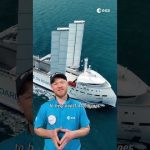
🚀 Have you ever wondered how we transport rockets?
All the elements that make up Ariane 6 are manufactured in mainland Europe and then transported by this ship, named Canopée.
It is the first custom-built transporter to use sails, reducing emissions and saving on fuel by up to 30%, and on this trip, it travels for 10 days covering over 7000 km to reach Europe’s Spaceport in French Giuana.
The hybrid-propulsion vessel is 121 m long and has 37 m tall sails. Canopée rotates continuously between stop-offs to load each Ariane 6 stage and other parts and ship them across the Atlantic Ocean to Europe’s spaceport.
👉 Register for ChatGPT & AI workshop for FREE: https://web.growthschool.io/HIS 👉 100% Discount for first 1000 people 🔥 👉 Become the top 1% professional by learning ChatGPT and AI today 🔥 ❤️ Reshare this with your friends who will need this 😇
📚 Sources: Doukas – Historia Byzantina, Decline and Fall of Byzantium to the Ottoman Turks, trans. H.J. Magoulias (Detroit, 1975) Ahmed Ibn Arabshah – Tamerlane or Timur the Great Amir, trans J.H Sanders (London, 1936) Johann Schiltberger – The Bondage and Travels of Johann Schiltberger in Europe, Asia and Africa 1396-1427, trans. J. Buchan Telfer (London, 1879) Beatrice Forbes Manz – The Rise and Rule of Tamerlane, (Cambridge, 1989) Justin Marozzi – Tamerlane: Sword of Islam, Conqueror of the World, (Cambridge, 2006) Hilda Hookham – Tamburlaine the Conqueror, (London, 1962) Donald Nicol – The Last Centuries of Byzantium 1261 – 1453 second edition, (Cambridge, 1993) Halil Inalcik – The Ottoman Empire – The Classical Age, 1300-1600 (London, 1973) Erik Hildinger – Warriors of the Steppe: Military History of Central Asia, 500BC – 1700AD (New York, 1997)
Aurora made a rare appearance across both the Northern and Southern Hemisphere skies after Earth was hit by one of the strongest geomagnetic storms for years. The storm over the weekend was classed as the highest G5.
Don’t worry if you missed them, we are entering a “solar maximum” where the Sun becomes very active meaning more storms and a greater chance of seeing Aurora in more places.
Let us know if and where you saw them in the comments👇
Steve Spangler is a bestselling author, STEM educator and Emmy award-winning television personality with more than 2,100 television appearances to his credit. Steve appeared as a regular guest on the Ellen DeGeneres Show from 2007-2022. Learn more about Steve at https://stevespangler.com/about-steve-spangler/
#stiinta #fizica #science #tehnologie #technology #cristianpresura “Ce vedem aici este o “ploaie solara”! In partea de jos este suprafata Soarelui. In partea de sus este atmosfera Soarelui, denumita si corona sau coroana, in termeni populari. Doar ca amosfera Soarelui, care se intinde pe milioane de kilometri, este facuta din plasma, in cazul de fata un gaz puternic ionizat. Asta se vede foarte bine in pozele cu eclipse de Soare. Plasma, din care este facut atmsofera Soarelui, ascunde un mister: temperatura ei este de milioane de grade Celsius, desi suprafata Soarelui are doar 6000 de grade Celsius. Cum se poate?In mod normal, cand ne indepartam de foc, temperatura scade.iata misterul nerezolvat! In imagine vedem cum plasma din atmsofera se raceste si cade apoi catre suprafata Soarelui, in linii luminoase, despre care se crede ca urmeaza liniile de camp magnetic. Mai vedem pe suprafata Soarelui tot felul de structuri ce fac parte din cromosfera, care este partea de jos a atmsoferei Soarelui, de doar cateva mii de kilometri inaltime. Cromosfera este interfata dintre Soarele ce “bolboroseste” si atmosfera lui. Aici se initiaza eruptiile solare. Un lucru e cert daca privim din nou aceasta “ploaie” de pe Soare: nu ne va racori! “
A group of 12 volunteers are sticking to a strict bed routine for 60 days, lying with their feet up and one shoulder always touching the mattress. This reclined lifestyle includes meals, showers and toilet breaks, as well as intensive cycling and centrifuge rides for some.
The BRACE study follows a two-month bedtime schedule to investigate how cycling and artificial gravity could counteract changes the human body experiences in space.
Astronauts face similar physiological problems as elderly and bedridden patients on Earth. During space missions, astronauts’ bodies go through a wide array of changes – everything from their eyes to their heart might be affected, and their muscles and bones start to deteriorate. To battle this degradation, crew members exercise two hours per day on the International Space Station.
The BRACE study involves male participants between the ages of 20 and 45 years with good physical and mental health. They are placed in beds tilted 6° below the horizontal position. As blood flows to the head and muscle wears out from lack of use, researchers chart how their bodies react.
Researchers split the volunteers in three groups. One group cycles in bed, a second one cycles while being spun on a centrifuge, and a third control group stays in bed for the full two months with no bike exercise or centrifuge rides. The centrifuge mimics artificial gravity, acting on all organs at once. Volunteers are spun to drive blood towards their feet, where the force of gravity doubles during the ride. Scientists hope artificial gravity could be used to keep astronauts fit and healthy in space.
Now halfway through its second edition, the experiment will finish on 4 May 2024, after 95 days of intense clinical testing and monitoring. This campaign takes place at MEDES, the Institute for Space Medicine and Physiology in Toulouse, France, and is supported by the French Space Agency CNES.
The study involves 14 European and international science teams that are working to release the results from the first BRACE campaign in 2023. Researchers are assessing a wide range of changes in the cardiovascular, metabolic, musculoskeletal, neuro-sensorial, haematological, and immunological systems.
The tests will provide a better understanding of the effects of prolonged bedrest to the benefit of those in space and on Earth. Results could help design countermeasures and improve health for patients suffering from accelerated ageing due to a sedentary lifestyle.
Get ready for a magnetic overload with Science Max! This compilation is bursting with electrifying experiments and surprising science facts. First, Phil explores the mind-blowing world of magnetic levitation – can we use magnets to make things float (including himself!)? Then, he cranks things up a notch by building the strongest electromagnet he can and plays with some seriously cool ferrofluid (think science wizardry!). But wait, there’s more! Phil takes a detour into the world of power with a giant, pumpkin-launching trebuchet. This episode has it all – magnets, electricity, and pumpkin projectiles! Buckle up and prepare to be amazed!
A new target launch date for our Boeing Crew Flight Test, making progress on major hardware for Gateway, and presidential honors for helping to advance NASA’s mission … a few of the stories to tell you about – This Week at NASA!
Video Producer: Andre Valentine Video Editor: Haley Reed Narrator: Emanuel Cooper Music: Universal Production Music
Steve Spangler is a bestselling author, STEM educator and Emmy award-winning television personality with more than 2,100 television appearances to his credit. Steve appeared as a regular guest on the Ellen DeGeneres Show from 2007-2022. Learn more about Steve at https://stevespangler.com/about-steve-spangler/
🚩 Click https://betterhelp.com/historymarche for 10% off your first month of therapy with our sponsor BetterHelp. 🚩 Join over 4 million people who’ve met with a therapist on BetterHelp and started living a healthier, happier life.
🚩Big thanks to Eastern Roman History and Warhawk for collaborating with me on this video. Check out their awesome history content: Eastern Roman History https://www.youtube.com/@EasternRomanHistory Warhawk https://www.youtube.com/@WarhawkYT
🎼 Music: Instinct – Bensound Impact Allegretto – Kevin MacLeod Crypto – Kevin MacLeod Epidemic Sound Filmstro
📚 Primary sources: Al Baladhuri, The Origins of the Islamic State, translated by Philip K. Hittil, Vols. II (New York: Columbia University, 1916). History of the Patriarchs, Severus ibn al Muqaffaʿ, Alexandrinische Patriarchengeschichte von S. Marcus bis Michael I 61-767, nach der ältesten 1266 geschriebenen Hamburger Handschrift im arabischen Urtext, edited by C. F. Seybold (Hamburg, 1912). John of Nikiu, The Chronicle of John Bishop of Nikiu, translated by R. H. Charles (London: Williams and Norgate, 1913).
📚 Scholarship: Booth, P., ‘The Muslim Conquest of Egypt Reconsidered’ in Zuckerman, C. Constructing the Seventh Century, (Paris, 2013). 639-670. Butler, A. J., The Arab Conquest of Egypt and the Last Thirty Years of Roman Dominion, Reprint 1978 (Oxford: Oxford University Press, 1902). Howard-Johnston, J., Witnesses to a World Crisis: Historians and Histories of the Middle East in the Seventh Century, (Oxford: Oxford University Press, 2010).