Aboard the International Space Station, NASA astronauts Nichole Ayers, Anne McClain, and Jonny Kim share a Fourth of July message and extend their best wishes to those back on Earth in a video recorded on June 16, 2025.
Meet Flyeye — the telescope that sees space like a fly! 🪰
With its very first glimpse of the sky, Flyeye is ready to begin scanning for asteroids that might one day come a little too close to Earth.
Inspired by the compound eye of a fly, it can spot a huge chunk of sky in one go — more than 200 times the area of the full Moon. And it’s designed to do it all automatically, night after night.
It hasn’t found any space rocks yet, but it’s only just opened its eye. This is the first step towards a future network of fly-eyed telescopes keeping watch over our planet.
With only a very thin atmosphere, and no magnetic field, the Moon can’t protect itself from the elements that come from outer space, making the outlook look bleak for our grey companion.
What the Moon does experience is solar wind, a stream of tiny particles coming from the Sun.
During some parts of the month, Earth’s own magnetic field partially shields the Moon from the stream of solar wind particles that constantly bombard it.
Following the successful launch of Axiom Mission 4 from NASA’s Kennedy Space Center on Wednesday, June 25, its four crew members are arriving at the International Space Station.
Ax-4 is scheduled to dock with the station at 6:30 a.m. EDT (1030 UTC) on Thursday, June 26; arrival coverage will continue as the Ax-4 crew enters the station and makes welcome remarks. During their two-week stay aboard the orbiting laboratory, the crew of Ax-4 will engage in science, outreach, and commercial activities.
Peggy Whitson, former NASA astronaut and director of human spaceflight at Axiom Space, is commanding the mission, with ISRO (Indian Space Research Organisation) astronaut Shubhanshu Shukla serving as pilot. The two mission specialists are ESA (European Space Agency) project astronaut Sławosz Uznański-Wiśniewski of Poland and Tibor Kapu of Hungary. This mission is sending the first ISRO astronaut to the station as part of a joint effort between NASA and the Indian space agency. Ax-4 is also carrying the first astronauts from Poland and Hungary to stay aboard the space station.
Whether you’re marking the solstice, enjoying a yoga session for International Yoga Day or listening to your favourite tune for World Music Day, 21 June invites us all to pause, soak in the sunlight and tune in to what makes us feel alive.
This year’s solstice happened at exactly 04:42 AM CEST, the moment the Sun reached its northernmost point in the sky. Seen from space, Earth puts on quite the show. These views capture a full year of shifting light and shadow, from one June solstice to the next.
At this point in our orbit, the day–night line (known as the terminator) is tilted at its most dramatic angle. The Northern Hemisphere gets its longest day of the year, while the Southern Hemisphere experiences its shortest. So whether you’re basking in the glow or curling up in the dusk, we wish you a happy solstice — and a moment to breathe, move and groove.
What if satellite cloud data could become music? Meet Hakuryu — a dragon born as the European Space Agency’s EarthCARE satellite, singing a song of peace for our planet.
EarthCARE is the European Space Agency’s most advanced Earth Explorer launched to date, equipped with instruments that help us understand clouds and aerosols in new and unprecedented ways.
It is a collaboration between ESA and the Japanese Aerospace Exploration Agency, JAXA, who designed and developed the satellite’s Cloud Profiling Radar (CPR) instrument. JAXA called EarthCARE Hakuryu, which is Japanese for White Dragon.
Hakuryu now lends its name to the title of a groundbreaking immersive installation that creates an audiovisual story from EarthCARE cloud and aerosol data in a way that has never been seen or heard before.
Through data sonification, Hakuryu transforms over thirty types of data into immersive soundscapes and music. Clouds become choirs as Hakuryu sings to Earth, with voices from notable public, scientific and ESA figures joined by those needing care most – people from the frontline of climate change, displacement and conflict.
Adding to this, data from atmospheric elements such as rain, snow, dust and smoke are rendered as rich environmental sonic textures. Simultaneously the same data is transformed into clouds, creating a vibrant trail behind an animated white dragon. Viewers slowly fly with Hakuryu, in a beautiful representation of Earth as it moves from day into night on its journey around the sun.
The film you see here comprises one entire EarthCARE orbit around our planet. It is running live all week at ESA’s Living Planet Symposium in Vienna, from 23 to 27 June 2025, as an immersive installation. Following its debut, Hakuryu will travel the world in a variety of ways soon to be revealed.
We are Europe’s gateway to space. Our mission is to shape the development of Europe’s space capability and ensure that investment in space continues to deliver benefits to the citizens of Europe and the world. Check out https://www.esa.int/ to get up to speed on everything space related.
A miniature capsule shoots off at 4000 km per hour, mimicking the aerodynamics of a Mars atmospheric entry before crashing at supersonic speeds into a wall.
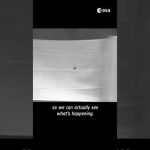
The tiny replica of the Entry, Descent and Landing Module (EDLM) blasts off from a smooth bore gun faster than a speeding bullet. This video has been slowed down 60 times – the actual flight lasted just half a second.
This activity is part of a series of free-flight experiments with a scaled-down version of the ExoMars landing module – measuring just 8 cm in diameter compared to the actual 3.8-metre spacecraft that will carry the Rosalind Franklin rover.
These tests provide critical data on how the spacecraft will behave during its entry into the martian atmosphere. Following a two-year journey to the Red Planet, the ExoMars descent module will approach Mars at a speed of 21 000 km per hour, relying on heat shields, parachutes and retro rockets to land safely.
The first set of tests took place in March at the French-German Research Institute of Saint-Louis(ISL), a front-line research centre with facilities for investigating the aerodynamics of vehicles like reentry capsules.
Engineers equipped the mini ExoMars landing capsule with internal electronics to monitor its 400-metre flight path. The test models were mounted in special sabots that detached from the capsules when fired from the smooth powder gun. Test speeds ranged from 1800 to 4300 kilometres per hour.
The team used 20 models during the tests. Each model carried several sensors to collect flight data. Teams used shadowgraph imaging, magnetometers, accelerometers, and radar to analyse the capsule’s movement, trajectory and stability.
📹 European Space Agency (ESA) 📸 Thales Alenia Space Italia, Ariane Group, Fluid Gravity Engineering Ltd, French-German Research Institute of Saint-Louis
What does it take to gaze through time to our universe’s very first stars, galaxies, and light? “Cosmic Dawn: The Untold Story of the James Webb Space Telescope,” a NASA+ documentary, takes you behind the scenes of Webb’s journey, through the eyes of the dreamers who made it possible.
The documentary brings viewers on an unprecedented journey through Webb’s delicate assembly, rigorous testing, and triumphant launch, showcasing the sheer complexity and breathtaking risks involved in creating a telescope capable of peering billions of years into the past. Follow the telescope from an idea developed at NASA’s Goddard Space Flight Center all the way to the launchpad in French Guiana, with never-before-seen footage captured by the Webb film crew offering intimate access to the challenges and triumphs along the way.
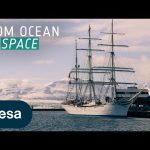
After an extraordinary six-week voyage from northern Norway, the iconic Norwegian tall ship Statsraad Lehmkuhl has docked in Nice, France, concluding ESA’s 2025 Advanced Ocean Training Course. Braving everything from wild storms to calm seas, students aboard mastered techniques for collecting ocean measurements and harnessed satellite data to unlock insights into our blue planet. Led by experts, this real-world expedition offered more than education – it sparked curiosity and a deeper commitment to understanding and protecting our oceans.
We are Europe’s gateway to space. Our mission is to shape the development of Europe’s space capability and ensure that investment in space continues to deliver benefits to the citizens of Europe and the world. Check out https://www.esa.int/ to get up to speed on everything space related.
Coming June 2025 to NASA+, YouTube, and other platforms, the original documentary film “Cosmic Dawn” takes you behind the scenes of the James Webb Space Telescope.
Relive the pitfalls and the triumphs of the world’s most powerful space telescope—from developing the idea of an impossible machine to watching with bated breath as it unfolded, hurtling through space a million miles away from Earth.
You’ve seen the universe through the eyes of Webb. Now discover how this technological marvel came about through the eyes of the scientists, engineers, and dreamers who made it possible.
Roy Gibson was ESA’s very first Director General. Born in 1924, he led the Agency from its foundation in 1975 until 1980.
Ulf Merbold was the first ESA astronaut to fly in space, as part of the crew of the STS-9 Spacelab 1 mission on Space Shuttle Columbia in 1983.
Claudie Heigneré made history in 2001 as the first female European astronaut on a ‘taxi flight’ to the International Space Station.
Gerhard Schwehm was ESA’s first planetary scientist, working on the Giotto mission that provided the first close-up images of a comet nucleus. He then became Mission Manager for the Rosetta mission until his retirement.
Paolo Ferri dedicated 20 years to Rosetta, first as Operations Manager, then as Flight Director, and eventually as Head of the Mission Operations Department.
Elsa Montagnon is currently Head of the Mission Operations Division. Previously, she was Spacecraft Operations Manager for BepiColombo, Europe’s first mission to Mercury, launched in 2018.
Josef Aschbacher became ESA Director General in 2021. From 2016–21, he was ESA Director for Earth Observation Programmes He has been a key leader of the European Copernicus programme, which is now considered to be one of the most successful Earth observation programmes in the world.
📹 European Space Agency (ESA) 📸 European Space Agency (ESA)
For half a century, the European Space Agency (ESA) has been serving Europe as its space agency and inspiring its citizens. On 30 May 1975, the ESA Convention was signed by 10 founding Member States and has since now expanded to 23 Member States, three Associate Members, four Cooperating States and a Cooperation Agreement with Canada. This anniversary year provides the opportunity to reflect not only on ESA’s past achievements, but even more so on its future perspectives.
Credits: European Space Agency (ESA)
*Correction: 1990, Launch of NASA/ESA Hubble Space Telescope*
We are Europe’s gateway to space. Our mission is to shape the development of Europe’s space capability and ensure that investment in space continues to deliver benefits to the citizens of Europe and the world. Check out https://www.esa.int/ to get up to speed on everything space related.
Axiom Mission 4, set to lift off at 2:31 a.m. EDT (0631 UTC) on Wednesday, June 25, is Axiom’s fourth private astronaut mission to the International Space Station. Ax-4 is launching from NASA’s Kennedy Space Center aboard SpaceX’s Dragon spacecraft.
During their two-week stay aboard the orbiting laboratory, the crew of Ax-4 will engage in science, outreach, and commercial activities.
Peggy Whitson, former NASA astronaut and director of human spaceflight at Axiom Space, will command the mission, while ISRO (Indian Space Research Organisation) astronaut Shubhanshu Shukla will serve as pilot. The two mission specialists are ESA (European Space Agency) project astronaut Sławosz Uznański-Wiśniewski of Poland and Tibor Kapu of Hungary. This mission will send the first ISRO astronaut to the station as part of a joint effort between NASA and the Indian space agency. Ax-4 will also carry the first astronauts from Poland and Hungary to stay aboard the space station.
Launch coverage is led by Axiom Space, with support from NASA and SpaceX; NASA’s primary mission responsibilities begin during Dragon’s approach to the International Space Station, the start of Ax-4 integrated operations. Learn more about NASA’s role in Ax-4 and how we’re working with our industry partners to open low Earth orbit to more people, more science, and more opportunities: https://go.nasa.gov/4mRkpGj
Song: ‘Apache’ by Kevin Graham Content ID: WXGBDH0A08QGK9CG
Song: ‘Majestic Skies’ by Strength To Last Content ID: VINOM8MWVMC8LB7X
When it comes to experiments in space, astronauts on the International Space Station face challenges you won’t find on Earth: bubbles don’t rise, things float away and many Earth-based lab tools don’t always work the same way. So science in space needs to me reimagined from the ground up.
A NASA scientist explains how we study life, chemistry and physics in orbit.
How big is space? It’s one of the most mind-bending questions we can ask because the deeper we look, the more the universe keeps going. We’ve measured billions of light-years in every direction and still haven’t reached the edge.
A NASA scientists explains what we know — and don’t know — about the size of the cosmos.
Europe’s Galileo is the world’s most precise satellite navigation system, providing metre-level accuracy to billions of users. ESA and European industry are preparing a new generation of satellites for the European Union, the Galileo Second Generation or G2, that will revolutionise the fleet with enhanced capabilities.
Galileo Second Generation satellites will integrate seamlessly with the current fleet to form the largest European satellite constellation and deliver essential services worldwide. With fully digital navigation payloads, electric propulsion, a better-performing navigation antenna, inter-satellite link capacity and an advanced atomic clock configuration, G2 satellites will provide more robust and reliable positioning, navigation and timing.
Galileo is managed and funded by the European Commission, in partnership with ESA and EUSPA. Since its inception, ESA leads the design and development and is entrusted with R&D activities. EUSPA is the system prime for the operational system and oversees the exploitation of services.
We are Europe’s gateway to space. Our mission is to shape the development of Europe’s space capability and ensure that investment in space continues to deliver benefits to the citizens of Europe and the world. Check out https://www.esa.int/ to get up to speed on everything space related.
Will the Sun ever burn out? Not quite, but it will change dramatically. Like all stars, it’s going through a life cycle powered by nuclear fusion. Right now, it’s halfway through its 10-billion-year lifetime.
Eventually, the Sun will expand into a red giant, engulfing the inner planets, then collapse into a white dwarf — a small, hot, dim remnant of its former self.
A NASA scientist explains what’s ahead for our star.
Subscribe to NASA’s flagship YouTube channel to join astronauts on a spacewalk, watch rocket launches, see innovative technology, chat with scientists, and so much more. This is your ticket to discover, innovate and explore with NASA.
Watch live video from the International Space Station, including inside views when the crew aboard the space station is on duty. Views of Earth are also streamed from an external camera located outside of the space station. During periods of signal loss due to handover between communications satellites, a blue screen is displayed.
The space station orbits Earth about 250 miles (425 kilometers) above the surface. An international partnership of five space agencies from 15 countries operates the station, and it has been continuously occupied since November 2000. It’s a microgravity laboratory where science, research, and human innovation make way for new technologies and research breakthroughs not possible on Earth. More: https://go.nasa.gov/3CkVtC8
Did you know you can spot the station without a telescope? It looks like a fast-moving star, but you have to know when to look up. Sign up for text messages or email alerts to let you know when (and where) to spot the station and wave to the crew: https://spotthestation.nasa.gov
Scientists speculate that the black hole is pulling in gas from nearby space and this has formed a disc of orbiting material around it. Something like a star or small black hole also orbiting around it, is flying through the disc over and over, causing shockwaves and powerful energy bursts.
Watching these repeated eruptions in real time gives scientists a rare chance to study how black holes behave and learn more about these strange, powerful events. But for now, we still have more questions than answers.
What exactly is a black hole? Well, they’re not holes at all, rather incredibly dense regions in space with gravity so strong, not even light can escape.
There are stellar-mass black holes, which form when massive stars collapse and explode in a supernova, and supermassive black holes, which are millions to billions of times more massive and sit at the centers of galaxies.
Scientists know these cosmic powerhouses shape galaxies and influence how the universe evolves. But how do supermassive black holes form? That’s still one of astronomy’s biggest mysteries. A NASA scientist explains what we know (and don’t know) about these cosmic gargantuans.
A new study shows that the Nord Stream methane leak that happened in 2022 was bigger than we thought. How much bigger? Watch our video until the end to find out.
📹 European Space Agency (ESA) 📸 Pexels, contains modified Copernicus Sentinel data (2022), processed by ESA, GHGSat, Pléiades Neo, Planet Labs PBC
Our Biomass satellite has successfully launched, marking a major leap forward in understanding Earth’s forests and their vital role in the carbon cycle.
It lifted off on 29 April 2025 from Europe’s Spaceport in French Guiana aboard Vega-C, and is already sending back its first signals. Over the next few days, our mission controllers will carefully deploy Biomass’ enormous 12-metre-wide reflector – the key to its unique abilities.
📹 European Space Agency (ESA) 📸 ESA/CNES/Arianespace
After seven months, 93 million miles, and 670,000 photos, astronaut Don Pettit has returned to Earth. Pettit is taking part in a news conference on Monday, April 28, to discuss his 220-day mission to the International Space Station.
Pettit returned to Earth on April 19 (April 20, Kazakhstan time), along with Roscosmos cosmonauts Alexey Ovchinin and Ivan Vagner. Pettit celebrated his 70th birthday on April 20. During his time in orbit, Pettit conducted hundreds of hours of scientific investigations, including research into 3D printing, water sanitization, and growing plants in space.
Have questions for Don? Join us on NASA’s Instagram account after the news conference for a live Q&A: https://www.instagram.com/nasa/
In celebration of the NASA/ESA Hubble Space Telescope’s 35 years in Earth orbit, an assortment of images that were recently taken by Hubble has been released today. This stretches from the planet Mars to images of stellar birth and death, and a magnificent neighbouring galaxy. After over three decades of scrutinising our Universe, Hubble remains a household word as the most well-recognised telescope in scientific history.
ESA’s state-of-the-art Biomass mission is designed to provide new insights into the health and evolution of the world’s forests, helping us understand how they are changing over time and, importantly, their critical role in the global carbon cycle. Equipped with the first-ever fully polarimetric P-band synthetic aperture radar, this satellite can penetrate dense forest canopies. The long 70 cm wavelength of the radar enables it to measure ‘biomass’—the woody trunks, branches and stems—where trees store the majority of their carbon.
Credits: European Space Agency (ESA)
★ Subscribe: http://bit.ly/ESAsubscribe and click twice on the bell button to receive our notifications.
We are Europe’s gateway to space. Our mission is to shape the development of Europe’s space capability and ensure that investment in space continues to deliver benefits to the citizens of Europe and the world. Check out https://www.esa.int/ to get up to speed on everything space related.
How are we made of star stuff? Nearly all the elements in your body were forged in ancient stars long before Earth, the Sun or our galaxy even existed. When those stars exploded, they sent their material out into space, scattering elements like carbon, oxygen and iron across the universe. Billions of years later, those same ingredients came together to form everything we know — including you.
A NASA scientist explains how we really are made of star stuff and how telescopes like Hubble and Webb help us trace our cosmic origins.
Each year on 22 April, people across the planet join forces to raise awareness about the unequivocal effects of climate change and the importance of protecting our planet for future generations. We celebrate Earth Day every day at ESA. 💙
📹 European Space Agency (ESA) 📸 ESA/NASA 🎙️ The audio features a clip from David Attenborough
NASA missions have shared unique views of our home planet for more than 60 years. In that time, science and technology in air and space revolutionized our understanding of the Earth system.
We continue to move farther into space, documenting the universe around us. It’s when we turn our gaze back home that we are reminded of the significance of Earth.
To learn more about the NASA missions included in the video, visit:
Watch a SpaceX Dragon spacecraft dock to the International Space Station after a successful liftoff on April 21 at 4:15 a.m. EDT (0815 UTC). The spacecraft is carrying supplies – including food and essential equipment for the crew – as well as a variety of science experiments.
The Dragon spacecraft is scheduled to remain at the space station until May, when it will depart and return to Earth with research and cargo, splashing down off the coast of California.
Learn more about the science aboard, including studies to produce gold nanoparticles and to test a vision-based sensor that could improve navigation: https://youtu.be/4841piONzVk
On Thursday, May 1, NASA astronauts Anne McClain and Nichole Ayers will step outside the International Space Station to complete station upgrades. The spacewalk is scheduled to begin at 8 a.m. EDT (1200 UTC) and last about six and a half hours.
McClain and Ayers will relocate communications antenna and install a mounting bracket to prepare for the installation of a new set of International Space Station Rollout Solar Arrays, also called IROSAs, on a later spacewalk. The arrays will boost the station’s power generation capability by up to 30%.
McClain will wear a suit with red stripes; Ayers will wear an unmarked suit. This will be the third spacewalk for McClain and the first for Ayers.
As recently reported by Copernicus ECMWF in its European State of the Climate Report, Europe experienced several climate extremes like glacier ice loss, severe floods, wildfires, and heatwaves. But the continent didn’t experience the same weather uniformly: data show a distinct east‑west contrast during 2024, with eastern areas generally sunny and warm while western areas were cloudier and wetter.
📹 European Space Agency (ESA) 📸 Contains modified CopernicusEU Sentinel data (2022 & 2024), processed by ESA CC BY-SA 3.0 IGO 📊 C3S/Copernicus ECMWF/KNMI
After 220 days and 93.3 million miles in space, astronaut Don Pettit is returning to Earth on Saturday, April 19.
After undocking from the International Space Station alongside cosmonauts Alexey Ovchinin and Ivan Vagner, Pettit’s Soyuz MS-26 spacecraft will begin its deorbit burn at 8:26 p.m. EDT (0026 UTC April 20) and touch down on the steppes of Kazakhstan around 9:20 p.m. EDT (0120 UTC April 20).
This was Pettit’s fourth spaceflight; while on the station, Pettit contributed to research that benefits humanity and delighted photography enthusiasts around the world with his unique point of view.
Watch as NASA astronaut Don Pettit, along with Roscosmos cosmonauts Alexey Ovchinin and Ivan Vagner, undock from the International Space Station and begin their voyage back to Earth.
The Soyuz MS-26 spacecraft is set to undock from the space station at 5:57 p.m. EDT (2157 UTC), heading for a parachute-assisted landing at 9:20 p.m. EDT (0120 UTC or 6:20 a.m. Kazakhstan time, Sunday, April 20) on the steppes of Kazakhstan, southeast of the town of Dzhezkazgan. Landing will occur on Pettit’s 70th birthday.
Watch as three International Space Station crew members—NASA astronaut Don Pettit, along with Roscosmos cosmonauts Alexey Ovchinin and Ivan Vagner—begin final preparations for their return to Earth aboard Soyuz MS-26, currently targeted for Saturday, April 19.
(In local time, MS-26 will touch down on Sunday, April 20: Pettit’s 70th birthday!)
After entering the Soyuz MS-26 spacecraft, the spacecraft’s hatch will close at approximately 2:25 p.m. EDT (1825 UTC); the spacecraft is scheduled to undock at 5:57 p.m. EDT (2157 UTC).
This footage is from 20 January 2014, when ESA’s Rosetta spacecraft awoke from deep space hibernation, more than 800 million kilometres from Earth. After spending 31 months in a power-saving sleep mode to conserve energy while travelling through the cold, outer regions of the Solar System, Rosetta successfully reactivated and sent a signal back to Earth — a simple “Hello, world!” that marked the beginning of one of the most ambitious space missions in history. Rosetta went on to become the first spacecraft to rendezvous with a comet (67P/Churyumov–Gerasimenko), orbit it, and deploy a lander, Philae, to its surface.