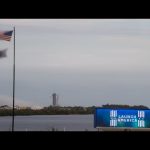
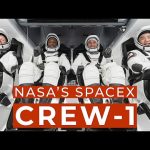
Watch as we #LaunchAmerica! Join us for live coverage of SpaceX Crew-1, the first crew rotation flight to the International Space Station by a U.S. commercial spacecraft. The crew is set to arrive at the International Space Station on Monday, Nov. 16 at 11 p.m. EST (Nov. 17 at 4 a.m. UTC). Watch continuous coverage of their entire ride, HERE: https://youtu.be/21X5lGlDOfg
The Crew Dragon ‘Resilience’ will carry astronauts Michael Hopkins, Victor Glover, and Shannon Walker of NASA and Soichi Noguchi of JAXA (Japan Aerospace Exploration Agency) to the station. Liftoff was at 7:27 p.m. EST, Sunday, Nov. 15 from Launch Complex 39A at NASA’s Kennedy Space Center in Florida.
NASA astronaut Victor Glover is launching to space for the first time on Nov. 15 when the NASA SpaceX Crew-1 mission lifts off from Kennedy Space Center. Glover is a graduate of the U.S. Air Force Test Pilot School, holds three master of science degrees, and was selected as a NASA astronaut in 2013.
“I do believe that human spaceflight is an imperative for our planet, and to be a part of that — to keep the progress going — I find very inspiring.”
NASA astronaut Dr. Shannon Walker holds a bachelor of arts degree in physics, a master of science and a doctorate of philosophy in space physics from Rice University. She launches on Nov. 15 at 7:27 p.m. aboard the NASA SpaceX Crew-1 mission, the first crew rotation flight of NASA’s Commercial Crew Program.
“The vehicle is definitely like a living creature. All the pipes, all the pipelines are alive.”
Japanese astronaut Soichi Noguchi of JAXA (Japan Aerospace Exploration Agency) is set to become the first international crew member to fly on a commercial crew mission on Nov. 15 at 7:27 p.m. EST, when the NASA SpaceX Crew-1 mission lifts off to the International Space Station.
Step inside the Main Control Room at ESOC, ESA’s European Space Operations Centre in Darmstadt, Germany, and one thing becomes immediately clear: teams that operate space missions are highly hierarchical, and the Flight Director is indisputably in charge.
How does this work, and why is this the case? In the last of his Masterclass series, Paolo Ferri delves into the culture of operations, from written rules and procedures to equally important unwritten principles that guide the day-to-day working lives of those flying Europe’s spacecraft.
Paolo explains that on rare occasions, an internal battle takes place when protocols, procedures and flight rules don’t seem up to the task, and someone must assume the huge responsibility of deciding whether or not they need to be violated to keep a mission functioning.
With 36 years’ of experience at ESA, Paolo Ferri is responsible for mission operations, and he has played a leading role in ensuring the success of missions like Eureca, ESA’s first-ever reusable satellite; Cluster, one of the longest-flying science missions; Venus Express, Europe’s first exploration of Earth’s ‘evil twin’; and Rosetta, humanity’s first landing on a comet.
In five episodes of ‘Leadership at Mission Control’, Paolo takes us through major events in his career at ESA, covering cornerstone missions, first attempts, overcoming technical challenges, building diverse teams, working under pressure and solving the unexpected problems that are part of any space endeavour.
This is the last episode of the ESA Masterclass series with Paolo Ferri. Thank you very much for watching!
★ Subscribe: http://bit.ly/ESAsubscribe and click twice on the bell button to receive our notifications.
We are Europe’s gateway to space. Our mission is to shape the development of Europe’s space capability and ensure that investment in space continues to deliver benefits to the citizens of Europe and the world. Check out http://www.esa.int/ESA to get up to speed on everything space related.
Join us LIVE from NASA’s Kennedy Space Center in Florida for updates as we prepare to #LaunchAmerica with NASA’s SpaceX Crew-1 mission.
The SpaceX Falcon 9 rocket and Crew Dragon spacecraft will carry astronauts Michael Hopkins, Victor Glover, and Shannon Walker of NASA, and astronaut Soichi Noguchi of the Japan Aerospace Exploration Agency (JAXA) to the International Space Station. Officials from NASA, SpaceX and U.S. Air Force 45th Weather Squadron will be on hand to talk about the upcoming mission scheduled for liftoff at 7:27 p.m. EST Sunday, Nov. 15.
The next space station crew launching from America, a mission milestone for our next Mars rover, and an update on a future Mars sample return mission … a few of the stories to tell you about – This Week at NASA!
Download Link https://images.nasa.gov/details-The%20Next%20Space%20Station%20Crew%20Launching%20From%20America%20on%20This%20Week%20@NASA%20%E2%80%93%20November%2013,%202020
Live from Kennedy Space Center, we’re counting down to #LaunchAmerica. Join Administrator Jim Bridenstine and officials from NASA and JAXA (Japan Aerospace Exploration Agency) for a preview of NASA’s SpaceX Crew-1 mission, set for liftoff on Sat., Nov. 14 at 7:29 p.m. EST. Astronauts Michael Hopkins, Victor Glover, and Shannon Walker of NASA and Soichi Noguchi of JAXA will launch aboard the Crew Dragon ‘Resilience’ spacecraft to the International Space Station.
The Copernicus Sentinel-2 mission takes us over Darmstadt, Germany, home to ESA’s European Space Operations Centre, in this week’s edition of the Earth from Space programme.
We are Europe’s gateway to space. Our mission is to shape the development of Europe’s space capability and ensure that investment in space continues to deliver benefits to the citizens of Europe and the world. Check out http://www.esa.int/ESA to get up to speed on everything space related.
In recognition of the 20th anniversary of continuous human presence aboard the International Space Station, listen as NASA public affairs specialist Brandi Dean talks with prominent members within NASA’s Flight Operations Directorate as they discuss the inner workings of flight operations for the International Space Station, where they were in their careers at the start of Expedition 1, and what it takes to ensure human spaceflight missions are safe and successful. Joining the conversation are Kenny Todd – Deputy Program Manager of the International Space Station, Norm Knight – Deputy Director of Flight Operations, David Korth – Deputy Manager of the ISS Avionics and Software Division, Holly Ridings – Chief Flight Director, Emily Nelson – Deputy Chief Flight Director, and Pooja Jesrani – one of NASA’s newest Flight Directors.
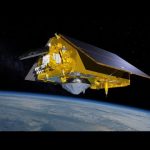
Final preparations are underway in California for the launch of Sentinel-6 Michael Freilich, a joint European and US satellite designed to take precise measurements of sea-level change. The satellite forms part of the European Union’s Copernicus Earth Observation programme and will employ a radar altimeter to map sea-surface topography. The satellite will provide fundamental data for climate science and policymaking, helping to protect the 600 million people who live in vulnerable coastal areas. It will also deliver near-realtime information for marine and weather forecasts.
The mission is a collaboration between ESA, the European Commission, EUMETSAT, NASA and NOAA, with support from the French space agency CNES. Scheduled for launch on 21 November on a SpaceX Falcon 9 rocket from the Vandenberg Air Force Base on the California coast, the satellite is named Michael Freilich after NASA’s former Director of Earth Science.
★ Subscribe: http://bit.ly/ESAsubscribe and click twice on the bell button to receive our notifications.
We are Europe’s gateway to space. Our mission is to shape the development of Europe’s space capability and ensure that investment in space continues to deliver benefits to the citizens of Europe and the world. Check out https://www.esa.int/ to get up to speed on everything space related.
Astronauts Mike Hopkins, Victor Glover, and Shannon Walker of NASA and Soichi Noguchi of JAXA participate in a live Q&A from Astronaut Crew Quarters at Kennedy Space Center. They’ll answer questions about their Nov. 14 launch to the International Space Station aboard the SpaceX Crew Dragon ‘Resilience’ spacecraft. This mission will be the first crew rotation mission with four astronauts flying on a commercial spacecraft, and the first including an international partner.
Understanding the laws of the universe is fundamental to flying missions in space. But one spacecraft under Paolo Ferri’s care seemed to be particularly susceptible to Murphy’s law – ‘Anything that can go wrong, will go wrong.’
In 1992, ESA’s first-ever reusable satellite, Eureca, was delivered into orbit (and later retrieved) by a NASA Space Shuttle. It spent just under a year in orbit, and presented a plethora of problems from Day 1. While it was ultimately successful, Eureca required constant care from engineering teams on ground as well as hands-on help from astronauts in orbit.
As Deputy Operations Manager for the mission, Paolo Ferri explains in his fourth masterclass how this intense period acted as a ‘school’ for him, as he and his team were put under immense pressure by this orbiting ‘box of surprises’ constantly on the edge of catastrophe and mission failure.
With 36 years’ of experience at ESA, Paolo Ferri is responsible for mission operations, and he has played a leading role in ensuring the success of missions like Eureca, ESA’s first-ever reusable satellite; Cluster, one of the longest-flying science missions; Venus Express, Europe’s first exploration of Earth’s ‘evil twin’; and Rosetta, humanity’s first landing on a comet.
In five episodes of ‘Leadership at Mission Control’, Paolo takes us through major events in his career at ESA, covering cornerstone missions, first attempts, overcoming technical challenges, building diverse teams, working under pressure and solving the unexpected problems that are part of any space endeavour.
New episodes from Paolo’s Masterclass will be released each Sunday, stay tuned!
★ Subscribe: http://bit.ly/ESAsubscribe and click twice on the bell button to receive our notifications.
We are Europe’s gateway to space. Our mission is to shape the development of Europe’s space capability and ensure that investment in space continues to deliver benefits to the citizens of Europe and the world. Check out http://www.esa.int/ESA to get up to speed on everything space related.
Watch live as all four NASA SpaceX Crew-1 astronauts arrive at NASA’s Kennedy Space Center on Sunday, Nov. 8, ahead of their Nov. 14 launch to the International Space Station for the first fully certified crew rotation mission of our Commercial Crew Program. Administrator Jim Bridenstine will join deputy administrator Jim Morhard and Junichi Sakai of the Japan Aerospace Exploration Agency (JAXA) to welcome NASA astronauts Victor Glover, Michael Hopkins, Shannon Walker, and JAXA astronaut Soichi Noguchi.
Marking 20 years of humans aboard the space station, getting out the vote from space, and preparations continue for NASA and SpaceX’s next crew launch … a few of the stories to tell you about – This Week at NASA!
The Copernicus Sentinel-1 mission takes us over Crete, Greece’s largest and most populous island, in this week’s edition of the Earth from Space programme.
We are Europe’s gateway to space. Our mission is to shape the development of Europe’s space capability and ensure that investment in space continues to deliver benefits to the citizens of Europe and the world. Check out http://www.esa.int/ESA to get up to speed on everything space related.
It’s not just Mission Control counting down – how are you getting ready for the next #LaunchAmerica mission? From building your own rocket to binge-watching launch coverage, share a video, photo or simply your thoughts for a chance to be featured on NASA TV and social media, as we prepare for Crew-1, the first certified mission under NASA’s Commercial Crew Program.
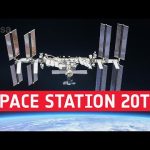
Monday 2 November 2020 marks 20 years of continuous human presence on the International Space Station. Relive a few memorable moments from the unique orbital outpost in this clip covering 20 years of the International Space Station in 60 seconds.Since Crew One took up residence on 2 November, 240 people including 18 ESA astronauts have lived and worked on the orbital outpost, carrying out essential research to benefit life on Earth.The next ESA mission to the International Space Station is set for 2021, when Thomas Pesquet will become the first European to fly on a SpaceX Crew Dragon spacecraft for his Alpha mission.
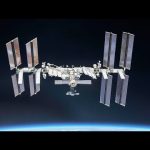
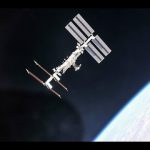
Monday 2 November, 2020 marks 20 years since the first crew took up residence on the International Space Station. Since then, 240 people including 18 ESA astronauts have lived and worked on the orbital outpost, carrying out essential research to benefit life on Earth.
In this clip, ESA astronauts Luca Parmitano, Alexander Gerst, Thomas Pesquet, Tim Peake, Andreas Mogensen, André Kuipers, Christer Fuglesang, Frank De Winne and Reinhold Ewald pay tribute to the Station. ESA Director General Jan Wörner and NASA Administrator Jim Bridenstine also speak about the Station’s significance for space exploration and international collaboration.
The next ESA mission to the International Space Station is set for 2021, when Thomas Pesquet will become the first European to fly on a SpaceX Crew Dragon spacecraft for his Alpha mission.
★ Subscribe: http://bit.ly/ESAsubscribe and click twice on the bell button to receive our notifications.
We are Europe’s gateway to space. Our mission is to shape the development of Europe’s space capability and ensure that investment in space continues to deliver benefits to the citizens of Europe and the world. Check out https://www.esa.int/ to get up to speed on everything space related.
This November the newest member of the EU’s Copernicus programme, Sentinel-6 Michael Freilich, will take to the heavens from Vandenberg Air Force Base in California. The satellite is named after NASA’s former Director of Earth Observation and is a radar altimetry mission to monitor sea-level rise, wave-height and windspeed.
The mission is a collaboration between ESA, the European Commission, EUMETSAT, NASA and NOAA, with support from the French space agency CNES. It will continue a three-decade-long time-series of radar altimetry missions that started with the Topex-Poseidon mission and was then followed by the Jason missions.
★ Subscribe: http://bit.ly/ESAsubscribe and click twice on the bell button to receive our notifications.
We are Europe’s gateway to space. Our mission is to shape the development of Europe’s space capability and ensure that investment in space continues to deliver benefits to the citizens of Europe and the world. Check out https://www.esa.int/ to get up to speed on everything space related.
As space missions have become more complex, the teamwork needed on the ground has also become more sophisticated and challenging. Through almost four decades at the forefront of Europe’s voyages in space, Paolo Ferri went from Operations Engineer on the Eureca mission to Operations Manager of the four-spacecraft Cluster mission and then the Rosetta mission, followed by serving as Flight Director on Rosetta, Venus Express and Goce. His career has been capped off by eight years as Head of Mission Operations for the Agency, overseeing all of ESA’s robotic mission operations.
In his third masterclass, Paolo shares what he has learnt going from an engineering expert with complete and specific knowledge of a single mission, to being responsible at a senior manager level for the success of dozens of missions operated by international teams each as diverse, unique and complex as the spacecraft they fly.
With 36 years’ of experience at ESA, Paolo Ferri is responsible for mission operations, and he has played a leading role in ensuring the success of missions like Eureca, ESA’s first-ever reusable satellite; Cluster, one of the longest-flying science missions; Venus Express, Europe’s first exploration of Earth’s ‘evil twin’; and Rosetta, humanity’s first landing on a comet.
In five episodes of ‘Leadership at Mission Control’, Paolo takes us through major events in his career at ESA, covering cornerstone missions, first attempts, overcoming technical challenges, building diverse teams, working under pressure and solving the unexpected problems that are part of any space endeavour.
New episodes from Paolo’s Masterclass will be released each Sunday, stay tuned!
★ Subscribe: http://bit.ly/ESAsubscribe and click twice on the bell button to receive our notifications.
We are Europe’s gateway to space. Our mission is to shape the development of Europe’s space capability and ensure that investment in space continues to deliver benefits to the citizens of Europe and the world. Check out http://www.esa.int/ESA to get up to speed on everything space related.
An international agreement to collaborate on Artemis, an intriguing discovery on the Moon, and an update on OSIRIS-REx … a few of the stories to tell you about – This Week at NASA!
Would you like to learn how to make your own Flacon 9 straw rocket to launch in your home? Watch this tutorial to learn how.
All you will need is paper, markers, scissors, tape, yarn or ribbon (optional) and a straw.
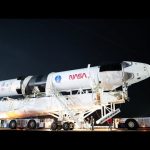
Don’t miss four astronauts launching to the International Space Station from Kennedy Space Center in Florida on this very rocket Nov. 14!
Feeling excited about the next #LaunchAmerica mission ? From building your own rocket to binge-watching launch videos, share a video, a photo or simply your thoughts using #LaunchAmerica for a chance to be featured on NASA TV or our social media platforms. Details: https://www.nasa.gov/nasa-invites-you-to-launchamerica
In recognition of the 20th anniversary of continuous human presence aboard the International Space Station, listen as Space Foundation board member Jeanne Meserve sits down with the Expedition 1 crew, William Shepherd (NASA astronaut and Commander of Expedition 1), Sergei Krikalev (Russian cosmonaut and Flight Engineer of Expedition 1), and Yuri Gidzenko (Russian cosmonaut and Soyuz Commander of Expedition 1), as they discuss what it was like to be the first ever crewed expedition to the International Space Station. Also joining the conversation are George Abbey, who was director of NASA’s Johnson Space Center at the time, and Ginger Kerrick, the Russian Training Integration Instructor for Expedition 1.
On Nov. 14, 2020, NASA astronauts Mike Hopkins, Victor Glover, Shannon Walker and JAXA astronaut Soichi Noguchi will launch on NASA’s SpaceX Crew-1 mission bound for the International Space Station. Once there, they will perform space station upgrades, conduct science experiments to benefit life on Earth, and continue preparing humanity for future missions to the Moon — and eventually Mars.
This is the first crew rotation mission with four astronauts flying on a commercial spacecraft, and the first including an international partner. Get on board. It’s #LaunchAmerica time!
This November, we celebrate 20 years of continuous human presence on the International Space Station — an incredible example of international cooperation. In our latest episode of #EZScience, NASA associate administrator for science Dr. Thomas Zurbuchen and National Air and Space Museum director Dr. Ellen Stofan discuss the incredible science that has been conducted on the orbiting laboratory and what’s next for human spaceflight.
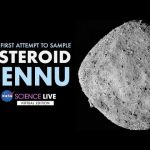
NASA has touched the surface of asteroid Bennu to collect the agency’s first ever asteroid sample, which will one day shed new insights on the history of our solar system… so what’s next? Join NASA’s OSIRIS-REx Asteroid Sample Return Mission experts and ask them your questions! Submit them using #ToBennuAndBack and tune in today at 6:15 p.m. ET as they walk you through new images and videos captured by the spacecraft as it descended down to the asteroid’s surface.
Throughout the life of every mission, radio signals are transmitted between stations on ground and the spacecraft orbiting Earth, or voyaging across the Solar System. These signals contain instructions and commands sent up from mission control, and beam down data such as views of our planet collected by high-tech instruments on board.
However, this ‘conversation’ between space and Earth is only as good as the conversations taking place on Earth, where effective communication and teamwork are fundamental. Effectively passing on information, experience and challenges are the key to success during critical operations, as teams evolve over the life of decades-long missions, and between different mission teams themselves.
In his second masterclass, Paolo Ferri illustrates the importance of effective communication with the help of Exosat, a flipchart and a ‘blind’ spacecraft, Venus Express.
With 36 years’ of experience at ESA, Paolo Ferri is responsible for mission operations, and he has played a leading role in ensuring the success of missions like Eureca, ESA’s first-ever reusable satellite; Cluster, one of the longest-flying science missions; Venus Express, Europe’s first exploration of Earth’s ‘evil twin’; and Rosetta, humanity’s first landing on a comet.
In five episodes of ‘Leadership at Mission Control’, Paolo takes us through major events in his career at ESA, covering cornerstone missions, first attempts, overcoming technical challenges, building diverse teams, working under pressure and solving the unexpected problems that are part of any space endeavour.
New episodes from Paolo’s Masterclass will be released each Sunday, stay tuned!
★ Subscribe: http://bit.ly/ESAsubscribe and click twice on the bell button to receive our notifications.
We are Europe’s gateway to space. Our mission is to shape the development of Europe’s space capability and ensure that investment in space continues to deliver benefits to the citizens of Europe and the world. Check out http://www.esa.int/ESA to get up to speed on everything space related.
A touch of history for our first asteroid sample return mission, a safe return from the International Space Station, and a big move in preparation for Artemis I … a few of the stories to tell you about – This Week at NASA!
We are Europe’s gateway to space. Our mission is to shape the development of Europe’s space capability and ensure that investment in space continues to deliver benefits to the citizens of Europe and the world. Check out http://www.esa.int/ESA to get up to speed on everything space related.
NASA astronaut Chris Cassidy and cosmonauts Anatoly Ivanishin and Ivan Vagner of Roscosmos will return to Earth from the International Space Station on Wed., Oct. 21, 2020. Tune in for deorbit burn and landing coverage as their Soyuz spacecraft descends to a parachute-assisted landing, set for 10:55 p.m. EDT southeast of the remote town of Dzhezkazgan, Kazakhstan.
The three crew members will wrap up a 196-day mission spanning 3,136 orbits of Earth and 83 million miles. Cassidy is completing his third spaceflight for a total of 378 days in space, the fifth highest total among U.S. astronauts. Ivanishin is completing his third flight into space, totaling 476 days. This was Vagner’s first spaceflight. During their expedition, Cassidy, Ivanishin, and Vagner welcomed the arrival of NASA astronauts Robert Behnken and Douglas Hurley on NASA’s SpaceX Demo-2 mission, the first crewed flight of a commercial spacecraft and the first launch of humans from American soil to the space station since 2011.
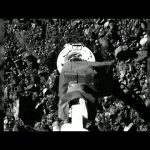
Yesterday, Oct. 20, our OSIRIS-REx spacecraft descended to the surface of asteroid Bennu, touched down and attempted to capture a sample using a “Touch-And-Go,” or TAG, maneuver. Join us at 5 p.m. EDT for a live broadcast with the mission team, as they provide a recap of yesterday’s journey #ToBennuAndBack and reveal first images and videos of this historic event.
Let’s do this, OSIRIS-REx! Time to journey #ToBennuAndBack. Tune in to our live broadcast as our spacecraft descends to the surface of asteroid Bennu, touches down for a few seconds & attempts to capture regolith (rocks and dust) using a “Touch-And-Go,” or TAG, maneuver. The spacecraft must target Bennu’s rocky surface with great accuracy, touching down within a rocky area just 52 ft (16 m) in diameter. During the maneuver, the spacecraft and the asteroid will be approximately 207 million miles (334 million km) from Earth.
Live coverage from Lockheed Martin’s facility in Denver, Colorado, with mission managers from the University of Arizona, Lockheed Martin, and NASA’s Goddard Space Flight Center begins at 5 p.m. EDT.
The spacecraft is scheduled to depart Bennu in 2021, and to deliver the collected sample to Earth on Sep. 24, 2023. It will be the first U.S. mission to carry samples from an asteroid back to Earth, and the largest sample returned from space since the Apollo era.
On Oct. 20, NASA will attempt to maneuver the OSIRIS-REx spacecraft down to touch the surface of asteroid Bennu and collect a sample. Join NASA’s Dr. Z and Dr. Glaze as we gear up for this historic event and ask them your questions using #ToBennuAndBack.
What would you pack for a journey to the Moon? Our Artemis program is working to send the next man and first woman to the Moon. As we prepare to fire up the engines of our Space Launch System Moon rocket for the “Green Run” tests, we asked you to send us your #NASAMoonKit. Want to share your own? Tag yourself on Twitter or Instagram with #NASAMoonKit.
In the first of the Masterclass series, we head to Darmstadt, Germany, where epoch-making robotic space exploration missions have been flown under the watchful eye of one man, Paolo Ferri.
Once a spacecraft is launched to space, that’s it. Thousands or millions of kilometres away, there can be no manual fixes, on-the-fly upgrades or last-minute changes. It’s now up to teams at mission control to use the tools and technologies at their disposal, as well as their own knowledge, teamwork and creativity to overcome the inevitable problems faced by any mission in space.
In ‘Thinking Outside the Box,” Paolo describes three missions that suffered unexpected and potentially fatal flaws: Smart-1, Cluster and Exosat, and how on-the-ground knowledge, innovation and ingenuity prevented their untimely demise, allowing the science to go on.
With 36 years’ of experience at ESA, Paolo Ferri is responsible for mission operations, and he has played a leading role in ensuring the success of missions like Eureca, ESA’s first-ever reusable satellite; Cluster, one of the longest-flying science missions; Venus Express, Europe’s first exploration of Earth’s ‘evil twin’; and Rosetta, humanity’s first landing on a comet.
In five episodes of ‘Leadership at Mission Control’, Paolo takes us through major events in his career at ESA, covering cornerstone missions, first attempts, overcoming technical challenges, building diverse teams, working under pressure and solving the unexpected problems that are part of any space endeavour.
New episodes from Paolo’s Masterclass will be released each Sunday, stay tuned!
★ Subscribe: http://bit.ly/ESAsubscribe and click twice on the bell button to receive our notifications.
We are Europe’s gateway to space. Our mission is to shape the development of Europe’s space capability and ensure that investment in space continues to deliver benefits to the citizens of Europe and the world. Check out http://www.esa.int/ESA to get up to speed on everything space related.
New crew safely aboard the space station, a launch update on another space station mission, and an international agreement on Artemis … a few of the stories to tell you about – This Week at NASA!
Tune in as experts from NASA, ESA (European Space Agency), EUMETSAT (European Organisation for the Exploitation of Meteorological Satellites, and NOAA (National Oceanic and Atmospheric Administration) discuss the upcoming launch of Sentinel-6 Michael Freilich, a satellite that will collect the most accurate data yet on global sea levels. The satellite is targeted for launch aboard a SpaceX Falcon 9 rocket on Nov. 10 at 2:31 p.m. EST, from Vandenberg Air Force Base in California.
Sentinel-6 Michael Freilich is a historic U.S.-European partnership that will continue the legacy of previous missions and extend our records of sea level into the fourth decade, collecting accurate measurements of sea surface height down to the centimeter for 90% of the world’s oceans.
The Copernicus Sentinel-2 mission takes us over Zeeland – the westernmost province in the Netherlands, in this week’s edition of the Earth from Space programme.
We are Europe’s gateway to space. Our mission is to shape the development of Europe’s space capability and ensure that investment in space continues to deliver benefits to the citizens of Europe and the world. Check out http://www.esa.int/ESA to get up to speed on everything space related.
On October 13, 2020, NASA and international partners from Australia, Canada, Italy, Japan, Luxembourg, the United Arab Emirates and the United Kingdom signed the Artemis Accords agreements for international participation in the agency’s Artemis program, during a virtual meeting of the International Astronautical Congress.
While NASA is leading the Artemis program, international partnerships will play a key role in achieving a sustainable and robust presence on the Moon while preparing to conduct a historic human mission to Mars. International cooperation on Artemis will bolster space exploration and enhance peaceful relationships between nations. The Artemis Accords will also reinforce the principles of the Outer Space Treaty.