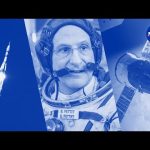
NASA astronaut Don Pettit is set to lift off on his fourth mission to the International Space Station on Wednesday, Sept. 11. Live NASA coverage begins at 11:15 a.m. EDT (1555 UTC) for a 12:23 p.m. (1623 UTC) launch from the Baikonur Cosmodrome in Kazakhstan.
Pettit’s first trip to the orbiting laboratory was in 2002, where he served as the NASA Science Officer aboard the station as part of Expedition 6. Pettit later traveled to the station aboard space shuttle Endeavour on STS-126, and most recently went to space in 2011. Pettit has a Ph.D. in chemical engineering from the University of Arizona.
Pettit will launch aboard the Roscosmos Soyuz MS-26 spacecraft, accompanied by cosmonauts Alexey Ovchinin and Ivan Vagner, where they will spend six months on the International Space Station before returning to Earth in the spring of 2025.
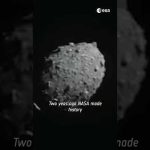
On 26 September 2022, NASA’s approximately half-tonne Double Asteroid Redirect Test (DART) spacecraft impacted the Dimorphos asteroid at an approximate speed of 6.1 km/s, shortening its orbit around Didymos by more than half an hour.
Our Hera spacecraft will be launched this October to reach Dimorphos and perform a close-up ‘crash scene investigation’, gathering data on the asteroid’s mass, structure and make-up to turn this kinetic impact method of planetary defence into a well understood and repeatable technique.
Steve Spangler is a bestselling author, STEM educator and Emmy award-winning television personality with more than 2,100 television appearances to his credit. Steve appeared as a regular guest on the Ellen DeGeneres Show from 2007-2022. Learn more about Steve at https://stevespangler.com/about-steve-spangler/
Join us as we enter ESA’s Heritage Missions data archive, which stores Earth observation data dating back to the 1970s.
ESA preserves this historical record from past satellite missions, which provides valuable information for long-term studies. The datasets from these missions are not only preserved, but continuously improved over time with reprocessing activities that make them compatible with products acquired by more recent missions and apply new processing algorithms that can improve the accuracy and quality of the products.
We are Europe’s gateway to space. Our mission is to shape the development of Europe’s space capability and ensure that investment in space continues to deliver benefits to the citizens of Europe and the world. Check out https://www.esa.int/ to get up to speed on everything space related.
Steve Spangler is a bestselling author, STEM educator and Emmy award-winning television personality with more than 2,100 television appearances to his credit. Steve appeared as a regular guest on the Ellen DeGeneres Show from 2007-2022. Learn more about Steve at https://stevespangler.com/about-steve-spangler/
Today, Salsa, the first of four satellites that make up our Cluster mission, will reenter Earth’s atmosphere over the South Pacific Ocean Uninhabited Area.
This marks the end of the historic mission, over 24 years after it was sent into space to measure Earth’s magnetic environment. Though the remaining three satellites will also stop making scientific observations, discoveries using existing mission data are expected for years to come.
This ‘targeted reentry’ is the first of its kind. ESA’s efforts to ensure a clean end to the Cluster mission go beyond international standards, making the agency a world-leader in sustainable space exploration.
The first of four satellites that make up ESA’s Cluster mission is coming safely back down to Earth, marking a brilliant end to this remarkable mission.
The satellite’s orbit was tweaked back in January to target a region as far as possible from populated regions. This ensures that any spacecraft parts that survive the reentry will fall over open ocean.
During 24 years in space, Cluster has sent back precious data on how the Sun interacts with Earth’s magnetic field, helping us better understand and forecast potentially dangerous space weather.
With this first ever targeted reentry, Cluster goes down in history for a different reason, taking ESA well beyond international space safety standards and helping ensure the long-term sustainability of space activities.
Credits: ESA – European Space Agency
Chapters: 00:00 Introduction to the Cluster Mission 02:17 How do we deorbit a satellite? 05:05 Why does Cluster’s reentry matter so much? 06:15 Conclusion
★ Subscribe: http://bit.ly/ESAsubscribe and click twice on the bell button to receive our notifications.
We are Europe’s gateway to space. Our mission is to shape the development of Europe’s space capability and ensure that investment in space continues to deliver benefits to the citizens of Europe and the world. Check out https://www.esa.int/ to get up to speed on everything space related.
Watch live as Boeing’s uncrewed Starliner spacecraft leaves low Earth orbit, reenters Earth’s atmosphere, and touches down at White Sands Space Harbor in New Mexico. Starliner is scheduled to begin its deorbit burn at 11:17 p.m. EDT on Friday, Sept. 6 (0317 UTC Sept. 7), with landing scheduled for 12:01 a.m. EDT (0401 UTC) on Saturday, Sept. 7.
NASA astronauts Butch Wilmore and Suni Williams launched aboard Starliner on June 5 for its first crewed flight, arriving at the International Space Station on June 6. As Starliner approached the orbiting laboratory, NASA and Boeing identified helium leaks and experienced issues with the spacecraft reaction control thrusters. For the safety of the astronauts, NASA announced on Aug. 24 that Starliner would return to Earth from the station without a crew. Wilmore and Williams will remain aboard the station and return home in February 2025 on the SpaceX Dragon spacecraft as part of NASA’s SpaceX Crew-9 mission.
Following Starliner’s return to Earth, a post-landing news conference is scheduled for 1:30 a.m. EDT (0530 UTC).
Watch live as Boeing’s Starliner spacecraft departs from the International Space Station for a landing at White Sands Space Harbor in New Mexico. The uncrewed spacecraft is scheduled to autonomously undock from the station at approximately 6:04 p.m. EDT (2204 UTC) Friday, Sept. 6, to begin the journey home, weather conditions permitting.
NASA astronauts Butch Wilmore and Suni Williams launched aboard Boeing’s Starliner spacecraft on June 5 for its first crewed flight, arriving at the space station on June 6. As Starliner approached the orbiting laboratory, NASA and Boeing identified helium leaks and experienced issues with the spacecraft reaction control thrusters. For the safety of the astronauts, NASA announced on Aug. 24 that Starliner will return to Earth from the station without a crew. Wilmore and Williams will remain aboard the station and return home in February 2025 aboard the SpaceX Dragon spacecraft with two other crew members assigned to NASA’s SpaceX Crew-9 mission.
Steve Spangler is a bestselling author, STEM educator and Emmy award-winning television personality with more than 2,100 television appearances to his credit. Steve appeared as a regular guest on the Ellen DeGeneres Show from 2007-2022. Learn more about Steve at https://stevespangler.com/about-steve-spangler/
Asigură-ți confidențialitatea cu Surfshark! Intră pe linkul meu 👇 https://surfshark.com/presura, introdu codul promoțional “presura”, astfel vei obține 4 luni gratuite. 00:00:00 – Se oprește din rotație nucleul Pământului? 00:01:24 – Periculos!! Nu faceți așa ceva!! 00:02:41 – Călătorie într-o gaură neagră. 00:03:32 – Turbulențe în timpul zborului cu avionul! 00:04:55 – Momentul sponsorului 00:05:54 – Oprește-te, n-ai văzut așa ceva! 00:07:23 – Cel mai precis ceas atomic!!! 00:08:47 – Meteorit? sau deșeu spațial? 🔸 SUSȚINE ȘI TU DIRECT ACTIVITATEA MEA ►https://patreon.com/cristianpresura 🔸 DEVINO YOUTUBE MEMBRU ►https://bit.ly/35Q8vXC 🔸 PAYPAL ► paypal.me/cristianpresura 🔸 DONORBOX ► https://donorbox.org/cristianpresura
Această schimbare de rotație a nucleului este foarte mică și a fost detectată doar prin studierea undelor seismice produse de cutremure mari. Deci, deși sună dramatic, această încetinire sau inversare a rotației nucleului nu are efecte imediate asupra vieții de zi cu zi și nu prezintă un risc pentru umanitate.
Pe lângă misterele nucleului Pământului, un alt subiect important este riscul de electrocutare pe vagoanele de tren. Mulți tineri continuă să se urce pe vagoane, fără a înțelege pericolul mortal pe care îl reprezintă liniile de înaltă tensiune. Majoritatea cred că electrocutarea apare doar atunci când atingi firul de înaltă tensiune. Cu toate acestea, chiar și la un metru și jumătate distanță de fir, riscul este imens. Firul de înaltă tensiune ionizează aerul din jur, ceea ce înseamnă că electricitatea poate „sări” prin aer către orice obiect aflat suficient de aproape, inclusiv o persoană. Astfel, cei care urcă pe vagoane devin, practic, un paratrăsnet uman, iar consecințele sunt fatale. Electrocutarea poate avea loc instantaneu, fără ca persoana să fi atins vreodată firul.
În zborul cu avionul, un alt pericol frecvent întâlnit este reprezentat de turbulențe. Acestea sunt cauzate de mișcările imprevizibile ale maselor de aer, pe care piloții nu le pot anticipa, deoarece aerul este invizibil. În mod normal, avionul este susținut de forța portantă generată de fluxul de aer deasupra și dedesubtul aripilor. Cu toate acestea, turbulențele modifică brusc presiunea aerului, făcând avionul să pară că „sare” în aer, similar cu o mașină care trece peste gropi. Pasagerii care nu poartă centura de siguranță riscă să fie aruncați din locurile lor și să sufere răni.’
Who’d have thought something as simple as a wooden ramp could teach so much about science? Of course, it’s helpful when it’s 2 stories tall. Explore friction with frogs, rice, one detective and two books stuck together! SUBSCRIBE FOR MORE SCIENCE ▶ https://youtube.com/@ScienceMax?feature=shared
🚩 If you like what you see, consider supporting my work on Patreon and you get ad-free early access to my videos for as little as $1 https://www.patreon.com/historymarche — You can also show your support by subscribing to the channel and liking the video. Thank you for watching.
Slime’s out of the bag! Phil gets messy (no surprise there) as we unravel the gooey secrets of this science sensation. We’ll delve into polymers, explore cross-linking, and discover why slime acts solid AND liquid! Get ready for some slimy experiments, awesome animations, and enough science puns to make your head spin! Let’s make slime SCIENCEtastic!
Wonder how rockets, spaceships, planes and other things fly?! This compilation of episodes will dive deep into the #Science of anti-gravity and MORE exciting things! Let’s make flying SCIENCEtastic!
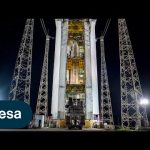
The Copernicus Sentinel-2C satellite lifted off on 5 September at 03:50 CEST (4 September 22:50 local time) aboard the last Vega rocket, flight VV24, from Europe’s Spaceport in French Guiana.
Sentinel-2C will continue the legacy of delivering high-resolution data that are essential to Copernicus – the Earth observation component of the EU Space Programme. Developed, built and operated by ESA, the Copernicus Sentinel-2 mission provides high-resolution optical imagery for a wide range of applications including land, water and atmospheric monitoring.
Sentinel-2C was the last liftoff for the Vega rocket – after 12 years of service this was the final flight, the original Vega is being retired to make way for an upgraded Vega-C.
Credits: ESA/CNES/Arianespace
Chapters: 00:00 Waiting for liftoff 01:10 Liftoff 04:25 Second stage separation 06:18 Sentinel-2C separation 06:46 Acquisition of signal 07:23 Statements
★ Subscribe: http://bit.ly/ESAsubscribe and click twice on the bell button to receive our notifications.
We are Europe’s gateway to space. Our mission is to shape the development of Europe’s space capability and ensure that investment in space continues to deliver benefits to the citizens of Europe and the world. Check out https://www.esa.int/ to get up to speed on everything space related.
Live views from the International Space Station are streaming from an external camera mounted on the station’s Harmony module.
The camera is looking forward at an angle so that International Docking Adapter 2 is visible. If the Harmony module camera is not available due to operational considerations for a longer period of time, a continuous loop of recorded Earth views will be displayed with the caption “Previously Recorded.”
The space station orbits Earth about 250 miles (425 kilometers) above the surface. An international partnership of five space agencies from 15 countries operates the station, and it has been continuously occupied since November 2000. It’s a microgravity laboratory where science, research, and human innovation make way for new technologies and research breakthroughs not possible on Earth. More: https://go.nasa.gov/3CkVtC8
Did you know you can spot the station without a telescope? It looks like a fast-moving star, but you have to know when to look up. Sign up for text messages or email alerts to let you know when (and where) to spot the station and wave to the crew: https://spotthestation.nasa.gov
Watch live video from the International Space Station, including inside views when the crew aboard the space station is on duty. Views of Earth are also streamed from an external camera located outside of the space station. During periods of signal loss due to handover between communications satellites, a blue screen is displayed.
The space station orbits Earth about 250 miles (425 kilometers) above the surface. An international partnership of five space agencies from 15 countries operates the station, and it has been continuously occupied since November 2000. It’s a microgravity laboratory where science, research, and human innovation make way for new technologies and research breakthroughs not possible on Earth. More: https://go.nasa.gov/3CkVtC8
Did you know you can spot the station without a telescope? It looks like a fast-moving star, but you have to know when to look up. Sign up for text messages or email alerts to let you know when (and where) to spot the station and wave to the crew: https://spotthestation.nasa.gov
Steve Spangler is a bestselling author, STEM educator and Emmy award-winning television personality with more than 2,100 television appearances to his credit. Steve appeared as a regular guest on the Ellen DeGeneres Show from 2007-2022. Learn more about Steve at https://stevespangler.com/about-steve-spangler/
Vega joined the family of launch vehicles at Europe’s Spaceport in French Guiana in 2012. At 30-m tall the rocket weighs 137 tonnes on the launch pad and reaches orbit with three solid-propellant powered stages before the fourth liquid-propellant stage takes over. By rocket standards Vega is lightweight and powerful, the first three stages burn through their fuel and bringing Vega and its satellites to space in just six minutes.
Specialising in launches of small satellites to orbits flying the Earth’s poles, Vega has an impressive roster of missions that it has sent to space. Flagship ESA missions that flew Vega include technology demonstrator and Earth vegetation watcher Proba-V and wind-monitoring satellite Aeolus. Vega’s heaviest payload launched was the 1906-kg LISA Pathfinder, a forerunner to LISA that will measure gravitational waves in space..
In 2015 Vega launched three ESA missions in one year, including reentry demonstrator IXV that showed Europe has the technology to launch a vehicle to space and return it safely to Earth. In less than two hours Vega accelerated IXV to speeds of 27 000 km/h at a height of 412 km before the reentry vehicle splashed down in the Atlantic Ocean. This demonstration mission was a precursor to the reuseable Space Rider spacecraft that will offer regular access to space for research and in orbit validation and demonstration missions and is paired with the Vega family of launchers.
With its Vespa secondary payload adapter, first launched in 2013 on Vega’s second flight, Vega offered different options for payload ride-sharing where multiple satellites are launched on one rocket. In 2020 a variant of Vespa called the Small Spacecraft Mission Service transported over 50 satellites at once to orbit.
Sentinel-2C is the last payload that the Vega rocket launches into space – after 12 years of service. Fittingly the Sentinel-2A and Sentinel-2B satellites were launched on Vega marking a logical conclusion to Vega’s stellar roster of satellites launched.
Credits: ESA – European Space Agency
★ Subscribe: http://bit.ly/ESAsubscribe and click twice on the bell button to receive our notifications.
We are Europe’s gateway to space. Our mission is to shape the development of Europe’s space capability and ensure that investment in space continues to deliver benefits to the citizens of Europe and the world. Check out https://www.esa.int/ to get up to speed on everything space related.
It’s time to say goodbye to our rocket with its final liftoff.
On this last flight, it will carry the Copernicus Sentinel-2C, into orbit. Vega already delivered Sentinel-2A and 2B to space in 2015 and 2017 ensuring constant monitoring of our planet for precision farming, water quality monitoring, natural disaster management and detecting methane emissions.
Since its inaugural flight in 2012, Vega has launched over 20 times, serving Europe with precision and excellence. Now, Vega-C is ready to take the reins, bringing more power and capacity to future missions.
https://shop.ecosolaris.ro/sisteme-fotovoltaice, folosește codul “presura15” și vei avea o reducere de 15% la comenzile online achitate cu cardul. Pentru o ofertă personalizată va rugam sa ne contactați la oferta@ecosolaris.ro
În trecut, eram sceptic în privința mașinilor electrice din cauza greutății și costului ridicat al bateriilor, precum și a performanței slabe la temperaturi scăzute. Deși vânzările au crescut semnificativ în ultimii ani, recentele încetiniri din piață subliniază necesitatea îmbunătățirii tehnologiei bateriilor.
Bateriile Li-ion, cele mai utilizate în prezent, au o densitate de energie practică de 200-300 Wh/kg, mult sub valoarea teoretică de 1000 Wh/kg. Diferența se datorează factorilor precum componentele suplimentare necesare și eficiența limitată a proceselor interne. Astfel, pentru a parcurge 500 km fără încărcare, o mașină ar avea nevoie de o baterie de aproximativ 400 kg, ceea ce este impracticabil.
Optimismul meu provine din potențialul de îmbunătățire al acestor baterii. Putem crește densitatea de energie pe kilogram prin identificarea unor materiale mai ușoare pentru structura cristalelor și putem îmbunătăți densitatea volumetrică prin dezvoltarea unor structuri mai compacte. De asemenea, costurile pot fi reduse prin optimizarea proceselor de fabricație sau prin descoperirea unor alternative mai ieftine și la fel de eficiente.
Cercetarea în domeniul bateriilor electrice este în plină expansiune, iar noi descoperiri promit să rezolve multe dintre problemele actuale, făcând posibilă atingerea unor autonomii de peste 1000 km. Sunt convins că, în ciuda obstacolelor prezente, viitorul aparține mașinilor electrice.”
Sentinel-2C is ready for launch! The new satellite will soon join its Copernicus Sentinel-2 family in orbit – where it will continue to provide detailed views of Earth’s land and coastal waters.
The mission is based on a constellation of two identical satellites: Sentinel-2A and Sentinel-2B. The constellation was originally designed to monitor land surfaces – but its scope has since expanded.
It now covers a wide range of applications including deforestation, water quality, monitoring natural disasters, methane emissions and much more. Sentinel-2C, once in orbit, will replace the Sentinel-2A unit – prolonging the life of the Sentinel-2 mission – ensuring a continuous supply of data for Copernicus, the Earth observation component of the EU Space Programme.
Tune in to ESA WebTV on 4 September from 03:30 CEST to watch the satellite soar into space on the last Vega rocket to be launched from Europe’s Spaceport in Kourou, French Guiana.
Credits: ESA – European Space Agency
★ Subscribe: http://bit.ly/ESAsubscribe and click twice on the bell button to receive our notifications.
We are Europe’s gateway to space. Our mission is to shape the development of Europe’s space capability and ensure that investment in space continues to deliver benefits to the citizens of Europe and the world. Check out https://www.esa.int/ to get up to speed on everything space related.
Slime is made of polymers, which are long chains of molecules that explain how many things are made. From plastics, to fabrics to our own DNA, polymers are everywhere. And we have a lot of them contained in a maxxed out tub of slime.
Steve Spangler is a bestselling author, STEM educator and Emmy award-winning television personality with more than 2,100 television appearances to his credit. Steve appeared as a regular guest on the Ellen DeGeneres Show from 2007-2022. Learn more about Steve at https://stevespangler.com/about-steve-spangler/
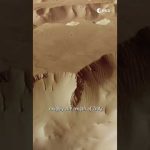
Noctis Labyrinthus is vast system of deep and steep valleys that stretches out for around 1190 km, roughly the length of Italy here on Earth.
It is nestled between the colossal martian ‘Grand Canyon’ (Valles Marineris) and the tallest volcanoes in the Solar System (the Tharsis region).
The intense volcanism in the nearby Tharsis region is to blame for the formation of these features; this volcanism caused large areas of martian crust to arch upwards and become stretched and tectonically stressed, leading to it thinning out, faulting and subsiding.
📹 ESA – European Space Agency 🖥️ ESA/DLR/FU Berlin
Steve Spangler is a bestselling author, STEM educator and Emmy award-winning television personality with more than 2,100 television appearances to his credit. Steve appeared as a regular guest on the Ellen DeGeneres Show from 2007-2022. Learn more about Steve at https://stevespangler.com/about-steve-spangler/
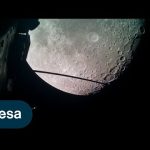
On 19–20 August 2024, Juice successfully completed a world-first lunar-Earth flyby, with flight controllers guiding the spacecraft first past the Moon, then past Earth. The gravity of the two changed Juice’s speed and direction, sending it on a shortcut to Jupiter via Venus.
The closest approach to the Moon was at 23:15 CEST on 19 August, deflecting Juice towards a closest approach to Earth just over 24 hours later at 23:56 CEST on 20 August. In the hours before and after both close approaches, Juice’s two monitoring cameras captured photos, giving us a unique ‘Juice eye view’ of our home planet.
Juice’s two monitoring cameras provide 1024 x 1024 pixel snapshots that can be processed in colour. Their main purpose is to monitor the spacecraft’s various booms and antennas, especially during the challenging period after launch. The photos they captured of the Moon and Earth during the lunar-Earth flyby are a bonus.
The piece of music that accompanies the images is called 11,2 km/s. It was composed by Gautier Acher back in 2015, and selected as the official theme music for ESA’s Estrack ground station network to mark its 40th anniversary (more information). The music is available under a CC BY-NC-SA licence.
Processing notes: The Juice monitoring cameras provide 1024 x 1024 pixel images. Upscaling software was used to convert the images into 2160 x 2160 pixel images, which match the 3480 x2160 pixel resolution of the 4K movie format.
Credits: ESA – European Space Agency Acknowledgements: Simeon Schmauß & Mark McCaughrean
★ Subscribe: http://bit.ly/ESAsubscribe and click twice on the bell button to receive our notifications.
We are Europe’s gateway to space. Our mission is to shape the development of Europe’s space capability and ensure that investment in space continues to deliver benefits to the citizens of Europe and the world. Check out https://www.esa.int/ to get up to speed on everything space related.
Human centrifuges simulate the gravitational forces, known as g-forces, experienced by astronauts during launch and return to Earth.
The g-forces in this centrifuge were directed from the chest to the back, reaching acceleration levels up to 6G (equivalent to 4.5 times Earth’s gravity).
The astronaut candidates reclined on their backs, reflecting the position astronauts assume in their launch vehicles.
Equipped with biomonitoring devices, they communicated with medical staff during the spin, describing the effects felt on their bodies.
NASA hosts a live news conference at 1 p.m. EDT from the agency’s Johnson Space Center in Houston, following the internal Agency Test Flight Readiness Review for NASA’s Boeing Crew Flight Test.
NASA’s Boeing Crew Flight Test launched on June 5 on a ULA (United Launch Alliance) Atlas V rocket from Space Launch Complex-41 at Cape Canaveral Space Force Station in Florida. It is an end-to-end test of the Starliner system as part of the agency’s Commercial Crew Program.
Phil builds a balloon powered car in the lab. Then he tries to make one big enough to ride. Can the Science Max build team find a big enough balloon? Or are balloons the way to go? Plus, Newton’s Cradle out of bowling balls, how Guinea Pigs got their name and Newton’s 3rd Law
Have you ever done a science experiment and wondered “What would this be like if it were HUGE?” Welcome to Science Max, the exciting series that turbocharges all the science experiments you’ve done at home.
Steve Spangler is a bestselling author, STEM educator and Emmy award-winning television personality with more than 2,100 television appearances to his credit. Steve appeared as a regular guest on the Ellen DeGeneres Show from 2007-2022. Learn more about Steve at https://stevespangler.com/about-steve-spangler/
Hot and Cold. A home-made hot air balloon gets turned into a giant floating monstrosity! Plus: dry ice, the coldest temperature possible and Phil wears a suit of blubber and gets into a tub of ice water.
As Earth’s climate changes, we’re seeing shifts in the intensity of events such as record-breaking heat waves, severe floods, prolonged droughts, devastating wildfires, and stronger hurricanes. Join NASA’s Chief Scientist Dr. Kate Calvin and climate expert Dr. Michelle Hawkins on Wednesday, Aug. 21 at 3 p.m. EDT on NASA Science Live as they discuss the science behind these changes. Have questions? Ask them in our live chat during the broadcast.