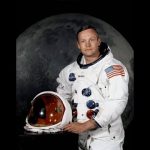
The primary objective of Apollo 11 was to complete a national goal set by President John F. Kennedy on May 25, 1961: perform a crewed lunar landing and return to Earth. The success of the mission was celebrated globally and united all humankind. This video shows the parades that celebrated the successful return of Neil Armstrong, Michael Collins and Buzz Aldrin.
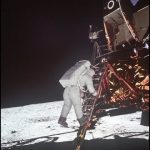
Neil Armstrong and Buzz Aldrin spent more than two hours outside their spacecraft on the Moon. They studied the surface. They collected rocks. After almost a day, they blasted off. They docked with Michael Collins in orbit around the Moon.
On July 20, 1969, humans walked on another world for the first time in history, achieving the goal that President John F. Kennedy had set in 1961, before Americans had even orbited the Earth. After a landing that included dodging a lunar crater and boulder field just before touchdown, Apollo 11 astronauts Neil Armstrong and Buzz Aldrin explored the area around their lunar landing site for more than two hours.
When the lunar module landed at 4:17 p.m EDT, only 30 seconds of fuel remained. Armstrong radioed “Houston, Tranquility Base here. The Eagle has landed.” Mission control erupted in celebration as the tension breaks, and a controller tells the crew “You got a bunch of guys about to turn blue, we’re breathing again.”
Seeking ideas for landing systems to return humans to the Moon, showcasing our aeronautics research efforts, and the science connection to Apollo 11’s splashdown … a few of the stories to tell you about – This Week at NASA!
This video is available for download from NASA’s Image and Video Library: https://images.nasa.gov/details-NHQ_2019_0726_Seeking%20Landers%20to%20Return%20Humans%20to%20the%20Moon%20on%20This%20Week%20@NASA%20%E2%80%93%20July%2026,%202019.html
Celebrating the 50th anniversary of Apollo 11, moving toward the first flight of our Artemis Program, and a new crew to the space station on an historic date for humans in space … a few of the stories to tell you about – This Week at NASA!
This video is available for download from NASA’s Image and Video Library: https://images.nasa.gov/details-NHQ_2019_0722_Celebrating%20the%2050th%20anniversary%20of%20Apollo%2011%20on%20This%20Week%20@NASA%20%E2%80%93%20July%2022,%202019.html
Which camera to send to the Moon? The iconic images taken with the Hasselblad 500 series captivated the world. Today, Hasselblad cameras are synonymous with the Apollo missions. We visited Gothenburg to find out how a Swedish camera made it to the Moon.
We are Europe’s gateway to space. Our mission is to shape the development of Europe’s space capability and ensure that investment in space continues to deliver benefits to the citizens of Europe and the world. Check out http://www.esa.int/ESA to get up to speed on everything space related.
NASA Astronauts Christina Koch and Nick Hague join the world in celebrating the 50th anniversary of the Apollo 11 Moon landing — only, they do it from around 250 miles (~400 km) above the Earth’s surface on board the International Space Station.
The accomplishments of the Apollo program did not only take humans farther than ever before, but they have prepared us to take humans even farther. Learn more about our plans to bring humans to the Moon, Mars and beyond with our Artemis program: https://www.nasa.gov/specials/moon2mars/
What does a half-century of lunar science sound like? Join Moon data expert Ernie Wright on a musical time-traveling journey through the Apollo program and the exploration era of today. We explore what we knew about the Moon before Apollo, what we discovered because of it and the mysteries today’s scientists are working to solve.
Elena, from Nantes, France, shares her memory of watching the Apollo 11 landing from a friend’s house in Seattle.
Data sonification by SYSTEM Sounds/Matt Russo and Andrew Santaguida
Music by Lee Rosevere and Daniel Wyantis
This video is public domain and along with other supporting visualizations can be downloaded from the Scientific Visualization Studio at: https://svs.gsfc.nasa.gov/13204
When people think about the big players of the space industry, they don’t tend to think about Europe. But believe it or not the European Space Agency or ESA has the second highest budget out of any space agency. So what are they doing with all that money?
NASA commemorated the many contributions of retired mathematician Katherine Johnson to America’s space program during a building dedication ceremony on May 5, at the agency’s Langley Research Center in Hampton, Virginia. Langley’s new Katherine G. Johnson Computational Research Facility was formally dedicated to the venerated mathematician and Presidential Medal of Freedom recipient.
Johnson worked at Langley from 1953 until her retirement in 1986, beginning as a research mathematician — part of a pool of women hired to perform mathematical equations and calculations by hand for engineers. She quickly distinguished herself and was permanently assigned to the branch that would later calculate the launch windows for NASA’s first Project Mercury flights.
Notable accomplishments include her computation, by hand, of the launch window and trajectory for Alan Shepard’s maiden space voyage aboard Freedom 7 in 1961, and verification, also by hand, of calculations made by the first computers for John Glenn’s history-making orbit around the Earth in 1962. She also calculated the trajectory for the historic Apollo 11 first moon landing flight in 1969.
There was more celebration of Apollo 11’s 45th anniversary at several events around the country – and more opportunity for the agency to highlight its “next giant leap” to send humans to Mars. Those events included a ceremony during which Kennedy Space Center’s Operations and Checkout Building was renamed on July 21, in honor of Apollo 11 Commander Neil Armstrong, who passed away in 2012. The facility, which was used to process and test Apollo spacecraft, is now being used to assemble NASA’s Orion spacecraft. Also, ISS astronauts appear in the House, Space station cargo ships, Extreme underwater mission underway, RS-25 Engine installed for testing, and more!
NASA is celebrating the 45th anniversary of the historic Apollo 11 mission to the moon. On July 20, 1969, Neil Armstrong and Buzz Aldrin, with crewmate Michael Collins manning the command service module from lunar orbit, became the first humans on the moon — with Armstrong’s historic first step onto the lunar surface becoming a symbolic giant leap for humanity. Today, with Apollo 11 as inspiration, NASA is taking the steps needed for America’s next giant leap, to send astronauts to Mars. The path to Mars will use a stepping stone approach consisting of key elements, including human health and technology research aboard the International Space Station; development and evolution of NASA’s Space Launch System rocket and Orion deep space capsule and development of other game-changing technologies to enable tomorrow’s missions. Also, Science instruments for Europa mission?, Cygnus cargo craft arrives at ISS, News conference with next ISS crew, 5th Anniversary of Bolden’s Confirmation, The Search for Life in the Universe.
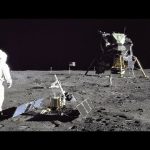
Original Mission Video as aired in July 1969 depicting the Apollo 11 astronauts conducting several tasks during extravehicular activity (EVA) operations on the surface of the moon. The EVA lasted approximately 2.5 hours with all scientific activities being completed satisfactorily. The Apollo 11 (EVA) began at 10:39:33 p.m. EDT on July 20, 1969 when Astronaut Neil Armstrong emerged from the spacecraft first. While descending, he released the Modularized Equipment Stowage Assembly on the Lunar Module’s descent stage. A camera on this module provided live television coverage of man’s first step on the Moon. On this, their one and only EVA, the astronauts had a great deal to do in a short time. During this first visit to the Moon, the astronauts remained within about 100 meters of the lunar module, collected about 47 pounds of samples, and deployed four experiments. After spending approximately 2 hours and 31 minutes on the surface, the astronauts ended the EVA at 1:11:13 a.m. EDT on July 21.