🔔 Subscribe for more history
🚩 If you like what you see, consider supporting my work on Patreon and you get ad-free early access to my videos for as little as $1 https://www.patreon.com/historymarche
In the summer of 552, the Gothic War reached a new and desperate phase. The fields near Taginae had just witnessed a brutal clash between East Roman arms and the Ostrogothic host. The Roman general Narses, commanding a diverse force of imperial troops, barbarian auxiliaries, and mounted archers, had secured a decisive moment in Justinian’s long and costly effort to reclaim Italy.
But the Goths, despite their king falling in battle, were not prepared to surrender. Leaders among them rallied survivors and gathered reinforcements, and the Goths began to stir once more, bound together by the sheer will to resist Justinian.
Justinian’s dream of restoring imperial unity appeared tantalizingly close, yet the road ahead was strewn with peril. Italy was exhausted—its cities scarred by sieges, its farmlands stripped bare by years of war. The loyalties of local populations remained uncertain, wavering between fear of Gothic reprisals and mistrust of Byzantine rule.
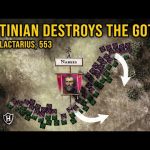
The stage was set for a confrontation in the shadow of Mount Vesuvius.
📢 Narrated by David McCallion
🎼 Music:
EpidemicSound
Filmstro
📖 Sources and Citations:
History of the Wars (Gothic War) – Procopius (545)
Rome Resurgent – Peter Heather (2018)
Military History of Late Rome 518–565 – John D. Burtt (1955)
History of the Later Roman Empire – J. B. Bury (1923)
The Byzantine Wars – John Haldon (2008)
Narses and the Battle of Taginae (Busta Gallorum) 552: Procopius and sixth century warfare – Philip Rance (2005)
50 Battles That Changed the World: The Conflicts That Most Influenced the Course of History – William Weir (2004)
Justinian’s Wars: Belisarius, Narses, and the reconquest of the West – Roy Boss (1993)
Correction:
00:05 There is no proof that Narses did not have facial hair. In the original mosaic from ~550 AD, standing next to Justinian, Narses is portrayed with a mustache and a thin beard. Eunuchs who were castrated after puberty did have facial hair and a male voice. Although it is unknown when Narses was castrated, the fact that he is portrayed as having a mustache in the 550’s suggests he did have facial hair.
#history #medieval #byzantinehistory #rome