Tag: Asteroid (Celestial Object Category)

  • Asteroid Day – ESA experts explain the nature and threat of asteroids

    Asteroid Day – ESA experts explain the nature and threat of asteroids

    If an asteroid were spotted headed towards Earth, what could humanity do about it? On 30 June, world renowned scientists, Nobel laureates, astronauts, technologists and artists join forces for Asteroid Day (http://www.asteroidday.org/), a global awareness movement to spread knowledge about asteroids and ways to protect Earth from such threats. The Day is held on the anniversary of the 1908 Siberian Tunguska event, the largest asteroid to impact our planet in recent history.

    To mark Asteroid Day, ESA experts on Near-Earth Objects (NEO) and asteroids have answered the public’s most insightful questions. Respondents include Ian Carnelli, AIM Project Manager, Detlef Koshny, SSA-NEO Segment Manager and Michael Kueppers, AIM Project Scientist.

    If approved next year by Europe’s space ministers, 2020 will see the launch of ESA’s deep space Asteroid Impact Mission or AIM, as part of AIDA (Asteroid Impact & Deflection Assessment), a larger international effort to investigate planetary defence techniques. AIM will travel to a binary asteroid system – the paired Didymos asteroids, which will come a comparatively close 11 million km to Earth in 2022. After encounter and study, the mission will then witness the asteroid being struck by another spacecraft, returning data to help guide planetary defence strategies.

    Visit AIM (http://www.esa.int/aim) for more information.

    Copyright: ESA
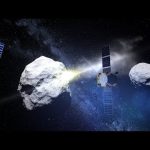
  • Asteroid Impact Mission

    Asteroid Impact Mission

    The Asteroid Impact Mission (AIM) is a candidate mission currently undergoing preliminary design work.

    Launched in October 2020, AIM would travel to a binary asteroid system – the paired Didymos asteroids, which will come a comparatively close 11 million km to Earth in 2022. The 800 m-diameter main body is orbited by a 170 m moon, informally called ‘Didymoon’.

    This smaller body is AIM’s focus: the spacecraft would perform high-resolution visual, thermal and radar mapping of the moon to build detailed maps of its surface and interior structure.

    The main AIM spacecraft is planned to carry at least three smaller spacecraft – the Mascot-2 asteroid lander, being provided by DLR (Mascot-1 is already flying on JAXA’s Hayabusa-2), as well as two or more CubeSats. AIM would test optical communications and inter-satellite links in deep space, essential technology for future exploration.

    If approved, AIM would also be Europe’s contribution to the larger Asteroid Impact & Deflection Assessment mission: AIDA. In late 2022, the NASA-led part of AIDA will arrive: the Double Asteroid Redirection Test, or DART, probe will approach the binary system – then crash straight into the asteroid moon at about 6 km/s.

    AIM is intended to be watching closely as DART hits Didymoon. In the aftermath, it will perform detailed before-and-after comparisons on the structure of the body itself, as well as its orbit, to characterise DART’s kinetic impact and its consequences.

    This video is also available in the following languages:
    French: https://youtu.be/8GjVhBQsISc
    German: https://youtu.be/Sht_Kmaf5sU
    Spanish: https://youtu.be/KpmuzduOjhE

    Credits: ESA/ScienceOffice.org

  • AIDA: Asteroid Impact and Deflection Assessment study

    AIDA: Asteroid Impact and Deflection Assessment study

    The Asteroid Impact and Deflection Assessment (AIDA) study examines ways to potentially deflect asteroids from trajectories that could lead to them impacting Earth. The Johns Hopkins University Applied Physics Laboratory would work with NASA and ESA on the mission, which includes two independent spacecraft: an impactor (to be built by APL for NASA) and an impact monitor (to be built by ESA).

    The target of this mission is the binary asteroid system Didymos. The impactor would strike the smaller secondary of Didymos, while the monitor would observe and measure any change in the relative orbit.

    Learn more:
    http://www.esa.int/Our_Activities/Technology/NEO/Asteroid_Impact_Deflection_Assessment_AIDA_study
    http://neo.jpl.nasa.gov/
    http://www.neoshield.net/en/index.htm