Tag: become

  • Mating Hera: two become one

    Mating Hera: two become one

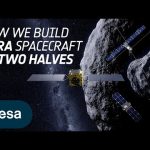
    Hera is complete. ESA’s asteroid mission for planetary defence was built and prepared in two halves, but now, through a painstaking operation, they have been mated together to make a single spacecraft, ready for full-scale testing of its readiness for space.

    The mating took place at OHB Bremen in Germany, with Hera’s Core Module raised more than 3 m above its Propulsion Module then gradually and carefully slotted into place, over a three-hour period. The modules had been placed in cages to ensure their correct alignment relative to each other down to a few tenths of a millimetre.

    Hera’s Propulsion Module incorporates its propellant tanks – housed within a central titanium cylinder, the ‘backbone’ of the spacecraft – along with piping and thrusters, which will have the job of hauling the mission across deep space for more than two years, then to manoeuvre around the Dimorphos and Didymos asteroids.

    Meanwhile Hera’s Core Module can be thought of as the brains of the mission, hosting its onboard computer, mission systems and instruments.

    Once the tip of the Propulsion Module cylinder met the top deck of the Core Module the mating was complete. Then an initial test bolt was inserted to check the alignment was entirely correct in advance of the two modules being fully bolted together.

    The combined Hera spacecraft is scheduled to go through a test campaign to assess its readiness for spaceflight, along with the two CubeSats it will carry aboard, in preparation for its October 2024 lift-off.

    Credits: ESA – European Space Agency
    Footage: ESA / OHB

    ★ Subscribe: http://bit.ly/ESAsubscribe and click twice on the bell button to receive our notifications.

    Check out our full video catalog: http://bit.ly/SpaceInVideos
    Follow us on Twitter: http://bit.ly/ESAonTwitter
    On Facebook: http://bit.ly/ESAonFacebook
    On Instagram: http://bit.ly/ESAonInstagram
    On LinkedIn: https://bit.ly/ESAonLinkedIn
    On Pinterest: https://bit.ly/ESAonPinterest
    On Flickr: http://bit.ly/ESAonFlickr

    We are Europe’s gateway to space. Our mission is to shape the development of Europe’s space capability and ensure that investment in space continues to deliver benefits to the citizens of Europe and the world. Check out https://www.esa.int/ to get up to speed on everything space related.

    Copyright information about our videos is available here: https://www.esa.int/ESA_Multimedia/Terms_and_Conditions

    #ESA
    #Hera
    #PlanetaryDefence

  • When Computers Become Human: A Kid’s Guide to the Future of Artificial Intelligence

    When Computers Become Human: A Kid’s Guide to the Future of Artificial Intelligence

    This film is adapted from Kelly Lane’s new book, When Computers Become Human: A Kid’s Guide to the Future of Artificial Intelligence (MSAC Philosophy Group, Mt. San Antonio College, 2017). Covers some of the history of computing and the digital future. Narrated by Kelly Lane, a 11 year old middle school student.

  • Detroit: Become Human – E3 2016 Trailer | PS4

    Detroit: Become Human – E3 2016 Trailer | PS4

    Here’s the E3 2016 premiere trailer for Detroit: Become Human.

    May contain content inappropriate for children, visit www.esrb.org for rating information

  • How to become an astronaut

    How to become an astronaut

    ‘How do I become an astronaut?’ is a question that Frank Danesy has been asked many, many times. In this video Frank talks about the qualities needed to become an astronaut, the selection campaigns and the rigorous training involved for the lucky few who are eventually chosen.

  • NASA’s MESSENGER to Become First Spacecraft to Orbit Mercury

    NASA’s MESSENGER to Become First Spacecraft to Orbit Mercury

    After more than a dozen laps through the inner solar system, NASA’s MESSENGER spacecraft will move into orbit around Mercury on March 17, 2011. The durable spacecraft — carrying seven science instruments and fortified against the blistering environs near the sun — will be the first to orbit the innermost planet. At 8:45 p.m. EDT, MESSENGER — having pointed its largest thruster very close to the direction of travel — will fire that thruster for nearly 14 minutes, with other thrusters firing for an additional minute, slowing the spacecraft by 862 meters per second (1,929 mph). The orbit insertion will place the spacecraft into a 12 hour orbit about Mercury with a 200 kilometer (124 mile) minimum altitude. At the time of orbit insertion, MESSENGER will be 46.14 million kilometers (28.67 million miles) from the sun and 155.06 million kilometers (96.35 million miles) from Earth. MESSENGER has been on a 6.6 year mission to become the first spacecraft to orbit Mercury. The spacecraft followed a path through the inner solar system, including one flyby of Earth, two flybys of Venus, and three flybys of Mercury. This impressive journey is returning the first new spacecraft data from Mercury since the Mariner 10 mission over 30 years ago.