Our planet is facing an unprecedented crisis as we continue to wrestle with the impacts of coronavirus. With its unparalleled technical and scientific expertise, NASA has joined the fight against the pandemic. Join us Thursday, June 25 at 3 p.m. EDT on #NASAScience Live to learn about the ideas and developments that NASA has contributed to confront this global health crisis.
With the Covid-19 pandemic halting our daily lives and forcing many countries and region into lockdown, the economic effects have been devastating. Closed borders have caused traffic jams and disrupted supply chains. In Europe, for example, the agriculture industry has suffered. Normally the industry relies on migrant labour to harvest crops, but as the lockdown continues, crops remain unpicked – putting farmers and the food supply under pressure. How can the food supply chain more sustainable?
★ Subscribe: http://bit.ly/ESAsubscribe and click twice on the bell button to receive our notifications.
We are Europe’s gateway to space. Our mission is to shape the development of Europe’s space capability and ensure that investment in space continues to deliver benefits to the citizens of Europe and the world. Check out http://www.esa.int/ESA to get up to speed on everything space related.
As the COVID-19 pandemic has disrupted lives across the globe, Earth-observing satellites take the pulse of our planet from space. While the global lockdown has had a massive impact on daily life and the economy, there have been environmental benefits that are visible from space. How can we preserve these positives when returning to ‘business as usual’?
★ Subscribe: http://bit.ly/ESAsubscribe and click twice on the bell button to receive our notifications.
We are Europe’s gateway to space. Our mission is to shape the development of Europe’s space capability and ensure that investment in space continues to deliver benefits to the citizens of Europe and the world. Check out http://www.esa.int/ESA to get up to speed on everything space related.
Answering the call to help combat coronavirus, a launch date for our Demo-2 mission, and … celebrating 30 years of Hubble … a few of the stories to tell you about – This Week at NASA!
This video is available for download from NASA’s Image and Video Library: https://images.nasa.gov/details-Answering%20the%20Call%20to%20Help%20Combat%20Coronavirus%20on%20This%20Week%20@NASA%20%E2%80%93%20April%2024,%202020
In these times of confinement, ESA astronaut support engineer Romain Charles shares nine tips on how to live in isolation – he spent 520 days locked in a mockup spacecraft and is a true expert on the subject.
Mars500 locked six ‘marsonauts’ in a simulated spaceship near Moscow, Russia for 520 days, the time it would take to fly to Mars and back plus 30 days spent exploring its surface. It was the first full-length, high-fidelity simulation of a human mission to our neighbouring planet. The crew went into lockdown on 3 June 2010, and they did not open the hatch until 17 months later on 4 November 2011.
Mars 500 was a success in that it proved that humans can survive the inevitable isolation that is needed for a mission to Mars and back. Psychologically, we can do it!
The crew had their ups and downs, but these were to be expected. In fact, scientists anticipated many more problems, but the crew did very well coping with the monotonous mission, with little variation in food and even a communication delay over 12 minutes one-way.
During their simulated mission, the crew lived in isolation without fresh food, sunlight or fresh air. The participants from Italy, Russia, China and France had no external cues such as the Sun going down at night to remind them when to sleep.
Their bodies are among the most researched in the world. Years of constant monitoring, prodding and taking blood allowed scientists examined how they reacted to the time in confinement with experiments focussing on their bodies, mental states and performance.
More on Mars 500: www.esa.int/Mars500
★ Subscribe: http://bit.ly/ESAsubscribe and click twice on the bell button to receive our notifications.
We are Europe’s gateway to space. Our mission is to shape the development of Europe’s space capability and ensure that investment in space continues to deliver benefits to the citizens of Europe and the world. Check out http://www.esa.int/ESA to get up to speed on everything space related.
The impact of coronavirus to NASA’s missions, prelaunch training continues for the next space station crew, and launch preparations for Orion … a few of the stories to tell you about – This Week at NASA!
This video is available for download from NASA’s Image and Video Library: https://images.nasa.gov/details-NASA_2020_0327_The%20Impact%20of%20Coronavirus%20to%20NASA%E2%80%99s%20Missions%20on%20This%20Week%20@NASA%20%E2%80%93%20March%2027,%202020
🇳🇱Jump to the Dutch section: 0:57:50
🇩🇪Jump to the German section: 1:57:57
🇮🇹Jump to the Italian section: 2:57:44
🇫🇷Jump to the French section: 3:57:50
🇬🇧Jump to the English section: 4:58:41
Asteroid Day and the European Space Agency connected Europe and the world with astronauts, scientists and performers bringing a message of hope and support for those facing the global Coronavirus crisis.
This online programme was broadcast sequentially in Dutch, German, Italian, French and English to inspire armchair explorers everywhere.
Featuring
André Kuipers, Frank De Winne, Matthias Maurer, Alexander Gerst, Thomas Reiter, Samantha Cristoforetti, Jean-François Clervoy, Thomas Pesquet, Timothy Peake, Rusty Schweickart, Nicole Stott, Tom Jones, Dumitru-Dorin Prunariu, Anousheh Ansari
Special guests
Gianluca Masi, Jan Wörner, Mayim Bialik, Murad Osmann, Alison Pill, Paulina Chávez, Angélique Kidjo, Grig Richters
Moderators
Sander Koenen, Ranga Yogeshwar, Rossella Panarese, Bruce Benamran, Brian Cox
We are Europe’s gateway to space. Our mission is to shape the development of Europe’s space capability and ensure that investment in space continues to deliver benefits to the citizens of Europe and the world. Check out http://www.esa.int/ESA to get up to speed on everything space related.
NASA addresses the coronavirus pandemic, some online material to stay connected with NASA, and more testing with our Orion spacecraft … a few of the stories to tell you about – This Week at NASA!
This animation, using data from the Copernicus Sentinel-5P satellite, shows the nitrogen dioxide emissions from 20 December 2019 until 16 March 2020 – using a 10-day moving average. The drop in emissions in late-January is visible, coinciding with the nationwide quarantine, and from the beginning of March, the nitrogen dioxide levels have begun to increase.
We are Europe’s gateway to space. Our mission is to shape the development of Europe’s space capability and ensure that investment in space continues to deliver benefits to the citizens of Europe and the world. Check out http://www.esa.int/ESA to get up to speed on everything space related.
ESA astronaut Thomas Pesquet gives us some advice on what to do during a period of social distancing like the one many of us have to endure during the COVID-19 outbreak.
* Turn CC on for English or French captions *
Credits: ESA/T. Pesquet
★ Subscribe: http://bit.ly/ESAsubscribe and click twice on the bell button to receive our notifications.
We are Europe’s gateway to space. Our mission is to shape the development of Europe’s space capability and ensure that investment in space continues to deliver benefits to the citizens of Europe and the world. Check out http://www.esa.int/ESA to get up to speed on everything space related.
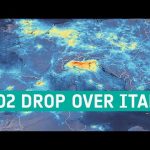
New data from the Copernicus Sentinel-5P satellite reveal the decline of air pollution, specifically nitrogen dioxide emissions, over Italy. This reduction is particularly visible in northern Italy which coincides with its nationwide lockdown to prevent the spread of the coronavirus.
The animation shows the fluctuation of nitrogen dioxide emissions across Europe from 1 January 2020 until 11 March 2020, using a 10-day moving average. These data are thanks to the Tropomi instrument on board the Copernicus Sentinel-5P satellite which maps a multitude of air pollutants around the globe.
Claus Zehner, ESA’s Copernicus Sentinel-5P mission manager, comments, “The decline in nitrogen dioxide emissions over the Po Valley in northern Italy is particularly evident.
“Although there could be slight variations in the data due to cloud cover and changing weather, we are very confident that the reduction in emissions that we can see, coincides with the lockdown in Italy causing less traffic and industrial activities.”
Josef Aschbacher, ESA’s Director of Earth Observation Programmes, says, “Copernicus Sentinel-5P Tropomi is the most accurate instrument today that measures air pollution from space. These measurements, globally available thanks to the free and open data policy, provide crucial information for citizens and decision makers.”
The coronavirus disease (COVID-19) was recently declared a pandemic by the World Health Organisation, with more than 125 000 current cases of the disease reported globally. In Italy, the number of coronavirus cases drastically soared making it the country with the largest number of cases outside of China.
In an attempt to reduce the spread of the disease, Italy’s Prime Minister Giuseppe Conte announced a lockdown of the entire country – closing schools, restaurants, bars, museums and other venues across the country.
The Sentinel-5 Precursor – also known as Sentinel-5P – is the first Copernicus mission dedicated to monitoring our atmosphere. The satellite carries the Tropomi instrument to map a multitude of trace gases such as nitrogen dioxide, ozone, formaldehyde, sulphur dioxide, methane, carbon monoxide and aerosols – all of which affect the air we breathe and therefore our health, and our climate.
Given the growing importance and need for the continuous monitoring of air quality, the upcoming Copernicus Sentinel-4 and Sentinel-5 missions, as part of the EU’s Copernicus programme, will monitor key air quality trace gases and aerosols. These missions will provide information on air quality, stratospheric ozone and solar radiation, as well as climate monitoring.
Credits: contains modified Copernicus Sentinel data (2020), processed by ESA, CC BY-SA 3.0 IGO
★ Subscribe: http://bit.ly/ESAsubscribe and click twice on the bell button to receive our notifications.
We are Europe’s gateway to space. Our mission is to shape the development of Europe’s space capability and ensure that investment in space continues to deliver benefits to the citizens of Europe and the world. Check out http://www.esa.int/ESA to get up to speed on everything space related.