Tag: Cosmos

  • The Hyades cluster

    The Hyades cluster

    Animated 3D view of the sky as observed by ESA’s Gaia satellite using information from the mission’s second data release.

    The bright band in the left half of the image is the Milky Way, where most of the stars in our Galaxy reside. The animation starts with the Orion constellation at the centre; we then move towards the neighbouring Taurus constellation and to the Hyades star cluster, which is part of this constellation. Hyades is the closest open cluster to the Solar System, some 150 light-years away.

    The animation first shows the 3D structure of the cluster, based on accurate position and distance information from Gaia. Then an animated view of the future motions of stars is shown – both in Hyades and beyond. This is based on Gaia’s measurements of the velocity of stars across the sky, also known as proper motion.

    Credit: ESA/Gaia/DPAC, CC BY SA 3.0 IGO

    Acknowledgement: Gaia Data Processing and Analysis Consortium (DPAC); Gaia Sky; S. Jordan / T. Sagristà, Astronomisches Rechen-Institut, Zentrum für Astronomie der Universität Heidelberg, Germany

    ★ Subscribe: http://bit.ly/ESAsubscribe

    Learn more: bit.ly/GaiaRickestStarMap
  • Gaia’s first asteroid survey

    Gaia’s first asteroid survey

    Animated view of 14 099 asteroids in our Solar System, as viewed by ESA’s Gaia satellite using information from the mission’s second data release. The orbits of the 200 brightest asteroids are also shown, as determined using Gaia data.

    In future data releases, Gaia will also provide asteroid spectra and enable a complete characterisation of the asteroid belt. The combination of dynamical and physical information that is being collected by Gaia provides an unprecedented opportunity to improve our understanding of the origin and the evolution of the Solar System.

    Credit: ESA/Gaia/DPAC, CC BY SA 3.0 IGO

    Acknowledgement: Gaia Data Processing and Analysis Consortium (DPAC); Orbits: Gaia Coordinating Unit 4; P. Tanga, Observatoire de la Côte d’Azur, France; F. Spoto, IMCCE, Observatoire de Paris, France; Animation: Gaia Sky; S. Jordan / T. Sagristà, Astronomisches Rechen-Institut, Zentrum für Astronomie der Universität Heidelberg, Germany

    ★ Subscribe: http://bit.ly/ESAsubscribe

    Learn more: bit.ly/GaiaRickestStarMap
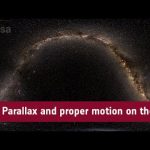
  • 360º Parallax and proper motion on the sky

    360º Parallax and proper motion on the sky

    A 360° animated view of the entire sky on 25 April 2018.

    After a few seconds, the stars start moving in the sky according to parallax, an apparent shift caused by Earth’s yearly motion around the Sun. Then, constellation outlines appear as visual aids. Finally, stars start moving according to their true motion through space, which is visible on the sky as proper motion. Parallaxes have been exaggerated by 100 000 and proper motions have been speeded up by one trillion (10^12) to make them visible in this animation. This animation is based on data from the second data release of ESA’s Gaia satellite, which has measured the positions, parallaxes and motions of more than one billion stars across the sky to unprecedented accuracy.

    ESA/Gaia/DPAC, CC BY SA 3.0 IGO

    Acknowledgement: Gaia Data Processing and Analysis Consortium (DPAC); Gaia Sky; S. Jordan / T. Sagristà, Astronomisches Rechen-Institut, Zentrum für Astronomie der Universität Heidelberg, Germany

    ★ Subscribe: http://bit.ly/ESAsubscribe

    Learn more: http://bit.ly/GaiaRickestStarMap

  • To Europe’s spaceport!

    To Europe’s spaceport!

    Meet our new space explorers, the spacecraft of the BepiColombo mission, as they begin their adventure to planet Mercury. But first, they have to navigate through Amsterdam Schiphol airport to reach Europe’s spaceport in Kourou, French Guiana.

    The spacecraft really do depart from Schiphol; along with essential ground-support equipment they are scheduled to fly in a series of Antonov aircraft during the last week of April and first week of May. Upon arrival at Kourou, an intensive six-months of preparations will prepare the mission for launch. The launch window opens 5 October until 29 November 2018.

    Find out more about the BepiColombo mission on esa.int/bepicolombo

    Credits: ESA

    ★ Subscribe: http://bit.ly/ESAsubscribe

    Follow Bepi: http://bit.ly/BepiTwitter
    Follow MMO: http://bit.ly/MMOTwitter
    Follow MTM: http://bit.ly/MTMtwitterESA

  • Waiting for Gaia

    Waiting for Gaia

    On 25 April 2018, ESA’s Gaia mission will publish its much awaited second data release, including high-precision measurements of nearly 1.7 billion stars in our Galaxy.

    Scientists who have been working on creating and validating the data contained in the catalogue tell us why they are waiting for this extraordinary release.

    Featured in the video: Antonella Vallenari (INAF, Astronomical Observatory of Padua), Anthony Brown (Leiden University), Timo Prusti (European Space Agency), Annie Robin (Institut UTINAM, OSU THETA Franche-Comté-Bourgogne), Laurent Eyer (University of Geneva) and Federica Spoto (IMCCE, Observatory of Paris).

    A media briefing on the second Gaia data release will be held at the ILA Berlin Air and Space Show in Germany on 25 April 11:00-12:15 CEST. Watch the webstream at www.esa.int/live

    Learn more about Gaia: bit.ly/ESAsGaia

    ★ Subscribe: http://bit.ly/ESAsubscribe

  • ESA Euronews: Surfing scientists

    ESA Euronews: Surfing scientists

    We meet a surfing scientist and toxic algae hunters to see how Sentinel-3 satellite data is used to study the coastline of the English Channel in this month’s episode of Space.

    Bob Brewin is pioneering a new technique in satellite oceanography – by going surfing.
    The Plymouth Marine Laboratory scientist uses his board to take sea surface temperature measurements, and then use them to better interpret data from European satellite Sentinel-3.

    This video is also available in the following languages:
    German: https://youtu.be/1dU52RA1IEE
    French: https://youtu.be/kSJXmrSWG-s
    Italian: https://youtu.be/PRPvcvZgQno
    Spanish: https://youtu.be/H0vQdyanyKk
    Portuguese: https://youtu.be/_nP6Bmpa6YQ
    Greek: https://youtu.be/y4zObvFjckY
    Hungarian: https://youtu.be/kj3-iO2S4UQ

    ★ Subscribe to the channel: http://bit.ly/ESAsubscribe

  • Earth from Space: special edition

    Earth from Space: special edition

    In this special edition of Earth from Space, senior project scientist at Gamma Remote Sensing, Dr Maurizio Santoro, joins the show to discuss how his team estimates forest biomass from space.

    ★ Subscribe: http://bit.ly/ESAsubscribe

  • Paxi on the ISS: Sleeping in space

    Paxi on the ISS: Sleeping in space

    Our alien friend Paxi, ESA Education’s mascot, went to visit American astronaut Scott Tingle on board the International Space Station. Tingle tells Paxi about how astronauts sleep in weightlessness, an important aspect of living on the ISS.

    Credit: ESA/NASA

    #ESA
    #Paxi
    #InternationalSpaceStation

  • What is Dark Matter? A New Clue!

    What is Dark Matter? A New Clue!

    Scientists may have found clues to the nature of dark matter in a signal from the universe’s first stars.
    – Subscribe: https://www.youtube.com/WhatThePhysics?sub_confirmation=1

    Here is the research paper: https://www.nature.com/articles/nature25792
    Authors: Judd D. Bowman, Alan E. E. Rogers, Raul A. Monsalve, Thomas J. Mozdzen & Nivedita Mahesh

    This evidence seems to suggest that the dark matter is particles that are less than four times the mass of a proton and are moving at non-relativistic speeds. This is consistent with dark matter particles being so-called WIMPs: https://en.wikipedia.org/wiki/Weakly_interacting_massive_particles.

    Have questions, ask me:
    twitter @gkestin

    Credits
    Host, Producer: Greg Kestin
    Researchers: Greg Kestin, Samia Bouzid
    Writers: Greg Kestin, Samia Bouzid
    Scientific Consultant: Douglas Finkbeiner
    Editorial input from: Julia Cort, Ari Daniel
    Filming: Greg Kestin
    Animation and Editing: Greg Kestin
    Special thanks: Avi Loeb, entire NOVA team
    Media Courtesy of: NASA, ESO, and CERN
    Dark matter halo footage courtesy of ESO/L. Calçada.
    From the producers of PBS NOVA © WGBH Educational Foundation
    Funding provided by FQXi
    Music provided by APM

  • The value of the Moon with Paul D. Spudis | Space Bites

    The value of the Moon with Paul D. Spudis | Space Bites

    The Moon is a destination, a laboratory for science, a place to learn the skills of planetary exploration, and a source of materials and energy for use on the Moon and in space to create new spacefaring capability.

    Advocate of a human return on the Moon, Paul D. Spudis, Senior Staff Scientist at the Lunar and Planetary Institute in Houston (Texas, USA), takes us on a journey to rediscover the value of lunar exploration, a topic on which he has spent more than 40 years of study, thought and publications.

    Space Bites hosts the best talks on space exploration from the most inspiring and knowledgeable speakers from the field. Held at the technical heart of the European Space Agency in the Netherlands, the lectures are now also available on YouTube. If you want to know about the present and future challenges of ESA, stay tuned for more.

    To know more about the exploration of the Moon visit http://lunarexploration.esa.int

    ★ Subscribe: http://bit.ly/ESAsubscribe and click twice on the bell button to receive our notifications.

    Check out our full video catalog: http://bit.ly/SpaceInVideos
    Follow us on Twitter: http://bit.ly/ESAonTwitter
    On Facebook: http://bit.ly/ESAonFacebook
    On Instagram: http://bit.ly/ESAonInstagram
    On Pinterest: https://bit.ly/ESAonPinterest
    On Flickr: http://bit.ly/ESAonFlickr

    We are Europe’s gateway to space. Our mission is to shape the development of Europe’s space capability and ensure that investment in space continues to deliver benefits to the citizens of Europe and the world. Check out https://www.esa.int/ to get up to speed on everything space related.

    Copyright information about our videos is available here: https://www.esa.int/ESA_Multimedia/Terms_and_Conditions

    #ESA
    #SpaceBites
    #LunarExploration

  • Black Holes Explained – From Birth to Death

    Black Holes Explained – From Birth to Death

    Black holes. Lets talk about them.

    OUR CHANNELS
    ▀▀▀▀▀▀▀▀▀▀▀▀▀▀▀▀▀▀▀▀▀▀▀▀▀▀
    German Channel: https://kgs.link/youtubeDE
    Spanish Channel: https://kgs.link/youtubeES

    HOW CAN YOU SUPPORT US?
    ▀▀▀▀▀▀▀▀▀▀▀▀▀▀▀▀▀▀▀▀▀▀▀▀▀▀
    This is how we make our living and it would be a pleasure if you support us!

    Get Merch designed with ❤ from https://kgs.link/shop
    Join the Patreon Bird Army 🐧 https://kgs.link/patreon

    DISCUSSIONS & SOCIAL MEDIA
    ▀▀▀▀▀▀▀▀▀▀▀▀▀▀▀▀▀▀▀▀▀▀▀▀▀▀
    Reddit: https://kgs.link/reddit
    Instagram: https://kgs.link/instagram
    Twitter: https://kgs.link/twitter
    Facebook: https://kgs.link/facebook
    Discord: https://kgs.link/discord
    Newsletter: https://kgs.link/newsletter

    OUR VOICE
    ▀▀▀▀▀▀▀▀▀▀▀▀▀▀▀▀▀▀▀▀▀▀▀▀▀▀
    The Kurzgesagt voice is from
    Steve Taylor: https://kgs.link/youtube-voice

    OUR MUSIC ♬♪
    ▀▀▀▀▀▀▀▀▀▀▀▀▀▀▀▀▀▀▀▀▀▀▀▀▀▀
    700+ minutes of Kurzgesagt Soundtracks by Epic Mountain:

    Spotify: https://kgs.link/music-spotify
    Soundcloud: https://kgs.link/music-soundcloud
    Bandcamp: https://kgs.link/music-bandcamp
    Youtube: https://kgs.link/music-youtube
    Facebook: https://kgs.link/music-facebook

    The Soundtrack of this video:

    https://soundcloud.com/epicmountain/black-holes
    https://epicmountainmusic.bandcamp.com/track/black-holes
    http://epic-mountain.com

    Help us caption & translate this video!

    http://www.youtube.com/timedtext_cs_panel?c=UCsXVk37bltHxD1rDPwtNM8Q&tab=2

  • Chem C3000 – Thames & Cosmos

    Chem C3000 – Thames & Cosmos

    Thames & Cosmos Chem C3000 is without a doubt one of the best starter chemistry kits on the market. The set includes real chemicals and a full color manual to guide you thru over 300 experiments! Excellent preparation for high-school level chemistry.