Tag: discovers

  • Euclid discovers a stunning Einstein ring 🤩

    Euclid discovers a stunning Einstein ring 🤩

    Euclid, the European Space Agency’s dark Universe detective, has made an astonishing discovery – right in our cosmic backyard.

    An Einstein Ring, an extremely rare phenomenon, has been found hiding in plain sight in a galaxy not so far away. 🤩

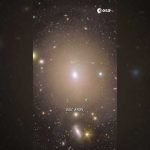
    During early testing in September 2023, the team spotted something special in one of Euclid’s first images—an Einstein Ring! This rare phenomenon, caused by gravitational lensing, was found around the well-known galaxy NGC 6505, just 590 million light-years away. The light from a much more distant galaxy (4.42 billion light-years away) is bending around it, creating a stunning cosmic ring.

    This discovery shows just how powerful Euclid is. With its mission now in full swing, we can expect many more hidden cosmic wonders to be revealed!

    📹 ESA – European Space Agency
    📸 ESA/Euclid/Euclid Consortium/NASA, image processing by J.-C. Cuillandre, G. Anselmi, T. Li

    #ESA #Euclid #EinsteinRing
  • Gaia discovers a unique black hole

    Gaia discovers a unique black hole

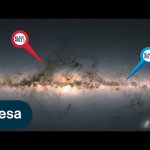
    ESA’s Gaia mission has helped discover a new kind of black hole. The new family already has two members, and both are closer to Earth than any other black hole that we know of.

    The two black holes were discovered by studying ultra-precise measurements of stellar positions and motions in Gaia’s third data release.

    A strange ‘wobble’ in the movement of two stars on the sky indicated that they are orbiting a very massive object. In both cases, the objects are approximately ten times more massive than our Sun. Other explanations for these massive companions, like double-star systems, were ruled out since they do not seem to emit any light.

    Gaia’s second black hole, BH2, is located 3800 light-years away from Earth. It is a binary system consisting of a red giant star and likely a black hole.

    In this animation of Gaia BH2, created in Gaia Sky, the orbits are accurately sized, but the back hole diameter is not to scale.

    Credit: ESA/Gaia/DPAC

    ★ Subscribe: http://bit.ly/ESAsubscribe and click twice on the bell button to receive our notifications.

    Check out our full video catalog: http://bit.ly/SpaceInVideos
    Follow us on Twitter: http://bit.ly/ESAonTwitter
    On Facebook: http://bit.ly/ESAonFacebook
    On Instagram: http://bit.ly/ESAonInstagram
    On LinkedIn: https://bit.ly/ESAonLinkedIn
    On Pinterest: https://bit.ly/ESAonPinterest
    On Flickr: http://bit.ly/ESAonFlickr

    We are Europe’s gateway to space. Our mission is to shape the development of Europe’s space capability and ensure that investment in space continues to deliver benefits to the citizens of Europe and the world. Check out https://www.esa.int/ to get up to speed on everything space related.

    Copyright information about our videos is available here: https://www.esa.int/ESA_Multimedia/Terms_and_Conditions

    #ESA
    #Earth
    #EarthObservation

  • NASA’s Kepler Spacecraft Discovers Its First Rocky Exoplanet

    NASA’s Kepler Spacecraft Discovers Its First Rocky Exoplanet

    NASA’s Kepler spacecraft has discovered Kepler-10b, its first confirmed rocky planet and the smallest transiting exoplanet discovered to date. Kepler-10b is only 1.4 times the size of Earth and has an average density of 8.8 grams per cubic centimeter, similar to that of an iron dumbbell. The planet orbits its star in only 0.84 days and is not in the habitable zone, where liquid water could exist.

  • NASA-Funded Research Discovers Life Built with Toxic Chemical

    NASA-Funded Research Discovers Life Built with Toxic Chemical

    NASA-funded astrobiology research has changed the fundamental knowledge about what comprises all known life on Earth.

    Researchers conducting tests in the harsh environment of Mono Lake in California have discovered the first known microorganism on Earth able to thrive and reproduce using the toxic chemical arsenic. The microorganism substitutes arsenic for phosphorus in its cell components.

    This finding of an alternative biochemistry makeup will alter biology textbooks
    and expand the scope of the search for life beyond Earth. The research
    is published in this week’s edition of Science Express.