
Tag: DLR German Aerospace Center

  • 3D-printing moondust bricks with focused solar heat

    3D-printing moondust bricks with focused solar heat

    Bricks have been 3D printed out of simulated moondust using concentrated sunlight. This ESA project took place at the DLR German Aerospace Center facility in Cologne, with a 3D printer table attached to a solar furnace, baking successive 0.1 mm layers of moondust at a temperature of 1000°C. A 20 x 10 x 3 cm brick for building can be completed in around five hours. DLR Cologne’s solar furnace has two working setups: as a baseline, it uses 147 curved mirror facets to focus either actual sunlight into a high temperature beam, employed to melt together the grains of regolith. But this mode is weather dependent, so a solar simulator was subsequently employed as well – based on an array of xenon lamps more typically found in cinema projectors.

    Read more: http://www.esa.int/Our_Activities/Space_Engineering_Technology/Printing_bricks_from_moondust_using_the_Sun_s_heat

    Copyrights
    Video: ESA, CC BY-SA 3.0 IGO – https://creativecommons.org/licenses/by-sa/3.0/igo/
    Music: Future Perfect 4 (60), David O’Brien, audionetwork.com
  • The floodwaters of Mars

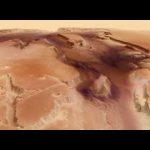
    The floodwaters of Mars

    Travel across the dramatic flood plains of Mars to celebrate ten years of imaging the Red Planet with Mars Express

    Ten years ago, on 14 January 2004, Mars Express took its very first images of Mars in colour and in 3D.

    To mark the occasion, the team produced a fly-through movie of the ancient flood plain Kasei Valles. The movie is based on the 67-image mosaic released as part of the ten-years-since-launch celebrations in June 2013. See http://www.esa.int/Our_Activities/Space_Science/Mars_Express/The_floodwaters_of_Mars.

    The scene spans 987 km in the north–south direction, 19–36°N, and 1550 km in the east–west direction (280–310°E). It covers 1.55 million square kilometres, an area equivalent to the size of Mongolia.

    Kasei Valles is one of the largest outflow channel systems on Mars, created during dramatic flood events. From source to sink, it extends some 3000 km and descends 3 km.

    Kasei Valles splits into two main branches that hug a broad island of fractured terrain — Sacra Mensa — rising 2 km above the channels that swerve around it. While weaker materials succumbed to the erosive power of the fast-flowing water, this hardier outcrop has stood the test of time.

    Slightly further downstream, the flood waters did their best to erase the 100 km-wide Sharonov crater, crumpling its walls to the south. Around Sharonov many small streamlined islands form teardrop shapes rising from the riverbed as water swept around these natural obstacles.

    The Planetary Science and Remote Sensing Group at Freie Universität Berlin produced the movie. The processing of the High Resolution Stereo Camera image data was carried out at the DLR German Aerospace Center.

    Credit: ESA/DLR/FU Berlin (G. Neukum) / Music: Crabtambour