Kick back to images and videos captured by ESA astronaut Alexander Gerst during his Blue Dot mission on the ISS. An ESA for Lufthansa inflight film.
Music Space by Borisov. Images: ESA/NASA.
Kick back to images and videos captured by ESA astronaut Alexander Gerst during his Blue Dot mission on the ISS. An ESA for Lufthansa inflight film.
Music Space by Borisov. Images: ESA/NASA.
Earth from Space is presented by Kelsea Brennan-Wessels from the ESA Web-TV virtual studios. The one hundred fifty-first edition features a satellite image of New York City in the United States.
See also http://www.esa.int/spaceinimages/Images/2015/07/New_York_City to download the image
Earth from Space is presented by Kelsea Brennan-Wessels from the ESA Web-TV virtual studios. The sandy and rocky terrain of the Sahara desert in central Algeria, captured by the Sentinel-2A satellite, is featured in the one hundred fiftieth edition.
See also http://www.esa.int/spaceinimages/Images/2015/07/Central_Algeria to download the image.
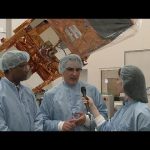
In this special edition, Sentinel-2 Project Manager François Spoto and System Engineering and Operations Manager Omar Sy join the show to tell us more about the Sentinel-2A satellite and its mission at IABG in Munich, Germany.
More about Sentinel-2:
http://www.esa.int/Our_Activities/Observing_the_Earth/Copernicus/Sentinel-2
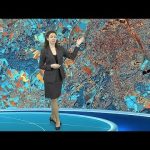
Earth from Space is presented by Kelsea Brennan-Wessels from the ESA Web-TV virtual studios. The one hundred thirty-fourth edition features a false-colour image of Belgium’s capital.
See also http://www.esa.int/spaceinimages/Images/2015/02/Brussels to download the image.
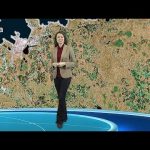
Earth from Space is presented by Kelsea Brennan-Wessels from the ESA Web-TV virtual studios. The one hundred thirty-third edition features a mosaic of Sentinel-1A radar scans, pieced together to create a single image of Estonia.
See also http://www.esa.int/spaceinimages/Images/2015/02/Estonia to download the image.
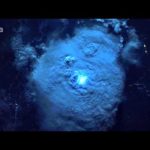
Lightning illuminates the area they strike on Earth but their flash can be seen from space too. This timelapse was made from 49 images taken 400 km above Earth in 2012 by an astronaut on the International Space Station travelling at 28 800 km/h. At these distances a camera flash is pointless, but our planet moves by so quickly images can end up being blurred.
ESA’s Nightpod camera aid compensates for the motion of the Station. The target stays firmly centred in frame so the final image is in focus. Astronauts can set up the device to take ultra-sharp images automatically using off-the-shelf cameras.
The steady progression of frames seen in this video with the target staying in centre frame would be nearly impossible without Nightpod.
A look inside the life, science and adventure of being an astronaut aboard the International Space Station.
www.nasa.gov/mission_pages/station
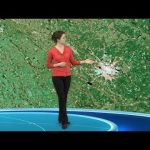
Earth from Space is presented by Kelsea Brennan-Wessels from the ESA Web-TV virtual studios. The one hundred twenty-sixth edition features a mosaic of Sentinel-1A radar scans, pieced together to create a single image of Romania.
See also http://www.esa.int/spaceinimages/Images/2014/12/Romania to download the image.
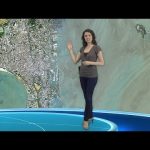
Earth from Space is presented by Kelsea Brennan-Wessels from the ESA Web-TV virtual studios. Explore the city of Mumbai in the one hundred twenty-first edition.
See also http://www.esa.int/spaceinimages/Images/2014/10/Mumbai_India to download the image.
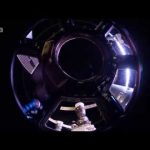
This timelapse video from space was taken by ESA astronaut Alexander Gerst from the Cupola observatory module on the International Space Station as it orbited Earth at around 400 km altitude. As the Space Station passes over Earth at night we can see city lights and lightning.
The International Space Station travels at 28 800 km/h meaning that it only takes 90 minutes to circle Earth completely. Each orbit the Station moves around 2200 km to the West in relation to 90 minutes before.
Astronauts often use normal consumer digital cameras to take pictures of Earth through Europe’s observatory module Cupola in their spare time. Setting the camera to take an image every few seconds and then playing the images back quickly create this timelapse effect.
Alexander worked as a geophysicist and volcanologist before he was chosen as an ESA astronaut in 2009. His Blue Dot mission includes an extensive scientific programme of experiments in physical science, biology, and human physiology as well as radiation research and technology demonstrations. All experiments chosen make use of the out-of-this-world laboratory to improve life on Earth or prepare for further human exploration of our Solar System.
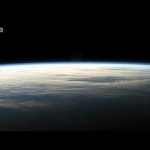
This timelapse video from space has it all: an orbit of Earth with lightning and aurora, followed by a space sunrise and daytime views of our cloudy planet. The images were taken by ESA astronaut Alexander Gerst as he orbited Earth on the International Space Station at around 400 km altitude. The nighttime video shows a Soyuz spacecraft that ferries the astronauts to the outpost. At the end of the video green aurora can be seen as Earth’s interacts with solar radiation.
The International Space Station travels at 28 800 km/h meaning that it only takes 90 minutes to circle Earth completely. Each orbit the Station moves around 2200 km to the West in relation to 90 minutes before.
Astronauts often use normal consumer digital cameras to take pictures of Earth through Europe’s observatory module Cupola in their spare time. Setting the camera to take an image every few seconds and then playing the images back quickly create this timelapse effect.
Alexander worked as a geophysicist and volcanologist before he was chosen as an ESA astronaut in 2009. His Blue Dot mission includes an extensive scientific programme of experiments in physical science, biology, and human physiology as well as radiation research and technology demonstrations. All experiments chosen make use of the out-of-this-world laboratory to improve life on Earth or prepare for further human exploration of our Solar System.
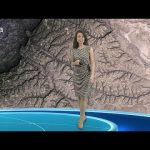
Earth from Space is presented by Kelsea Brennan-Wessels from the ESA Web-TV virtual studios. In the one-hundred-thirteenth edition, visit the Cal Madow mountain range in northern Somalia.
See also http://www.esa.int/spaceinimages/Images/2014/07/Cal_Madow_mountain_range_Somalia to download the image.

Earth from Space is presented by Kelsea Brennan-Wessels from the ESA Web-TV virtual studios. A Ramsar wetland of international importance located in southern Iran is featured in the one-hundred-ninth edition.
See also http://www.esa.int/spaceinimages/Images/2014/06/Rud-e-Gaz_and_Rud-e-Hara_wetlands to download the image.
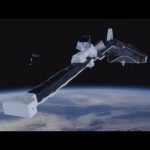
Earth’s magnetosphere is an invisible shield, protecting our planet from harmful solar radiation.
Many living organisms – from bacteria to insects or birds – seem to rely on Earth’s magnetic field to navigate. Man has been doing so for a thousand years since the invention of the compass.
But research shows the magnetic field is weakening and scientists are trying to understand why.
Some believe it signals a pole reversal in progress, not an uncommon phenomenon in the history of our planet.
As ground observatories fail to grasp the whole picture, we are sending magnetometers into orbit to try to measure the magnitude and the direction of the magnetic field.
Find out more, this week, in Space.
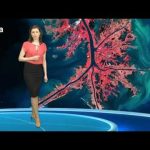
Earth from Space is presented by Kelsea Brennan-Wessels from the ESA Web-TV virtual studios.
In the twenty-fourth edition we look at the Mississippi River Delta, where the largest river in the United States empties into the Gulf of Mexico.