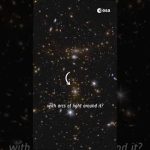
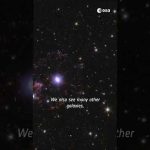
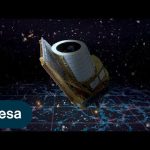
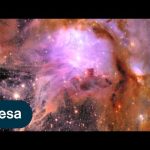
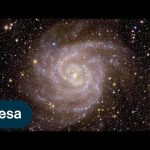
On 19 March 2025, our Euclid mission released its first batch of survey data, including a preview of its deep fields. Here, hundreds of thousands of galaxies in different shapes and sizes take centre stage and show a glimpse of their large-scale organisation in the cosmic web.
📹 ESA – European Space Agency 📸 ESA /Euclid/Euclid Consortium/@NASA, image processing by J.-C. Cuillandre, E. Bertin, G. Anselmi Euclid Deep Field South, 70x zoom: ESA/Euclid/Euclid Consortium/NASA, image processing by J.-C. Cuillandre, E. Bertin, G. Anselmi
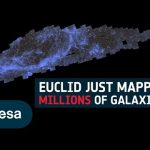
On 19 March 2025, our Euclid mission released its first batch of survey data, revealing an astonishing view of the cosmic web.
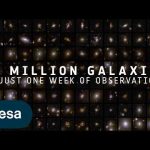
With just one scan of its deep fields, Euclid has already detected 26 million galaxies, some as far as 10.5 billion light-years away! This is just a preview of what’s to come, as Euclid will continue mapping the Universe in unprecedented detail.
What’s in this first release? – Three vast mosaics covering 63 square degrees of the sky – A catalogue of 380 000 galaxies, classified with AI + citizen scientists – 500 new gravitational lens candidates, almost all never seen before – The first hints of Euclid’s full cosmic atlas, which will eventually cover one-third of the sky
This data is a huge leap forward in understanding how galaxies are distributed across the Universe and how dark matter and dark energy shape the cosmos.
Over the next six years, Euclid will revisit these deep fields 30 to 52 times, uncovering billions of galaxies and pushing the astrophysics’ boundaries.
📹 @europeanspaceagency 📸 ESA /Euclid/Euclid Consortium/@NASA, image processing by J.-C. Cuillandre, E. Bertin, G. Anselmi Euclid Deep Field South, 70x zoom: ESA/Euclid/Euclid Consortium/NASA, image processing by J.-C. Cuillandre, E. Bertin, G. Anselmi
The European Space Agency’s Euclid space telescope mission has scouted out the three areas in the sky where it will eventually provide the deepest observations of its mission.
In just one week of observations, with one scan of each region so far, Euclid already spotted 26 million galaxies. The farthest of those are up to 10.5 billion light-years away.
In the coming years, Euclid will pass over these three regions tens of times, capturing many more faraway galaxies, making these fields truly ‘deep’ by the end of the nominal mission in 2030.
The first glimpse of 63 square degrees of the sky, the equivalent area of more than 300 times the full Moon, already gives an impressive preview of the scale of Euclid’s grand cosmic atlas when the mission is complete. This atlas will cover one-third of the entire sky – 14 000 square degrees – in this high-quality detail.
————————————————— Credits: ESA/Euclid/Euclid Consortium/NASA, image processing by J.-C. Cuillandre, E. Bertin, G. Anselmi, M. Walmsley, M. Huertas-Company; ESA/Gaia/DPAC; ESA/Planck Collaboration —————————————————
★ Subscribe: http://bit.ly/ESAsubscribe and click twice on the bell button to receive our notifications.
We are Europe’s gateway to space. Our mission is to shape the development of Europe’s space capability and ensure that investment in space continues to deliver benefits to the citizens of Europe and the world. Check out https://www.esa.int/ to get up to speed on everything space related.
Discover the first page of ESA Euclid’s great cosmic atlas and marvel at millions of stars and galaxies captured in pristine detail, in a huge 208-gigapixel mosaic. The mosaic covers an area of the Southern Sky more than 500 times the area of the full Moon as seen from Earth.
This video takes you through a rare sky dive. Starting from a vast cosmic panorama bedazzled by some 14 million galaxies, a series of ever-deeper zooms brings you to a crisp view of a swirling spiral galaxy, in a final image enlarged 600 times compared to the full mosaic.
Although the scenes are enticing, they are not taken for their beauty, but to help us advance our understanding of the cosmos. Many of the 14 million galaxies in the initial vista will be used to study the hidden influence of dark matter and dark energy on the Universe.
Unveiled as a teaser of the wide survey, the mosaic accounts for 1% of the area that Euclid will cover over six years, and was obtained by combining 260 observations collected in just two weeks.
This first chunk of Euclid’s survey was revealed on 15 October 2024 at the International Astronautical Congress in Milan, Italy, by ESA’s Director General Josef Aschbacher and Director of Science Carole Mundell.
————————————————— Copyright: ESA/Euclid/Euclid Consortium/NASA, CEA Paris-Saclay, image processing by J.-C. Cuillandre, E. Bertin, G. Anselmi; ESA/Gaia/DPAC; ESA/Planck Collaboration —————————————————
★ Subscribe: http://bit.ly/ESAsubscribe and click twice on the bell button to receive our notifications.
We are Europe’s gateway to space. Our mission is to shape the development of Europe’s space capability and ensure that investment in space continues to deliver benefits to the citizens of Europe and the world. Check out https://www.esa.int/ to get up to speed on everything space related.
ESA’s Euclid space mission has released five unprecedented new views of the Universe. These never-before-seen images demonstrate Euclid’s remarkable ability to unravel the secrets of the cosmos. Scientists are now equipped to hunt for rogue planets, study mysterious matter through lensed galaxies, and explore the evolution of the Universe. Join us as we explore these groundbreaking discoveries and what they mean for the future of space exploration.
Credits: ESA – European Space Agency
Chapters: 00:00 – 00:36 Intro 00:36 – 01:14 The Galaxy Cluster Abell 2390 01:15 – 02:14 Messier 78: Stellar Nurseries and Galactic Formation 02:15 – 03:02 Galaxies in the Dorado Group 03:03 – 04:27 NGC 6744 04:28 – 05:25 Abell 2764 05:26 – 6:16 Conclusion
★ Subscribe: http://bit.ly/ESAsubscribe and click twice on the bell button to receive our notifications.
We are Europe’s gateway to space. Our mission is to shape the development of Europe’s space capability and ensure that investment in space continues to deliver benefits to the citizens of Europe and the world. Check out https://www.esa.int/ to get up to speed on everything space related.
ESA is releasing a new set of full-colour images captured by the space telescope Euclid. Five new portraits of our cosmos were captured during Euclid’s early observations phase, each revealing amazing new science. Euclid’s ability to unravel the secrets of the cosmos is something you will not want to miss.
Credits: ESA – European Space Agency
★ Subscribe: http://bit.ly/ESAsubscribe and click twice on the bell button to receive our notifications.
We are Europe’s gateway to space. Our mission is to shape the development of Europe’s space capability and ensure that investment in space continues to deliver benefits to the citizens of Europe and the world. Check out https://www.esa.int/ to get up to speed on everything space related.
Today, ESA’s Euclid space mission releases five unprecedented new views of the Universe. The never-before-seen images demonstrate Euclid’s ability to unravel the secrets of the cosmos and enable scientists to hunt for rogue planets, use lensed galaxies to study mysterious matter, and explore the evolution of the Universe.
Read more about Euclid’s first images and download the individual images here:
Credits: ESA/Euclid/Euclid Consortium/NASA, image processing by J.-C. Cuillandre (CEA Paris-Saclay), G. Anselmi
★ Subscribe: http://bit.ly/ESAsubscribe and click twice on the bell button to receive our notifications.
We are Europe’s gateway to space. Our mission is to shape the development of Europe’s space capability and ensure that investment in space continues to deliver benefits to the citizens of Europe and the world. Check out https://www.esa.int/ to get up to speed on everything space related.
Euclid, our dark Universe detective was struggling to see the faint light from distant galaxies thanks to a tiny villain: ice! Building up on its mirrors, it was blocking the crucial light Euclid needs to unlock some of the Universe’s biggest mysteries – dark matter and dark energy.
But fear not! Across Europe, a team of brilliant scientists and engineers joined forces. Months of research led to a delicate de-icing procedure, and with a touch of targeted warmth, they were able to restore Euclid’s sight.
This icy situation turned into a shining example of international collaboration and innovative thinking. And who knows what cosmic secrets Euclid will uncover now that its vision is restored.
ESA is releasing the first full-colour images of the cosmos captured by its recently launched space telescope Euclid. Follow live a broadcast of the reveal on Tuesday 7 November at 13:15 GMT / 14:15 CET.
Never before has a telescope been able to create such razor-sharp astronomical images across such a large patch of the sky. Five images show that the telescope is ready for its mission to create the most extensive 3D map of the Universe yet and uncover some of its hidden secrets.
Credits: ESA – European Space Agency
★ Subscribe: http://bit.ly/ESAsubscribe and click twice on the bell button to receive our notifications.
We are Europe’s gateway to space. Our mission is to shape the development of Europe’s space capability and ensure that investment in space continues to deliver benefits to the citizens of Europe and the world. Check out https://www.esa.int/ to get up to speed on everything space related.
Today, ESA’s Euclid space mission reveals its first full-colour images of the cosmos. Never before has a telescope been able to create such razor-sharp astronomical images across such a large patch of the sky, and looking so far into the distant Universe. These five images illustrate Euclid’s full potential; they show that the telescope is ready to create the most extensive 3D map of the Universe yet, to uncover some of its hidden secrets.
Credits: ESA/Euclid/Euclid Consortium/NASA, image processing by J.-C. Cuillandre (CEA Paris-Saclay), G. Anselmi, CC BY-SA 3.0 IGO
★ Subscribe: http://bit.ly/ESAsubscribe and click twice on the bell button to receive our notifications.
We are Europe’s gateway to space. Our mission is to shape the development of Europe’s space capability and ensure that investment in space continues to deliver benefits to the citizens of Europe and the world. Check out https://www.esa.int/ to get up to speed on everything space related.
Never before has a telescope been able to create such razor-sharp astronomical images across such a large patch of the sky.
On Tuesday 7 November, ESA will release the first full-colour images captured by its recently launched Euclid space telescope. These images form part of the mission’s ‘Early Release Observations’ – where Euclid was tasked with scrutinising a set of celestial targets chosen for their public appeal and scientific value.
The five images are full of cosmic secrets waiting to be revealed. And this is just the beginning. During its six-year mission, Euclid will generate the equivalent of a million DVDs of data. These data will be used to create the biggest ever 3D map of the Universe and uncover the secrets of dark matter and dark energy.
In this video, hear from the experts about how Euclid has reached this milestone. Discover how they felt when they saw the first images, and find out what these images will reveal about the cosmos.
Watch the reveal of the images live through ESA Web TV or YouTube on 7 November, 13:15 GMT / 14:15 CET. At the same time, an ESA press release including all images will be published at esa.int/euclid.
Credits: ESA – European Space Agency Music: Carollyn Eden – 2 Million stars
★ Subscribe: http://bit.ly/ESAsubscribe and click twice on the bell button to receive our notifications.
We are Europe’s gateway to space. Our mission is to shape the development of Europe’s space capability and ensure that investment in space continues to deliver benefits to the citizens of Europe and the world. Check out https://www.esa.int/ to get up to speed on everything space related.
ESA’s Euclid mission is on a quest to unveil the nature of two elusive ‘dark’ entities. As the renowned theoretical physicist Stephen Hawking remarked in 2013, “The missing link in cosmology is the nature of dark matter and dark energy”.
During the last 70 years, scientists have made enormous progress in understanding the very initial phases of the Universe and its evolution to the present day. Thanks to advances in observations and theoretical modelling, a clear picture has emerged of how stars form, and how galaxies grow and interact with each other, coming together to form groups and clusters.
Yet, fundamental mysteries remain. 95% of the Universe appears to be made up of unknown ‘dark’ matter and energy. Dark matter and energy affect the motion and distribution of visible sources but do not emit, reflect or absorb any light. And scientists do not know what these dark entities actually are.
To address this question, Euclid will create a great map of the large-scale structure of the Universe across space and time by observing with unprecedented accuracy billions of galaxies out to 10 billion light-years. This is not easy, and making sure that Euclid is up to the task has required the expertise and dedication of many people over several years of work.
This video captures the journey behind the Euclid mission, from a human and intensely visual perspective. It shows tiny screws, winding cables and shiny surfaces in a whole new light, revealing how each piece comes together to form the space telescope. Be drawn in by awe-inspiring photos of the cosmos, and stay for the seemingly choreographed ballet of teamwork necessary to assemble and test the spacecraft, before being swept away by the emotion of the launch into space.
Euclid’s adventure has begun. With its observations during the coming years, it will help us uncover the missing link in cosmology and open the gate to the ‘dark’ side of the Universe.
Credit: ESA/Studio Redgrove CC BY-SA 3.0 IGO
★ Subscribe: http://bit.ly/ESAsubscribe and click twice on the bell button to receive our notifications.
We are Europe’s gateway to space. Our mission is to shape the development of Europe’s space capability and ensure that investment in space continues to deliver benefits to the citizens of Europe and the world. Check out https://www.esa.int/ to get up to speed on everything space related.
ESA’s Euclid mission will create a 3D-map of the Universe that scientists will use to measure the properties of dark energy and dark matter and uncover the nature of these mysterious components. The map will contain a vast amount of data, it will cover more than a third of the sky and its third dimension will represent time spanning 10 billion years of cosmic history.
But dealing with the huge and detailed set of novel data that Euclid observations will produce is not an easy task. To prepare for this, scientists in the Euclid Consortium have developed one of the most accurate and comprehensive computer simulations of the large-scale structure of the Universe ever produced. They named this the Euclid Flagship simulation.
Running on large banks of advanced processors, computer simulations provide a unique laboratory to model the formation and evolution of large-scale structures in the Universe, such as galaxies, galaxy clusters, and the filamentary cosmic web they form. These state-of-the-art computational techniques allow astrophysicists to trace the motion and behavior of an extremely large number of dark-matter particles over cosmological volumes under the influence of their own gravitational pull. They replicate how and where galaxies form and grow, and are used to predict their distribution across the celestial sphere.
Explore the Euclid Flagship simulation in this video and get a sneak preview of the structure of the dark Universe, as we currently model it. New insights will be brought to you by the Euclid mission in the coming years.
Credits: ESA/Euclid Consortium/Cacao Cinema The authors kindly acknowledge the use of the Splotch package: http://www.mpa-garching.mpg.de/~kdolag/Splotch
★ Subscribe: http://bit.ly/ESAsubscribe and click twice on the bell button to receive our notifications.
We are Europe’s gateway to space. Our mission is to shape the development of Europe’s space capability and ensure that investment in space continues to deliver benefits to the citizens of Europe and the world. Check out https://www.esa.int/ to get up to speed on everything space related.
Euclid’s two instruments have captured their first test images. The mesmerising results indicate that the space telescope will achieve the scientific goals that it has been designed for – and possibly much more
Although there are months to go before Euclid delivers its true new view of the cosmos, reaching this milestone means the scientists and engineers behind the mission are confident that the telescope and instruments are working well.
📹 ESA – European Space Agency
★ Subscribe: http://bit.ly/ESAsubscribe and click twice on the bell button to receive our notifications.
We are Europe’s gateway to space. Our mission is to shape the development of Europe’s space capability and ensure that investment in space continues to deliver benefits to the citizens of Europe and the world. Check out https://www.esa.int/ to get up to speed on everything space related.
If you think its only possible be held in orbit around a central body of mass – say a planet or a star – you’d be wrong. It is in fact possible to orbit around an invisible point, an oasis of forces, infinitesimal in size. ESA’s Euclid mission was launched on 1 July 2023 to uncover the secrets of the dark universe. Its destination? Like many astronomy missions before it, Lagrange point 2.
‘L2’ is an ideal location for astronomy missions because they can keep the Sun, Earth and Moon behind them at all times, so they don’t interfere with observations, while at the same time getting a clear view of deep space and pointing an antenna back to Earth to remain in close communication. The permanent sunlight on Euclid at L2 also keeps the telescope thermally stable, allowing for the extremely high stability required for the instrument’s long exposure observations. Euclid’s orbit around Lagrange point 2 is big. In terms of distance, the ‘radius’ of Euclid’s orbit varies from about 400 000 kilometres at its closest to the centre, and up to 800 000 kilometres at its furthest. By the time Euclid has completed one full revolution around L2, the Moon will have circled the Earth six times.
The reason for this large orbit is that it is almost free, in terms of fuel, to get there. The better the accuracy of the rocket that launches a mission into such a large halo orbit around L2, the less fuel that’s needed to perform correction manoeuvres – and Euclid only required a tiny correction manoeuvre after its near-perfect launch on a Space X Falcon 9.
This animation, created using “Gaia Sky”, shows Euclid’s path from Earth to this unique and useful position in space. Located about 1.5 million kilometres from Earth in the opposite direction from the Sun, the second Lagrange point (or Libration point) is about four times further away than our Moon.
Euclid will spend about a month getting to ‘L2’ followed by a planned six years in orbit, from where it will study the mysterious nature of dark matter and dark energy, that make up 95% of our Universe, but about which very little is known.
Credits: ESA/Gaia/DPAC, CC BY-SA 3.0 IGO
★ Subscribe: http://bit.ly/ESAsubscribe and click twice on the bell button to receive our notifications.
We are Europe’s gateway to space. Our mission is to shape the development of Europe’s space capability and ensure that investment in space continues to deliver benefits to the citizens of Europe and the world. Check out https://www.esa.int/ to get up to speed on everything space related.
ESA’s latest astrophysics mission, Euclid, lifted off on a Space X Falcon 9 from Cape Canaveral in Florida, USA, at 17:12 CEST on 1 July 2023.
Euclid has now started its month-long journey to Sun-Earth Lagrange point L2, located 1.5 million kilometres from Earth, in the opposite direction from the Sun.
The telescope will survey one third of the sky with unprecedented accuracy and sensitivity. By observing billions of galaxies out to 10 billion light-years, it will create the most extensive 3D-map of the Universe, with the third dimension representing time.
ESA’s Euclid mission is designed to explore the composition and evolution of the dark Universe. Euclid will chart how the Universe has expanded and how large-scale structure is distributed across space and time, revealing more about the role of gravity and the nature of dark energy and dark matter.
Four weeks after launch, Euclid will enter its orbit around L2. Once in orbit, mission controllers will start the activities to verify all functions of the spacecraft, check out the telescope and finally turn the instruments on. Following this, scientists and engineers will be engaged in an intense two-month phase of testing and calibrating Euclid’s scientific instruments, and preparing for routine observations. The telescope begins its early phase of the survey of the Universe three months after launch.
We are Europe’s gateway to space. Our mission is to shape the development of Europe’s space capability and ensure that investment in space continues to deliver benefits to the citizens of Europe and the world. Check out https://www.esa.int/ to get up to speed on everything space related.
ESA’s latest astrophysics mission, Euclid, lifted off on a Space X Falcon 9 from Cape Canaveral in Florida, USA, at 17:12 CEST on 1 July 2023.
Euclid has now started its month-long journey to Sun-Earth Lagrange point L2, located 1.5 million kilometres from Earth, in the opposite direction from the Sun.
The telescope will survey one third of the sky with unprecedented accuracy and sensitivity. By observing billions of galaxies out to 10 billion light-years, it will create the most extensive 3D-map of the Universe, with the third dimension representing time.
ESA’s Euclid mission is designed to explore the composition and evolution of the dark Universe. Euclid will chart how the Universe has expanded and how large-scale structure is distributed across space and time, revealing more about the role of gravity and the nature of dark energy and dark matter.
Four weeks after launch, Euclid will enter its orbit around L2. Once in orbit, mission controllers will start the activities to verify all functions of the spacecraft, check out the telescope and finally turn the instruments on. Following this, scientists and engineers will be engaged in an intense two-month phase of testing and calibrating Euclid’s scientific instruments, and preparing for routine observations. The telescope begins its early phase of the survey of the Universe three months after launch.
We are Europe’s gateway to space. Our mission is to shape the development of Europe’s space capability and ensure that investment in space continues to deliver benefits to the citizens of Europe and the world. Check out https://www.esa.int/ to get up to speed on everything space related.
Watch a replay of the launch broadcast for ESA’s Euclid.
ESA’s Euclid mission was launched into space on a SpaceX Falcon 9 from Cape Canaveral in Florida, USA, on 1 July 2023. It is now on its way to Sun-Earth Lagrange point L2.
By observing billions of galaxies out to 10 billion light-years, the space telescope will create the most detailed 3D-map of the Universe, with time as the third dimension.
The launch broadcast programme includes live segments from the launch site and ESA’s European Spacecraft Operations Centre (ESOC) in Darmstadt, Germany.
Credits: ESA/SpaceX
00:00 – 45:35 Pre-launch programmes 45:35 – 55:00 Lift-off 55:00 – 01:27:00 Booster landing in the ocean 01:27:00 – 01:31:00 Euclid space craft separation 01:31:00 – 01:42:29 Acquisition of Signal (AOS)
★ Subscribe: http://bit.ly/ESAsubscribe and click twice on the bell button to receive our notifications.
We are Europe’s gateway to space. Our mission is to shape the development of Europe’s space capability and ensure that investment in space continues to deliver benefits to the citizens of Europe and the world. Check out https://www.esa.int/ to get up to speed on everything space related.
ESA’s Euclid space telescope is nearly ready for launch. The spacecraft arrived in Florida on 30 April for final tests and checks, and now being integrated with the SpaceX Falcon 9 rocket that will carry it into space.
For the team at ESA’s European Space Operations Centre (ESOC) in Darmstadt, Germany, this means that the most intense phase of their work is about to begin. To prepare themselves, the team has simulated the launch operations, tackling issues ranging from team members falling ill to a computer mouse being taped over.
Euclid is ESA’s space telescope designed to explore the dark Universe. The mission will create the largest, most accurate 3D map of the Universe ever produced across 10 billion years of cosmic time. Euclid will explore how the Universe has expanded and how large-scale structure is distributed across space and time, revealing more about the role of gravity and the nature of dark energy and dark matter.
Euclid is targeted to launch on a SpaceX Falcon 9 rocket from Cape Canaveral in Florida, USA, at 11:11 local time / 16:11 BST / 17:11 CEST on Saturday 1 July 2023. A back-up launch date of Sunday 2 July 2023 is foreseen.
Credit: ESA – European Space Agency
★ Subscribe: http://bit.ly/ESAsubscribe and click twice on the bell button to receive our notifications.
We are Europe’s gateway to space. Our mission is to shape the development of Europe’s space capability and ensure that investment in space continues to deliver benefits to the citizens of Europe and the world. Check out https://www.esa.int/ to get up to speed on everything space related.
ESA’s Euclid mission is designed to bring the dark side of the Universe to light. Based on the way galaxies rotate and orbit one another, and the way in which the Universe is expanding, astronomers believe that two unseen entities dominate the composition of our cosmos. They call these mysterious components dark matter and dark energy, yet to date we have not been able to detect either of them directly, only inferring their presence from the effects they have on the Universe at large.
To better understand what dark matter and dark energy may be, we need a mission that can more closely reveal what effects they have had on galaxies, galaxy clusters and the expansion of the Universe itself. Euclid is that mission.
ESA’s Euclid mission will create a 3D-map of the Universe, with the third dimension representing time itself. The further away a galaxy is located, the longer its light has taken to reach us and so the earlier in cosmic history we will see it. By observing billions of galaxies out to a distance of 10 billion light-years, scientists will be able to chart the position and velocity of galaxies over immense distances and through most of cosmic history, and trace the way the Universe has expanded during that time. Euclid’s extraordinary optics will also reveal subtle distortions in the appearance of galaxies.
From this wealth of new data, astronomers will be able to infer the properties of dark energy and dark matter more precisely than ever before. This will help theorists pin down the nature of these mysterious components and develop a refined understanding of how gravity behaves at the largest distances.
Credit: ESA – European Space Agency
★ Subscribe: http://bit.ly/ESAsubscribe and click twice on the bell button to receive our notifications.
We are Europe’s gateway to space. Our mission is to shape the development of Europe’s space capability and ensure that investment in space continues to deliver benefits to the citizens of Europe and the world. Check out https://www.esa.int/ to get up to speed on everything space related.
ESA’s Euclid mission is designed to explore the composition and evolution of the dark Universe. The space telescope will create a great map of the large-scale structure of the Universe across space and time by observing billions of galaxies out to 10 billion light-years, across more than a third of the sky. Euclid will explore how the Universe has expanded and how structure has formed over cosmic history, revealing more about the role of gravity and the nature of dark energy and dark matter.
Euclid is a fully European mission, built and operated by ESA, with contributions from NASA. The Euclid Consortium – consisting of more than 2000 scientists from 300 institutes in 13 European countries, the US, Canada and Japan – provided the scientific instruments and scientific data analysis. ESA selected Thales Alenia Space as prime contractor for the construction of the satellite and its Service Module, with Airbus Defence and Space chosen to develop the Payload Module, including the telescope. NASA provided the near-infrared detectors of the NISP instrument.
More about Euclid: esa.int/euclid
★ Subscribe: http://bit.ly/ESAsubscribe and click twice on the bell button to receive our notifications.
We are Europe’s gateway to space. Our mission is to shape the development of Europe’s space capability and ensure that investment in space continues to deliver benefits to the citizens of Europe and the world. Check out https://www.esa.int/ to get up to speed on everything space related.
At the Thales Alenia Space test facility in Cannes, France, the massive door of the thermal vacuum chamber was opened after a month of rigorous testing of ESA’s Euclid mission to explore the dark Universe. In Cannes the fully integrated spacecraft was subjected to the conditions of space and its subsystems were fully tested for the first time. With the Euclid space telescope, scientists hope to learn more about dark matter and dark energy which could make up more than 95% of our Universe.
The film includes soundbites from ESA Euclid Mission and Payload Manager: Alexander Short and ESA Euclid VIS-Instrument Engineer: Magdalena Szafraniec.
★ Subscribe: http://bit.ly/ESAsubscribe and click twice on the bell button to receive our notifications.
We are Europe’s gateway to space. Our mission is to shape the development of Europe’s space capability and ensure that investment in space continues to deliver benefits to the citizens of Europe and the world. Check out https://www.esa.int/ to get up to speed on everything space related.
“After Euclid’s lifetime, it will just be floating in space. What if future beings found Euclid? How would they know anything about the humanity of the people?” – Tom Kitching, lead scientist of Euclid’s VIS instrument.
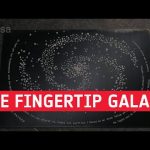
The team behind ESA’s Euclid mission has come together to create something special – a personal and collective galaxy-shaped fingerprint painting that has been attached to the spacecraft ready to launch into space. The collaborative nature of the artwork reflects the collaborative nature of the Euclid project overall; in both cases, people have come together to build something unique.
The Fingertip Galaxy was created by visual artist Lisa Pettibone and Euclid instrument scientist Tom Kitching. Since the very first fingerprint was pressed down in 2019, over 250 scientists and engineers have contributed to the piece of art.
So why a galaxy? Euclid is a galaxy-imaging machine that will observe billions of galaxies out to 10 billion light-years to make a 3D map of the Universe. The mission’s ultimate aim is to explore dark matter and dark energy.
“Although Euclid has always been beautiful in concept and materials, it didn’t really say anything about the people involved and humanity as a whole. We asked ourselves whether we could do something artistic that would speak to people,” says Lisa.
Scientists and engineers involved in Euclid were invited to dip their fingertips in paint and make their mark on a large piece of paper.
“We wanted something authentic, not perfect, and not shaped too much,” continues Lisa. “The result is a piece of art with a wonderful energy to it that captures all the energy of the people involved.”
The artwork was photographed and engraved onto a plaque using lasers at Mullard Space Science Laboratory – the same lasers that are used to etch parts for satellites. The plaque was fixed to Euclid and revealed at a ‘Goodbye Euclid’ event on 1 July 2022, when Euclid left Thales Alenia Space in Turin to head to Cannes for final testing as a complete system.
Euclid’s project scientist René Laureijs suggested adding text to the plaque to explain the thoughts behind it. Continuing the artistic nature of the project, poet Simon Barraclough wrote a dedicated poem, from which a short extract was chosen to be etched on to the plaque in a typewriter font that swirls around the galaxy of fingerprints. This video ends with Simon reading part of Since his poem.
Lisa summarises the Fingertip Galaxy: “It is adding an element of humanity to a dark, vast space, where as far as we can see there is no other intelligent life.”
Credit: Filmmaker/composer: Sam Charlesworth Fingertip Galaxy creators: Tom Kitching and Lisa Pettibone Poet: Simon Barraclough – ‘Unextraordinary Light (For Euclid)’ Special thanks: ESA, Euclid mission team, Mullard Space Science Laboratory Additional media: @NASA, Jeremy Perkins from unsplash.com
★ Subscribe: http://bit.ly/ESAsubscribe and click twice on the bell button to receive our notifications.
We are Europe’s gateway to space. Our mission is to shape the development of Europe’s space capability and ensure that investment in space continues to deliver benefits to the citizens of Europe and the world. Check out https://www.esa.int/ to get up to speed on everything space related.