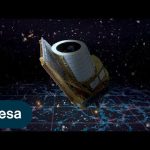
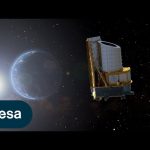
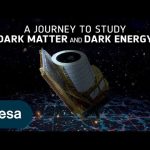
Euclid, the European Space Agency’s dark Universe detective, has made an astonishing discovery – right in our cosmic backyard.
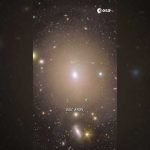
An Einstein Ring, an extremely rare phenomenon, has been found hiding in plain sight in a galaxy not so far away. 🤩
During early testing in September 2023, the team spotted something special in one of Euclid’s first images—an Einstein Ring! This rare phenomenon, caused by gravitational lensing, was found around the well-known galaxy NGC 6505, just 590 million light-years away. The light from a much more distant galaxy (4.42 billion light-years away) is bending around it, creating a stunning cosmic ring.
This discovery shows just how powerful Euclid is. With its mission now in full swing, we can expect many more hidden cosmic wonders to be revealed!
📹 ESA – European Space Agency 📸 ESA/Euclid/Euclid Consortium/NASA, image processing by J.-C. Cuillandre, G. Anselmi, T. Li
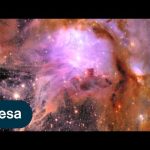
An ethereal dance of misty clouds of interstellar dust with a myriad of distant stars and galaxies speckled like paint drops over a black canvas. This is a sonification of a breathtaking image taken by ESA’s Euclid space telescope of the young star-forming region Messier 78.
The sonification offers a different representation of the data collected by Euclid, and lets us explore the stellar nurseries in M78 through sound. Close your eyes and listen to let the cosmic image be drawn by your mind’s eye, or watch as the traceback line in this video follows the sounds to colour the image from left to right.
The twinkling sounds of various pitches and volumes represent the galaxies and stars in the frame. The pitch of the sound points towards where we see the dot of light in the image. Higher pitches tell us that a star or galaxy appears further at the top in the image along the traceback line.
The brightness of these objects in and around M78 are represented by the volume of the twinkles. Whenever we hear a particularly loud clink, the star or galaxy that Euclid observed appears particularly bright in the image.
Underlying these jingling sounds, we can hear a steady undertone, made up of two chords which represent different regions in Messier 78. This sound intensifies as the traceback line approaches first the brightest, and later the densest regions in the nebula.
The first two deeper crescendos in this undertone indicate two patches in the image where the most intense colour is blue/purple. These appear as two ‘cavities’ in M78, where newly forming stars carve out and illuminate the dust and gas in which they were born.
The chords intensify a third time at a slightly higher pitch corresponding to the red-orange colours in the image, as the sound draws over the densest star-forming region of the frame. This stellar nursery is hidden by a layer of dust and gas that is so thick that it obscures almost all the light of the young stars within it.
Many thanks to Klaus Nielsen (DTU Space / Maple Pools) for making the sonification in this video. If you would like to hear more sonifications and music by this artist, please visit: https://linktr.ee/maplepools
————————————————— Credits Credit: ESA/Euclid/Euclid Consortium/NASA, image processing by J.-C. Cuillandre (CEA Paris-Saclay) and G. Anselmi, sonification by K. Nielsen (DTU Space/Maple Pools) License: CC BY-SA 3.0 or ESA Standard License
Video credit slate ESA/Euclid/Euclid Consortium/NASA Image processing: J.-C. Cuillandre (CEA Paris-Saclay), G. Anselmi Data sonification & music: Klaus Nielsen (DTU Space/Maple Pools) —————————————————
★ Subscribe: http://bit.ly/ESAsubscribe and click twice on the bell button to receive our notifications.
We are Europe’s gateway to space. Our mission is to shape the development of Europe’s space capability and ensure that investment in space continues to deliver benefits to the citizens of Europe and the world. Check out https://www.esa.int/ to get up to speed on everything space related.
ESA’s Euclid space mission has released five unprecedented new views of the Universe. These never-before-seen images demonstrate Euclid’s remarkable ability to unravel the secrets of the cosmos. Scientists are now equipped to hunt for rogue planets, study mysterious matter through lensed galaxies, and explore the evolution of the Universe. Join us as we explore these groundbreaking discoveries and what they mean for the future of space exploration.
Credits: ESA – European Space Agency
Chapters: 00:00 – 00:36 Intro 00:36 – 01:14 The Galaxy Cluster Abell 2390 01:15 – 02:14 Messier 78: Stellar Nurseries and Galactic Formation 02:15 – 03:02 Galaxies in the Dorado Group 03:03 – 04:27 NGC 6744 04:28 – 05:25 Abell 2764 05:26 – 6:16 Conclusion
★ Subscribe: http://bit.ly/ESAsubscribe and click twice on the bell button to receive our notifications.
We are Europe’s gateway to space. Our mission is to shape the development of Europe’s space capability and ensure that investment in space continues to deliver benefits to the citizens of Europe and the world. Check out https://www.esa.int/ to get up to speed on everything space related.
ESA is releasing a new set of full-colour images captured by the space telescope Euclid. Five new portraits of our cosmos were captured during Euclid’s early observations phase, each revealing amazing new science. Euclid’s ability to unravel the secrets of the cosmos is something you will not want to miss.
Credits: ESA – European Space Agency
★ Subscribe: http://bit.ly/ESAsubscribe and click twice on the bell button to receive our notifications.
We are Europe’s gateway to space. Our mission is to shape the development of Europe’s space capability and ensure that investment in space continues to deliver benefits to the citizens of Europe and the world. Check out https://www.esa.int/ to get up to speed on everything space related.
Today, ESA’s Euclid space mission releases five unprecedented new views of the Universe. The never-before-seen images demonstrate Euclid’s ability to unravel the secrets of the cosmos and enable scientists to hunt for rogue planets, use lensed galaxies to study mysterious matter, and explore the evolution of the Universe.
Read more about Euclid’s first images and download the individual images here:
Credits: ESA/Euclid/Euclid Consortium/NASA, image processing by J.-C. Cuillandre (CEA Paris-Saclay), G. Anselmi
★ Subscribe: http://bit.ly/ESAsubscribe and click twice on the bell button to receive our notifications.
We are Europe’s gateway to space. Our mission is to shape the development of Europe’s space capability and ensure that investment in space continues to deliver benefits to the citizens of Europe and the world. Check out https://www.esa.int/ to get up to speed on everything space related.
Euclid, our dark Universe detective was struggling to see the faint light from distant galaxies thanks to a tiny villain: ice! Building up on its mirrors, it was blocking the crucial light Euclid needs to unlock some of the Universe’s biggest mysteries – dark matter and dark energy.
But fear not! Across Europe, a team of brilliant scientists and engineers joined forces. Months of research led to a delicate de-icing procedure, and with a touch of targeted warmth, they were able to restore Euclid’s sight.
This icy situation turned into a shining example of international collaboration and innovative thinking. And who knows what cosmic secrets Euclid will uncover now that its vision is restored.
2023’s highlight was the highly anticipated launch of Juice, Europe’s Jupiter Icy Moon Explorer. The Juice spacecraft was placed on course to Jupiter on the second-to-last Ariane 5 launch vehicle in April. After an eight-year journey, Juice will begin observing the giant gas planet and its three large ocean-bearing moons – Ganymede, Calisto and Europa.
The Euclid space telescope was launched in July with the aim of unravelling the enigmas of ‘dark matter’ and ‘dark energy’. Euclid’s first images were released in November, revealing razor-sharp astronomical images with detail never before seen by a telescope across such a large patch of the sky.
After almost five years in space, ESA’s Aeolus wind mission was retired. This trailblazing mission was tasked with observing wind patterns from space thereby improving weather forecasts and climate models.. Aeolus data and technology will have an important role to play in the accuracy of future weather forecasting. On 28 July, it burned up in an assisted re-entry – the first assisted re-entry by a mission which was not designed to do so.
As space debris becomes an increasingly serious issue, ESA is determined to search for solutions. Together with its commercial and institutional partners, ESA has developed the ‘Zero Debris Charter’, launched this year. By signing the Charter, space entities worldwide can register their intent to work together towards the sustainable use of Earth’s orbital environment.
Earlier in in 2023, MTG-I1, the first of the Meteosat Third Generation missions, sent back its first images. The satellite was launched in 2022 and carries two instruments: a flexible combined imager and a lighting imager. Both instruments performed beyond expectation and a stunning combined image from both was revealed.
Earth observation is key to keeping our planet and the population as a whole, safe. Today, monitoring earthquakes, forest fires or flooding from space already helps to coordinate rescue response but the data can also be used to better understand phenomena such as climate change and support the IPCC climate reports.
Last year, NASA’s Dart mission impacted on a small moonlet of the asteroid Didymos, changing its course. We’ll soon be launching ESA’s Hera spacecraft to collect data on the aftermath of this collision. The Hera spacecraft was integrated and underwent testing this year in ESA ESTEC’s test centre in the Netherlands.
2023 also saw the first hardware tests for the second generation of Galileo satellites but even more importantly the Galileo High Accuracy Service was launched in January. This new service delivers centimetre accuracy from space further cementing Galileo’s reputation as the most accurate satellite navigation system in the world.
★ Subscribe: http://bit.ly/ESAsubscribe and click twice on the bell button to receive our notifications.
We are Europe’s gateway to space. Our mission is to shape the development of Europe’s space capability and ensure that investment in space continues to deliver benefits to the citizens of Europe and the world. Check out https://www.esa.int/ to get up to speed on everything space related.
ESA is releasing the first full-colour images of the cosmos captured by its recently launched space telescope Euclid. Follow live a broadcast of the reveal on Tuesday 7 November at 13:15 GMT / 14:15 CET.
Never before has a telescope been able to create such razor-sharp astronomical images across such a large patch of the sky. Five images show that the telescope is ready for its mission to create the most extensive 3D map of the Universe yet and uncover some of its hidden secrets.
Credits: ESA – European Space Agency
★ Subscribe: http://bit.ly/ESAsubscribe and click twice on the bell button to receive our notifications.
We are Europe’s gateway to space. Our mission is to shape the development of Europe’s space capability and ensure that investment in space continues to deliver benefits to the citizens of Europe and the world. Check out https://www.esa.int/ to get up to speed on everything space related.
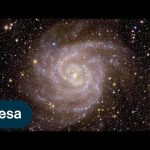
Today, ESA’s Euclid space mission reveals its first full-colour images of the cosmos. Never before has a telescope been able to create such razor-sharp astronomical images across such a large patch of the sky, and looking so far into the distant Universe. These five images illustrate Euclid’s full potential; they show that the telescope is ready to create the most extensive 3D map of the Universe yet, to uncover some of its hidden secrets.
Credits: ESA/Euclid/Euclid Consortium/NASA, image processing by J.-C. Cuillandre (CEA Paris-Saclay), G. Anselmi, CC BY-SA 3.0 IGO
★ Subscribe: http://bit.ly/ESAsubscribe and click twice on the bell button to receive our notifications.
We are Europe’s gateway to space. Our mission is to shape the development of Europe’s space capability and ensure that investment in space continues to deliver benefits to the citizens of Europe and the world. Check out https://www.esa.int/ to get up to speed on everything space related.
Never before has a telescope been able to create such razor-sharp astronomical images across such a large patch of the sky.
On Tuesday 7 November, ESA will release the first full-colour images captured by its recently launched Euclid space telescope. These images form part of the mission’s ‘Early Release Observations’ – where Euclid was tasked with scrutinising a set of celestial targets chosen for their public appeal and scientific value.
The five images are full of cosmic secrets waiting to be revealed. And this is just the beginning. During its six-year mission, Euclid will generate the equivalent of a million DVDs of data. These data will be used to create the biggest ever 3D map of the Universe and uncover the secrets of dark matter and dark energy.
In this video, hear from the experts about how Euclid has reached this milestone. Discover how they felt when they saw the first images, and find out what these images will reveal about the cosmos.
Watch the reveal of the images live through ESA Web TV or YouTube on 7 November, 13:15 GMT / 14:15 CET. At the same time, an ESA press release including all images will be published at esa.int/euclid.
Credits: ESA – European Space Agency Music: Carollyn Eden – 2 Million stars
★ Subscribe: http://bit.ly/ESAsubscribe and click twice on the bell button to receive our notifications.
We are Europe’s gateway to space. Our mission is to shape the development of Europe’s space capability and ensure that investment in space continues to deliver benefits to the citizens of Europe and the world. Check out https://www.esa.int/ to get up to speed on everything space related.
ESA’s Euclid mission is on a quest to unveil the nature of two elusive ‘dark’ entities. As the renowned theoretical physicist Stephen Hawking remarked in 2013, “The missing link in cosmology is the nature of dark matter and dark energy”.
During the last 70 years, scientists have made enormous progress in understanding the very initial phases of the Universe and its evolution to the present day. Thanks to advances in observations and theoretical modelling, a clear picture has emerged of how stars form, and how galaxies grow and interact with each other, coming together to form groups and clusters.
Yet, fundamental mysteries remain. 95% of the Universe appears to be made up of unknown ‘dark’ matter and energy. Dark matter and energy affect the motion and distribution of visible sources but do not emit, reflect or absorb any light. And scientists do not know what these dark entities actually are.
To address this question, Euclid will create a great map of the large-scale structure of the Universe across space and time by observing with unprecedented accuracy billions of galaxies out to 10 billion light-years. This is not easy, and making sure that Euclid is up to the task has required the expertise and dedication of many people over several years of work.
This video captures the journey behind the Euclid mission, from a human and intensely visual perspective. It shows tiny screws, winding cables and shiny surfaces in a whole new light, revealing how each piece comes together to form the space telescope. Be drawn in by awe-inspiring photos of the cosmos, and stay for the seemingly choreographed ballet of teamwork necessary to assemble and test the spacecraft, before being swept away by the emotion of the launch into space.
Euclid’s adventure has begun. With its observations during the coming years, it will help us uncover the missing link in cosmology and open the gate to the ‘dark’ side of the Universe.
Credit: ESA/Studio Redgrove CC BY-SA 3.0 IGO
★ Subscribe: http://bit.ly/ESAsubscribe and click twice on the bell button to receive our notifications.
We are Europe’s gateway to space. Our mission is to shape the development of Europe’s space capability and ensure that investment in space continues to deliver benefits to the citizens of Europe and the world. Check out https://www.esa.int/ to get up to speed on everything space related.
ESA’s Euclid mission will create a 3D-map of the Universe that scientists will use to measure the properties of dark energy and dark matter and uncover the nature of these mysterious components. The map will contain a vast amount of data, it will cover more than a third of the sky and its third dimension will represent time spanning 10 billion years of cosmic history.
But dealing with the huge and detailed set of novel data that Euclid observations will produce is not an easy task. To prepare for this, scientists in the Euclid Consortium have developed one of the most accurate and comprehensive computer simulations of the large-scale structure of the Universe ever produced. They named this the Euclid Flagship simulation.
Running on large banks of advanced processors, computer simulations provide a unique laboratory to model the formation and evolution of large-scale structures in the Universe, such as galaxies, galaxy clusters, and the filamentary cosmic web they form. These state-of-the-art computational techniques allow astrophysicists to trace the motion and behavior of an extremely large number of dark-matter particles over cosmological volumes under the influence of their own gravitational pull. They replicate how and where galaxies form and grow, and are used to predict their distribution across the celestial sphere.
Explore the Euclid Flagship simulation in this video and get a sneak preview of the structure of the dark Universe, as we currently model it. New insights will be brought to you by the Euclid mission in the coming years.
Credits: ESA/Euclid Consortium/Cacao Cinema The authors kindly acknowledge the use of the Splotch package: http://www.mpa-garching.mpg.de/~kdolag/Splotch
★ Subscribe: http://bit.ly/ESAsubscribe and click twice on the bell button to receive our notifications.
We are Europe’s gateway to space. Our mission is to shape the development of Europe’s space capability and ensure that investment in space continues to deliver benefits to the citizens of Europe and the world. Check out https://www.esa.int/ to get up to speed on everything space related.
Euclid’s two instruments have captured their first test images. The mesmerising results indicate that the space telescope will achieve the scientific goals that it has been designed for – and possibly much more
Although there are months to go before Euclid delivers its true new view of the cosmos, reaching this milestone means the scientists and engineers behind the mission are confident that the telescope and instruments are working well.
📹 ESA – European Space Agency
★ Subscribe: http://bit.ly/ESAsubscribe and click twice on the bell button to receive our notifications.
We are Europe’s gateway to space. Our mission is to shape the development of Europe’s space capability and ensure that investment in space continues to deliver benefits to the citizens of Europe and the world. Check out https://www.esa.int/ to get up to speed on everything space related.
If you think its only possible be held in orbit around a central body of mass – say a planet or a star – you’d be wrong. It is in fact possible to orbit around an invisible point, an oasis of forces, infinitesimal in size. ESA’s Euclid mission was launched on 1 July 2023 to uncover the secrets of the dark universe. Its destination? Like many astronomy missions before it, Lagrange point 2.
‘L2’ is an ideal location for astronomy missions because they can keep the Sun, Earth and Moon behind them at all times, so they don’t interfere with observations, while at the same time getting a clear view of deep space and pointing an antenna back to Earth to remain in close communication. The permanent sunlight on Euclid at L2 also keeps the telescope thermally stable, allowing for the extremely high stability required for the instrument’s long exposure observations. Euclid’s orbit around Lagrange point 2 is big. In terms of distance, the ‘radius’ of Euclid’s orbit varies from about 400 000 kilometres at its closest to the centre, and up to 800 000 kilometres at its furthest. By the time Euclid has completed one full revolution around L2, the Moon will have circled the Earth six times.
The reason for this large orbit is that it is almost free, in terms of fuel, to get there. The better the accuracy of the rocket that launches a mission into such a large halo orbit around L2, the less fuel that’s needed to perform correction manoeuvres – and Euclid only required a tiny correction manoeuvre after its near-perfect launch on a Space X Falcon 9.
This animation, created using “Gaia Sky”, shows Euclid’s path from Earth to this unique and useful position in space. Located about 1.5 million kilometres from Earth in the opposite direction from the Sun, the second Lagrange point (or Libration point) is about four times further away than our Moon.
Euclid will spend about a month getting to ‘L2’ followed by a planned six years in orbit, from where it will study the mysterious nature of dark matter and dark energy, that make up 95% of our Universe, but about which very little is known.
Credits: ESA/Gaia/DPAC, CC BY-SA 3.0 IGO
★ Subscribe: http://bit.ly/ESAsubscribe and click twice on the bell button to receive our notifications.
We are Europe’s gateway to space. Our mission is to shape the development of Europe’s space capability and ensure that investment in space continues to deliver benefits to the citizens of Europe and the world. Check out https://www.esa.int/ to get up to speed on everything space related.
ESA’s latest astrophysics mission, Euclid, lifted off on a Space X Falcon 9 from Cape Canaveral in Florida, USA, at 17:12 CEST on 1 July 2023.
Euclid has now started its month-long journey to Sun-Earth Lagrange point L2, located 1.5 million kilometres from Earth, in the opposite direction from the Sun.
The telescope will survey one third of the sky with unprecedented accuracy and sensitivity. By observing billions of galaxies out to 10 billion light-years, it will create the most extensive 3D-map of the Universe, with the third dimension representing time.
ESA’s Euclid mission is designed to explore the composition and evolution of the dark Universe. Euclid will chart how the Universe has expanded and how large-scale structure is distributed across space and time, revealing more about the role of gravity and the nature of dark energy and dark matter.
Four weeks after launch, Euclid will enter its orbit around L2. Once in orbit, mission controllers will start the activities to verify all functions of the spacecraft, check out the telescope and finally turn the instruments on. Following this, scientists and engineers will be engaged in an intense two-month phase of testing and calibrating Euclid’s scientific instruments, and preparing for routine observations. The telescope begins its early phase of the survey of the Universe three months after launch.
We are Europe’s gateway to space. Our mission is to shape the development of Europe’s space capability and ensure that investment in space continues to deliver benefits to the citizens of Europe and the world. Check out https://www.esa.int/ to get up to speed on everything space related.
ESA’s latest astrophysics mission, Euclid, lifted off on a Space X Falcon 9 from Cape Canaveral in Florida, USA, at 17:12 CEST on 1 July 2023.
Euclid has now started its month-long journey to Sun-Earth Lagrange point L2, located 1.5 million kilometres from Earth, in the opposite direction from the Sun.
The telescope will survey one third of the sky with unprecedented accuracy and sensitivity. By observing billions of galaxies out to 10 billion light-years, it will create the most extensive 3D-map of the Universe, with the third dimension representing time.
ESA’s Euclid mission is designed to explore the composition and evolution of the dark Universe. Euclid will chart how the Universe has expanded and how large-scale structure is distributed across space and time, revealing more about the role of gravity and the nature of dark energy and dark matter.
Four weeks after launch, Euclid will enter its orbit around L2. Once in orbit, mission controllers will start the activities to verify all functions of the spacecraft, check out the telescope and finally turn the instruments on. Following this, scientists and engineers will be engaged in an intense two-month phase of testing and calibrating Euclid’s scientific instruments, and preparing for routine observations. The telescope begins its early phase of the survey of the Universe three months after launch.
We are Europe’s gateway to space. Our mission is to shape the development of Europe’s space capability and ensure that investment in space continues to deliver benefits to the citizens of Europe and the world. Check out https://www.esa.int/ to get up to speed on everything space related.
Watch a replay of the launch broadcast for ESA’s Euclid.
ESA’s Euclid mission was launched into space on a SpaceX Falcon 9 from Cape Canaveral in Florida, USA, on 1 July 2023. It is now on its way to Sun-Earth Lagrange point L2.
By observing billions of galaxies out to 10 billion light-years, the space telescope will create the most detailed 3D-map of the Universe, with time as the third dimension.
The launch broadcast programme includes live segments from the launch site and ESA’s European Spacecraft Operations Centre (ESOC) in Darmstadt, Germany.
Credits: ESA/SpaceX
00:00 – 45:35 Pre-launch programmes 45:35 – 55:00 Lift-off 55:00 – 01:27:00 Booster landing in the ocean 01:27:00 – 01:31:00 Euclid space craft separation 01:31:00 – 01:42:29 Acquisition of Signal (AOS)
★ Subscribe: http://bit.ly/ESAsubscribe and click twice on the bell button to receive our notifications.
We are Europe’s gateway to space. Our mission is to shape the development of Europe’s space capability and ensure that investment in space continues to deliver benefits to the citizens of Europe and the world. Check out https://www.esa.int/ to get up to speed on everything space related.
ESA’s Euclid space telescope is nearly ready for launch. The spacecraft arrived in Florida on 30 April for final tests and checks, and now being integrated with the SpaceX Falcon 9 rocket that will carry it into space.
For the team at ESA’s European Space Operations Centre (ESOC) in Darmstadt, Germany, this means that the most intense phase of their work is about to begin. To prepare themselves, the team has simulated the launch operations, tackling issues ranging from team members falling ill to a computer mouse being taped over.
Euclid is ESA’s space telescope designed to explore the dark Universe. The mission will create the largest, most accurate 3D map of the Universe ever produced across 10 billion years of cosmic time. Euclid will explore how the Universe has expanded and how large-scale structure is distributed across space and time, revealing more about the role of gravity and the nature of dark energy and dark matter.
Euclid is targeted to launch on a SpaceX Falcon 9 rocket from Cape Canaveral in Florida, USA, at 11:11 local time / 16:11 BST / 17:11 CEST on Saturday 1 July 2023. A back-up launch date of Sunday 2 July 2023 is foreseen.
Credit: ESA – European Space Agency
★ Subscribe: http://bit.ly/ESAsubscribe and click twice on the bell button to receive our notifications.
We are Europe’s gateway to space. Our mission is to shape the development of Europe’s space capability and ensure that investment in space continues to deliver benefits to the citizens of Europe and the world. Check out https://www.esa.int/ to get up to speed on everything space related.
ESA’s Euclid mission is designed to bring the dark side of the Universe to light. Based on the way galaxies rotate and orbit one another, and the way in which the Universe is expanding, astronomers believe that two unseen entities dominate the composition of our cosmos. They call these mysterious components dark matter and dark energy, yet to date we have not been able to detect either of them directly, only inferring their presence from the effects they have on the Universe at large.
To better understand what dark matter and dark energy may be, we need a mission that can more closely reveal what effects they have had on galaxies, galaxy clusters and the expansion of the Universe itself. Euclid is that mission.
ESA’s Euclid mission will create a 3D-map of the Universe, with the third dimension representing time itself. The further away a galaxy is located, the longer its light has taken to reach us and so the earlier in cosmic history we will see it. By observing billions of galaxies out to a distance of 10 billion light-years, scientists will be able to chart the position and velocity of galaxies over immense distances and through most of cosmic history, and trace the way the Universe has expanded during that time. Euclid’s extraordinary optics will also reveal subtle distortions in the appearance of galaxies.
From this wealth of new data, astronomers will be able to infer the properties of dark energy and dark matter more precisely than ever before. This will help theorists pin down the nature of these mysterious components and develop a refined understanding of how gravity behaves at the largest distances.
Credit: ESA – European Space Agency
★ Subscribe: http://bit.ly/ESAsubscribe and click twice on the bell button to receive our notifications.
We are Europe’s gateway to space. Our mission is to shape the development of Europe’s space capability and ensure that investment in space continues to deliver benefits to the citizens of Europe and the world. Check out https://www.esa.int/ to get up to speed on everything space related.
ESA’s Euclid mission is designed to explore the composition and evolution of the dark Universe. The space telescope will create a great map of the large-scale structure of the Universe across space and time by observing billions of galaxies out to 10 billion light-years, across more than a third of the sky. Euclid will explore how the Universe has expanded and how structure has formed over cosmic history, revealing more about the role of gravity and the nature of dark energy and dark matter.
Euclid is a fully European mission, built and operated by ESA, with contributions from NASA. The Euclid Consortium – consisting of more than 2000 scientists from 300 institutes in 13 European countries, the US, Canada and Japan – provided the scientific instruments and scientific data analysis. ESA selected Thales Alenia Space as prime contractor for the construction of the satellite and its Service Module, with Airbus Defence and Space chosen to develop the Payload Module, including the telescope. NASA provided the near-infrared detectors of the NISP instrument.
More about Euclid: esa.int/euclid
★ Subscribe: http://bit.ly/ESAsubscribe and click twice on the bell button to receive our notifications.
We are Europe’s gateway to space. Our mission is to shape the development of Europe’s space capability and ensure that investment in space continues to deliver benefits to the citizens of Europe and the world. Check out https://www.esa.int/ to get up to speed on everything space related.