Tag: European Spaceport

  • Europe’s future in space transportation

    Europe’s future in space transportation

    Space is huge and essential to humankind, fuelling knowledge, supporting our economies and driving global prosperity. None of this would be possible without reliable access to space.

    Since 1979, Europe has relied on the Ariane rockets and Vega series to launch its missions. Today, with Ariane 6 and Vega-C, ESA ensures Europe’s autonomous and independent access to space. But we are also looking ahead. With the Ariane Smart Transfer and Release In-orbit Ship (ASTRIS), Phoebus, P160C boosters, the MR-10 engine and more, ESA is enhancing its rockets with new innovations that improve cost, performance, capability and sustainability.

    ESA is also leading the way in developing new propulsion systems to power the European launchers of the future. In collaboration with industry, ESA is supporting the development of new technologies to be used on rocket, boosters, upper stages, landers and spacecraft.

    Initiates like Boosters for European Space Transportation (BEST!), Technologies for High-thrust Re-Usable Space Transportation (THRUST!) and Future Innovation and Research in Space Transportation programme (FIRST!), are advancing key technologies for reusable boosters, engines and other innovations crucial for the future of space exploration. ESA’s Space Rider is a reusable spacecraft and robotic laboratory, designed to stay in low Earth-orbit for two months and return payloads to Earth. Themis is a prototype for testing reusable rocket technologies, including vertical takeoff, landing and reuse, powered by the Prometheus engine.

    The future of space transport extends beyond Earth launches, with in-orbit operations, transportation systems to support satellite servicing, orbital refuelling, and payload transfers between orbits.

    To support all of this, ESA is upgrading its ground support and Europe’s Spaceport in French Guiana, to accommodate more launches.

    Through programmes like ‘Boost!’ ESA is empowering the European Space Industry, supporting innovative companies which are creating new launch services. The European Launcher Challenge is shaping a competitive European launch sector for the future, strengthening Europe’s autonomous access to space.

    Credit: European Space Agency (ESA)

    Access the video on the ESA video library: https://www.esa.int/ESA_Multimedia/Videos/2025/06/The_future_of_ESA_Transportation

    ★ Subscribe: http://bit.ly/ESAsubscribe and click twice on the bell button to receive our notifications.

    Check out our full video catalog: http://bit.ly/SpaceInVideos
    Follow us on Twitter: http://bit.ly/ESAonTwitter
    On Facebook: http://bit.ly/ESAonFacebook
    On Instagram: http://bit.ly/ESAonInstagram
    On LinkedIn: https://bit.ly/ESAonLinkedIn
    On Pinterest: https://bit.ly/ESAonPinterest
    On Flickr: http://bit.ly/ESAonFlickr

    We are Europe’s gateway to space. Our mission is to shape the development of Europe’s space capability and ensure that investment in space continues to deliver benefits to the citizens of Europe and the world. Check out https://www.esa.int/ to get up to speed on everything space related.

    Copyright information about our videos is available here: https://www.esa.int/ESA_Multimedia/Terms_and_Conditions
  • Ariane 6 launch animation

    Ariane 6 launch animation

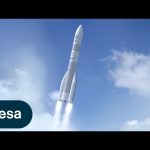
    Animation of the first launch of the Ariane 6 rocket with two boosters.

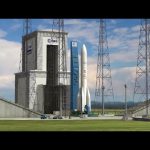
    Ariane 6 is an all-new design, created to succeed Ariane 5 as Europe’s heavy-lift launch system. With Ariane 6’s upper stage and its reignitable Vinci engine, Europe’s launch capability will be tailored to the needs of multiple payloads, for example to orbit satellite constellations. This autonomous capability to reach Earth orbit and deep space supports Europe’s navigation, Earth observation, scientific and security programmes. Ongoing development of Europe’s space transportation capabilities is made possible by the sustained dedication of thousands of talented people working in ESA’s 22 Member States.

    At over 60 metres tall, Ariane 6 will weigh almost 900 tonnes when launched with a full payload – roughly equivalent to one and a half Airbus A380 passenger aircraft.

    Vinci, the upper stage engine of Ariane 6 fed by liquid hydrogen and oxygen, can be stopped and restarted multiple times – to place satellites into different orbits and then de-orbit the upper stage, so it is not left behind as hazardous debris in space.

    For the development of Ariane 6, ESA is working with an industrial network of several hundred companies in 13 European countries, led by prime contractor ArianeGroup.

    France’s space agency, CNES, is preparing the Ariane 6 launch facilities at Europe’s Spaceport in French Guiana.

    Credits: ESA – European Space Agency

    ★ Subscribe: http://bit.ly/ESAsubscribe and click twice on the bell button to receive our notifications.

    Check out our full video catalog: http://bit.ly/SpaceInVideos
    Follow us on Twitter: http://bit.ly/ESAonTwitter
    On Facebook: http://bit.ly/ESAonFacebook
    On Instagram: http://bit.ly/ESAonInstagram
    On LinkedIn: https://bit.ly/ESAonLinkedIn
    On Pinterest: https://bit.ly/ESAonPinterest
    On Flickr: http://bit.ly/ESAonFlickr

    We are Europe’s gateway to space. Our mission is to shape the development of Europe’s space capability and ensure that investment in space continues to deliver benefits to the citizens of Europe and the world. Check out https://www.esa.int/ to get up to speed on everything space related.

    Copyright information about our videos is available here: https://www.esa.int/ESA_Multimedia/Terms_and_Conditions
    #ESA
    #Ariane6
    #Rockets

  • Ariane 6 launch complex – December 2020

    Ariane 6 launch complex – December 2020

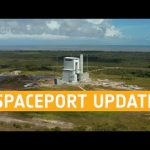
    Tour the Ariane 6 launch complex at Europe’s Spaceport in Kourou, French Guiana.

    The 8200 tonne 90 metre-high mobile gantry has platforms to enable engineers to access the vehicle for integration of the stages. This steel structure protects Ariane 6 before launch and is rolled back prior to liftoff.

    At the entrance of the gantry are two mockup Ariane 6 P120C rocket boosters. These are representative of the real boosters, having the same size and mass but filled with water instead of solid propellant and used in mechanical tests.

    The hydrogen and oxygen storage facilities are close by. Underground, engineers are preparing the launch support systems.

    A pumping station at the reservoir will supply the water to quell the exhaust at liftoff.

    Credits: CNES/ESA

    ★ Subscribe: http://bit.ly/ESAsubscribe and click twice on the bell button to receive our notifications.

    Check out our full video catalog: http://bit.ly/SpaceInVideos
    Follow us on Twitter: http://bit.ly/ESAonTwitter
    On Facebook: http://bit.ly/ESAonFacebook
    On Instagram: http://bit.ly/ESAonInstagram
    On Flickr: http://bit.ly/ESAonFlickr

    We are Europe’s gateway to space. Our mission is to shape the development of Europe’s space capability and ensure that investment in space continues to deliver benefits to the citizens of Europe and the world. Check out https://www.esa.int/ to get up to speed on everything space related.

    Copyright information about our videos is available here: https://www.esa.int/ESA_Multimedia/Terms_and_Conditions
    #ESA
    #SpaceCare
    #Ariane6

  • ESA Euronews: Pas de tir d’Ariane 6

    ESA Euronews: Pas de tir d’Ariane 6

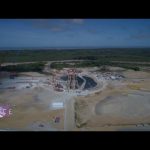
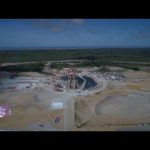
    Dans cette édition de Space, nous entrons dans les coulisses d’un chantier colossal au Centre spatial européen de Kourou en Guyane française. Un pas de tir est en train de sortir de terre en vue du vol inaugural d’Ariane 6 programmé en juillet 2020. Grâce à ce projet, l’Europe se relance dans la compétition mondiale qui oppose les acteurs du secteur spatial.

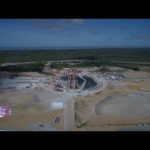
    Sur la côte nord-est de l’Amérique du Sud, à Kourou en Guyane, des ingénieurs européens s’affairent à la construction du nouveau pas de tir d’Ariane 6. Ce chantier colossal doit répondre à un objectif simple : diviser par deux, les coûts de lancement par rapport à son modèle précédent. Pour y parvenir, il faut d’abord une quantité astronomique de béton, d’acier et de main-d’oeuvre.

  • ESA Euronews: Ariane 6

    ESA Euronews: Ariane 6

    The race is on to build the new launch pad for the Ariane 6 rocket, due to make its maiden voyage in July 2020. Construction is in full swing in French Guiana as Europe builds not only a new rocket but also a new way of launching rockets, in a bid to face down competition from the likes of Space X.

    When Euronews visited, around 500 people were active on the site from six in the morning until ten at night, with attention focused on two key elements of the pad – firstly the huge flame trench which will take the hot gases away from the rocket on launch, and the new building in which the Ariane 6 will be built.

    This video is also available in the following languages:
    German: https://www.youtube.com/watch?v=n4u07oXpMLY />French: https://www.youtube.com/watch?v=R8Jiivb0eZs />Italian: https://www.youtube.com/watch?v=OEFpiOk6xQ0 />Spanish: https://www.youtube.com/watch?v=Z_8Gy7kQyI4 />Portuguese: https://www.youtube.com/watch?v=SzArKzBPF08 />Hungarian: https://www.youtube.com/watch?v=OdYyyMm4IyY />Greek: https://www.youtube.com/watch?v=b371yYF29MQ

  • ESA Euronews: Az Ariane-6 rakétát már az űrversenyre tervezik

    ESA Euronews: Az Ariane-6 rakétát már az űrversenyre tervezik

    Francia-Guyanáról köszöntjük az Euronews nézőit, Európa űrkikötőjében vagyunk.

    Egy hatalmas építkezés zajlik: új kilövőállást alakítanak ki az Ariane-6 rakétához. A tervek szerint 2020 júliusában bocsátják fel.

    Ma bepillantunk az előkészületek kulisszái mögé. Ami zajlik már nem csak kutatás, maga az űrbiznisz.

  • ESA Euronews: Ariane 6

    ESA Euronews: Ariane 6

    El Puerto Espacial Europeo en la Guyana francesa, está en plena efervescencia. Estamos en medio de una gigantesca obra. Aquí se sitúa la nueva plataforma de lanzamiento de Ariane 6, cuyo despegue está previsto en julio de 2020. Intentamos averigurar qué se necesita para mantenerse a la vanguardia en el negocio del espacio.

    Amanece en Guyana y los ingenieros europeos se afanan en la construcción del terminal de lanzamiento de Ariane 6. Esta gigantesca obra tiene un único objetivo: lanzar cohetes al espacio por un coste, dos veces inferior al de Ariane 5. Para lograrlo se necesita un montón de hormigón, de acero y de mano de obra.

  • Ariane 6

    Ariane 6

    At the European spaceport in Kourou, French Guiana, the new launch facilities for ESA’s Ariane 6 launcher are being built. With the Ariane 6 launcher and the upgrade of the Vega to Vega C, Europe expands its launching capacities by creating versatile launchers that meet market demands. At the same time ESA supports both institutional missions and European industry as both Ariane 6 and Vega C will be fully European. With Ariane 6 and Vega C, Europe secures its independent access to space for years to come.

  • LISA Pathfinder prepares for liftoff (4K timelapse replay)

    LISA Pathfinder prepares for liftoff (4K timelapse replay)

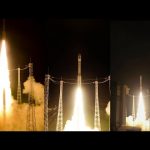
    This timelapse video shows the preparations for LISA Pathfinder’s launch at Europe’s Spaceport in Kourou, French Guiana. The video spans three weeks, starting on 12 November 2015 with the completed and fuelled spacecraft and ending on the 3 December launch day.

    Over this period, the spacecraft was attached to the payload adaptor of the Vega launcher, encapsulated within the half-shells of the rocket fairing, transferred to the launcher assembly area, and installed on top of Vega inside the mobile gantry, which was rolled back shortly before liftoff.

    LISA Pathfinder will test key technologies for space-based observation of gravitational waves – ripples in the fabric of spacetime that are predicted by Albert Einstein’s general theory of relativity.

    Credit/Copyrights: Directed by Stephane Corvaja, ESA; Edited by Manuel Pedoussaut, Zetapress; Music: Hubrid-Gravity

  • ESA Euronews: Soyuz descola pela primeira vez do Porto Espacial da Europa

    ESA Euronews: Soyuz descola pela primeira vez do Porto Espacial da Europa

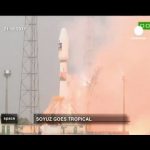
    Lançou o Sputnik e Gagarin para o espaço. O mítico foguetão russo Soyuz conta já com mais de 1700 voos. O lançamento do Porto Espacial Europeu, na Guiana Francesa, abre um novo capítulo na sua longa carreira.